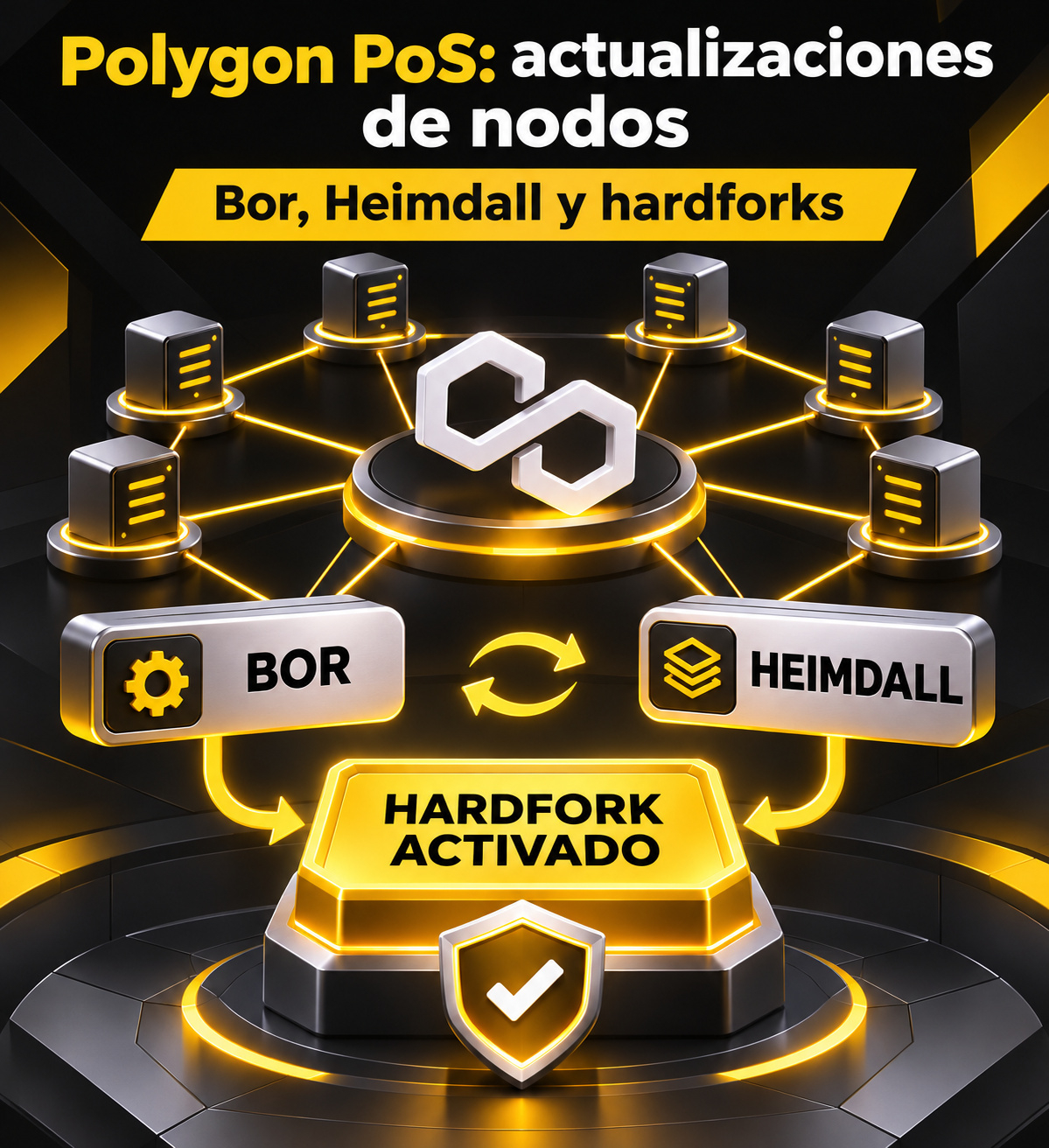
Polygon PoS updates Bor and Heimdall: what nodes should review
Confirmed fact: Polygon Labs announced Bor v2.11.0 for Polygon PoS and Amoy on November 5, 2026. It is the public build of v2.11.0-priv and includes the Uburu hard fork and security and stability fixes. Uburu was activated on Amoy at block 51.978.200 on November 4 and on mainnet at block 96.787.900 on November 5.
Operators still running Bor v2.10.3 or earlier stopped following the chain when those blocks were reached and must upgrade. Moving from the private build to the public one does not change consensus: the same code and the same fork blocks, with no genesis change, database migration, or resynchronization. Bor adds controls for conditional transactions in the txpool, disabled by default, and improvements to consensus, synchronization, and RPC.
Heimdall v0.13.2, released on November 3, activated the Karwar hard fork on mainnet at block 57.006.000. It includes limits on vote extension size, canonical signatures for checkpoints, and an improvement to RPC state. It also removes an unnecessary wait during consensus locking. This is a binary upgrade: it requires no configuration changes, state migration, or resynchronization.
The practical takeaway is operational: an active hard fork makes version discipline, checksum and signature verification, and coordination with Heimdall critical. Polygon warns that some packages may still be in the process of being published; it is advisable to validate the artifacts before using them. The upgrade does not guarantee higher performance or predict the token's price.
Market snapshot, not a signal: at 04:58 UTC, POL was trading near 0,09289 USDT (-4,207% in 24 h) and was moving about 4,86 million USDT; BTC stood at 75.795,35 (-5,886%) and ETH at 2.233,16 (-7,963%). This is context, not a reaction attributable to the announcement.
$POL $BTC $ETH
Educational Content. Not financial advice.
#Polygon #POL #Validadores #Hardfork #FinancialEducation