



#$1.5BInLeveragedCryptoBetsLiquidated
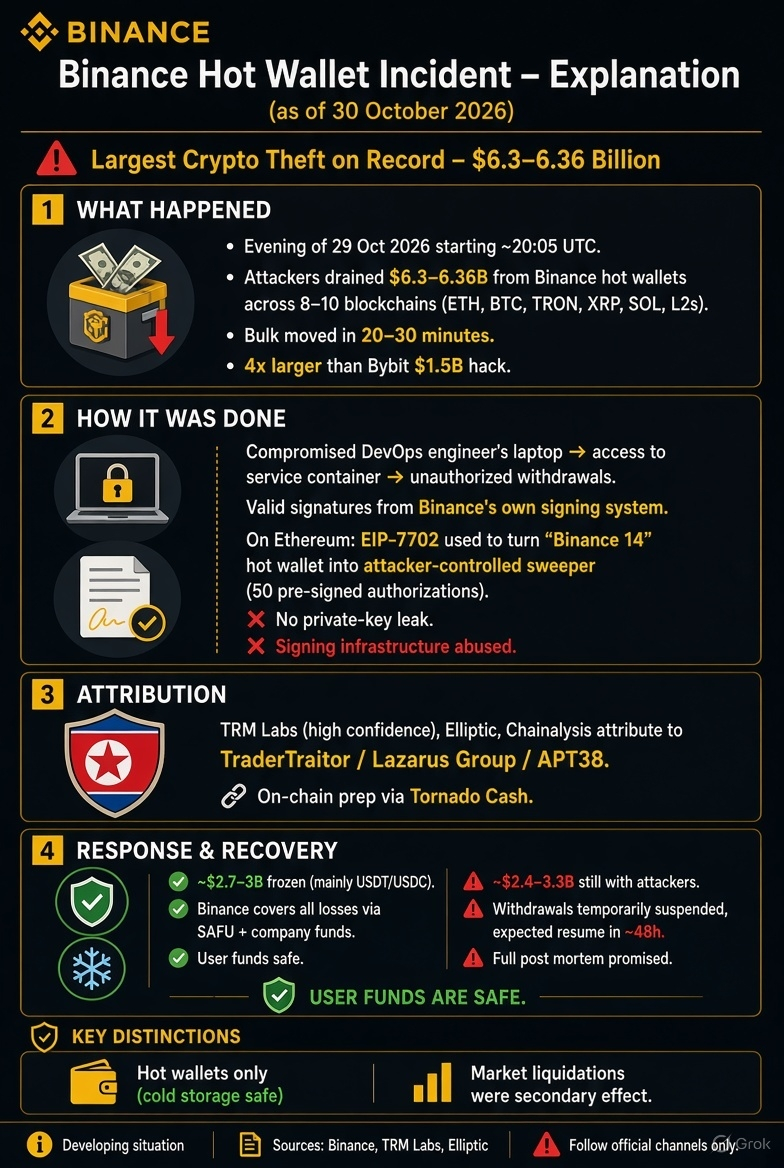
Binance Hot Wallet Incident – Explanation (as of 30 October 2026)
👉What Happened
On the evening of 29 October 2026 (starting around 20:05 UTC), attackers drained approximately $6.3–6.36 billion from Binance’s hot wallets across roughly 8–10 blockchains (primarily Ethereum, Bitcoin, TRON, XRP Ledger, Solana, and several Layer-2 networks).
The bulk of the funds moved in a short window of about 20–30 minutes, making this the largest cryptocurrency theft on record—roughly four times larger than the $1.5 billion Bybit hack in February 2025.
👉 How It Was Done (Technical Overview)
This was not a traditional private-key theft or smart-contract exploit in the classic sense.
- Binance’s initial investigation points to a compromised DevOps engineer’s laptop. This gave the attacker access to an internal service container that could submit withdrawal transactions.
- The attacker obtained the ability to generate valid signatures from Binance’s own hot-wallet signing system.
- On Ethereum specifically, the attackers used EIP-7702 (introduced in the 2025 Pectra upgrade). This feature allows an ordinary wallet to temporarily delegate its behavior to a smart contract. The attackers submitted 50 pre-signed EIP-7702 authorizations for a major Binance Ethereum hot wallet (often referred to as “Binance 14”), turning it into a “sweeper” contract under their control. They then drained the wallet (and continued sweeping new deposits for a period).
- On other chains, the transfers were ordinary signed transactions that appeared legitimate because they came from Binance’s own systems.
Binance has stated it has found no evidence of a wallet private-key leak. The keys themselves were not extracted; instead, the signing infrastructure was abused.
👉 Attribution
Blockchain intelligence firms TRM Labs (with high confidence), Elliptic, Chainalysis, and on-chain investigators have attributed the attack to TraderTraitor (also linked to the Lazarus Group / APT38), a North Korea-linked hacking unit previously tied to the Bybit exploit and other major thefts. On-chain preparation (funding via Tornado Cash, testing of code) and operational patterns support this assessment. Binance itself has not publicly named a specific group.
👉Response and Recovery Status
~ $2.7–3 billion has been frozen so far, mainly stablecoins (USDT by Tether, USDC by Circle, and others) plus some assets on Arbitrum.
The attackers quickly swapped a portion of freezable assets into non-freezable ones (primarily ETH and BTC). Roughly $2.4–3.3 billion remains under attacker control at the time of latest reports.
-> Binance has:
Temporarily suspended deposits and withdrawals while security reviews continue.
Pledged to cover all user losses using its Secure Asset Fund for Users (SAFU) plus company funds.
Stated that user funds are safe.
Indicated it expects to begin restoring withdrawals within roughly 48 hours (subject to completion of security checks).
Promised a full technical post-mortem and an updated Proof of Reserves once remediation is complete.
Engaged law enforcement and blockchain analytics partners to track and recover funds.
👉 Key Distinctions
Hot wallets hold only a portion of an exchange’s assets (the amount needed for day-to-day withdrawals and trading). The majority of user funds are typically kept in cold storage, which was not affected.
Liquidations in the broader market (≈ $1.5+ billion in leveraged positions) were a secondary effect caused by the confidence shock and resulting price drop, not direct losses from the hack itself.
👀 This remains a developing situation. Figures for total impact, frozen amounts, and recovery can still shift as investigations progress and more assets are frozen or recovered. Official updates should be followed only from Binance’s verified channels.



#KOSPIFalls3.53%BackBelow6000 #AmazonSharesFallAbout7%InPremarketTrading #USMidtermElections #BinanceWillListPredictPREDICT