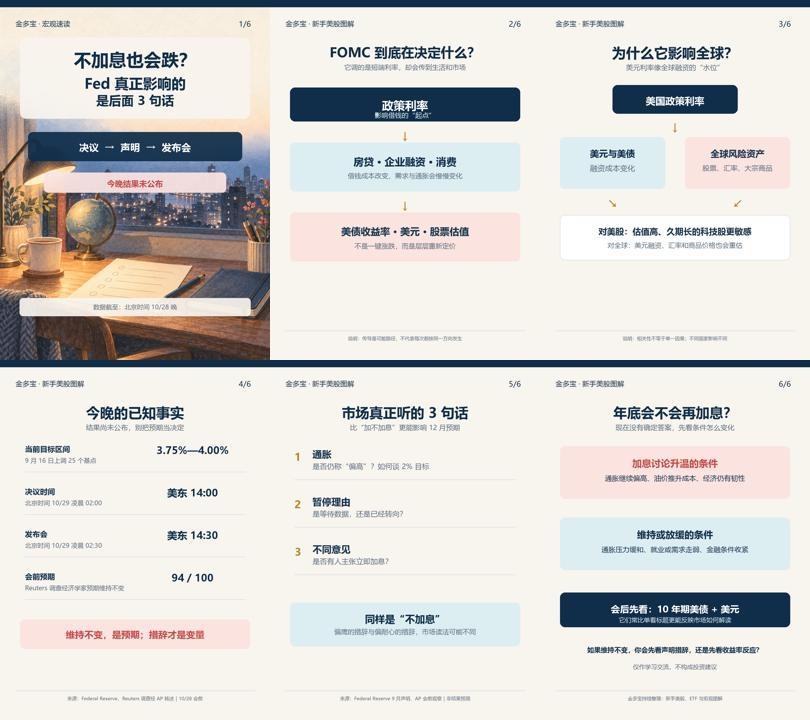

Many people treat a Federal Reserve meeting as a simple yes-or-no question: Will it raise rates or not? But what markets are really trading is often the next question: **After holding steady this time, what will happen in December and next year?**
The bottom line: Markets broadly expect the Fed to keep its federal funds target range at 3.75%–4.00% tonight. At its previous meeting on September 16, it had just raised rates by 25 basis points. Of the 100 economists surveyed by Reuters, 94 expected the Fed to hold rates steady this time. That was the expectation ahead of the meeting, not a confirmed outcome.
Why do rate decisions matter? The Fed sets a very short-term policy rate, but it affects mortgages, corporate financing, highly valued tech stocks, and assets around the world financed in dollars through borrowing costs, bond yields, the dollar, and risk appetite. It’s not that “one push of a button makes everything around the world rise or fall at once”; markets also reprice expectations for inflation, the economy, and the future path of policy.
So tonight, don’t focus only on the words “leave rates unchanged.” What matters is:
**First, how the statement describes inflation.** Last time, the Fed explicitly said inflation remained elevated and that it wanted to get back to its 2% target in a more timely manner. If tonight it continues to emphasize oil prices, broadening inflationary pressures, or the “pace of returning to 2%,” markets may focus more on the risk of further rate hikes.
**Second, how the Fed chair explains “hike in September, pause in October.”** If he stresses that the Fed is simply waiting for more data, rather than changing course, markets will keep watching for the end of the year. If he signals a stronger bias toward tightening, longer-term Treasury yields and the dollar may react first. I say “may” because bond markets will also be pricing in oil prices, government debt issuance, and economic data.
**Third, whether there is any dissent.** The last rate hike passed unanimously, 12–0. If a dissenting vote in favor of a hike emerges tonight, or if inflationary pressures come up repeatedly at the press conference, discussion of “whether to hike again in December” will intensify. Conversely, the absence of dissent alone is no reason to conclude that the rate-hiking cycle is over.
Will there be another hike by year-end? There’s no definitive answer right now. AP reports that Wall Street has broadly come to treat another hike in December as a possibility that needs to be seriously priced in; but that path still depends on upcoming inflation, employment, oil price, and economic data. For beginners, rather than betting on an outcome, it’s better to watch two market signals after the meeting: **whether the 10-year Treasury yield resumes rising and whether the dollar continues to strengthen.** They can help you gauge whether markets are reading tonight as “higher rates for longer” or simply breathing a sigh of relief for now.
In my view, unchanged rates don’t mean there’s no policy signal; and tech stocks rising or falling doesn’t mean the Fed is endorsing any particular sector.
**If rates really are left unchanged tonight, would you first look at the inflation language in the statement or at how Treasury yields react after the press conference? Why?**