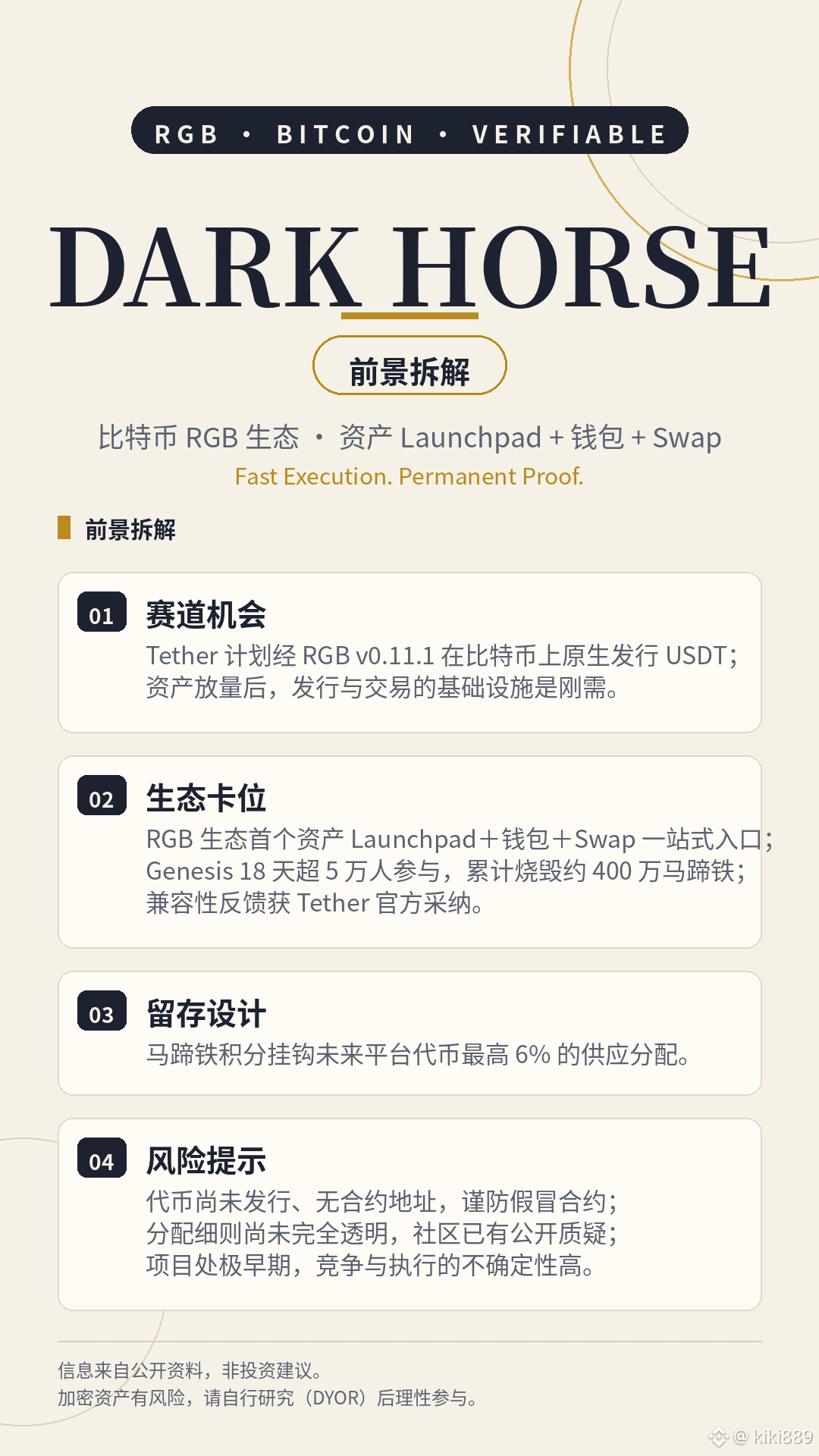
Breaking down DarkHorse: It’s betting not on horseshoes, but on the timing of the RGB opportunity
Yesterday, I introduced DarkHorse—the first asset launchpad in the Bitcoin RGB ecosystem, with a companion wallet and swap feature. Today, let’s look at its prospects.
First, the sector (facts): Tether has publicly announced plans to issue USDT natively on Bitcoin via RGB v0.11.1. This marks the stablecoin giant’s return to Bitcoin’s asset layer. The RGB ecosystem has also recently made public progress on sidechain integration and Lightning Network support. As the number of assets grows, infrastructure for issuing and trading them becomes essential.
Next, its positioning (facts + speculation): DarkHorse brings a launchpad, wallet, and swap feature together in one entry point, making it an early mover in the ecosystem’s application layer. According to the project, more than 50,000 people participated in its 18-day Genesis event. It has also continued Sybil screening and burned around 4 million horseshoe points in total. Compatibility feedback the team submitted to Tether’s Wallet Development Kit has been adopted by Tether. These are facts. The speculation is that if RGB assets really scale up, this kind of all-in-one entry point could benefit from the ecosystem’s growth.
Third, its retention design (speculation): Horseshoe points are tied to a maximum allocation of 6% of the future platform token supply, aligning early contributors and the project. This is a typical points-for-tokens model that aims to lock in the community’s attention. The design is in place, but whether it delivers depends on execution.
Finally, the risks (facts): The token has not yet been issued, and there is no contract address. All rules are subject to the final official announcement. How contributions will be verified and the details of the allocation are not yet fully transparent, and some community members have publicly raised questions. The project is at a very early stage, with significant uncertainty around both competition and execution.