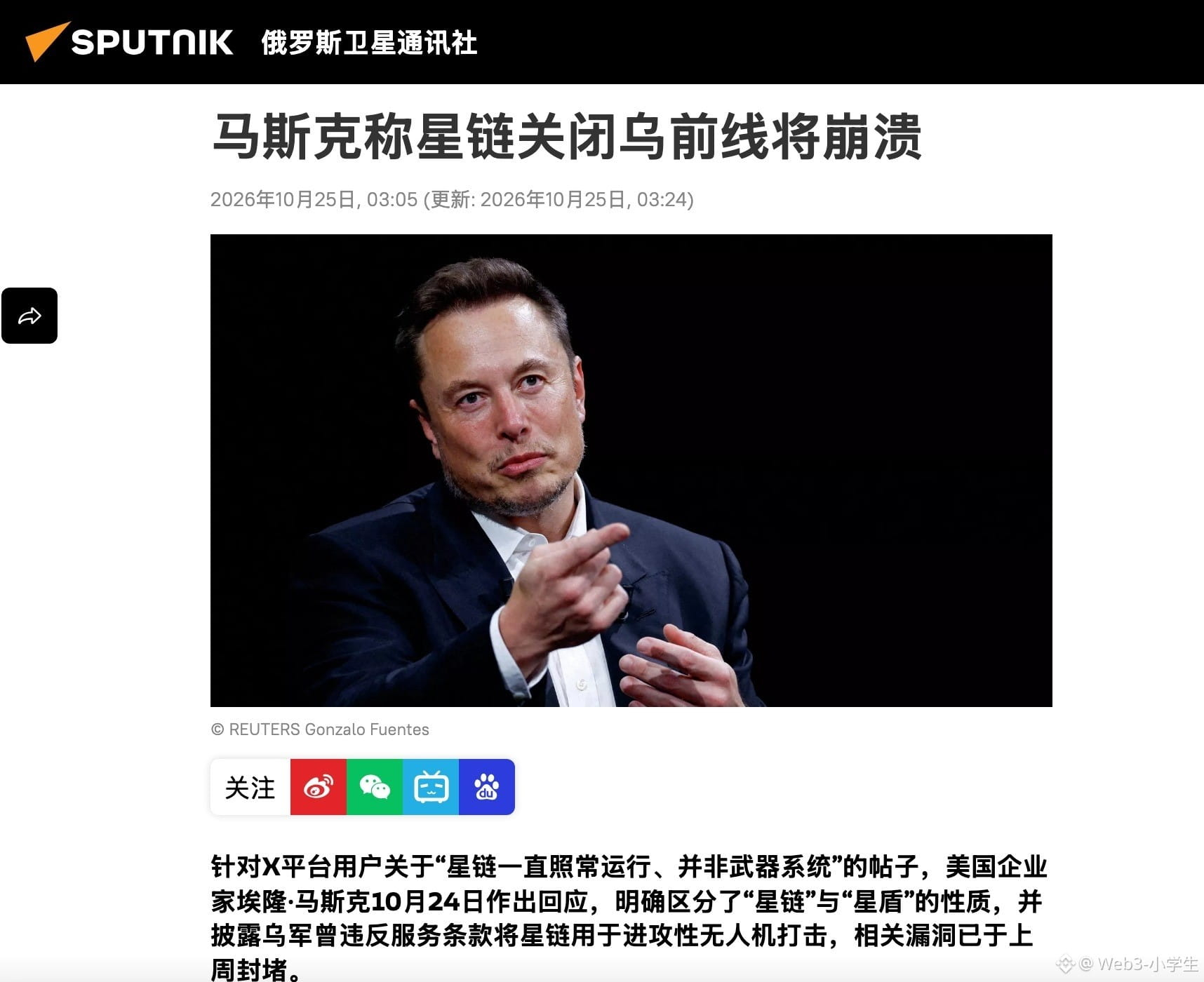
At 1 a.m. on October 14, a batch of drones flying through the air all suddenly fell out of the sky. No one fired a shot. No one gave any warning.
They were Ukrainian drones.
They were using Starlink, and once they went over 160 kilometers per hour, the connection dropped. The same equipment could reach 180 inside the EU.
A technical glitch?
It didn’t look like one. Someone changed a threshold in the backend, then sat back and waited to see what would happen.
As for who made the change, the five parties involved all told different stories. Musk said Starshield is owned and controlled by the U.S. government, and that any restrictions on speed or use are decided by the U.S. military. Pentagon chief Hegseth said no orders had been given. Secretary of State Rubio said he hadn’t known in advance. The Wall Street Journal reported that Rubio himself had issued the order.
All three said it wasn’t them.
That picture is the answer in itself. A link capable of cutting off communications for frontline troops all at once—and yet the contract never clearly said who gets to press that button.
Who pressed it?
No one’s owning up to it.
On October 24, Musk added another piece. He said Ukraine’s military had violated Starlink’s terms of service by using the civilian commercial service to control offensive drones, and that the vulnerability had been fixed the previous week.
A civilian service shouldn’t be used to kill people—that’s the line he drew himself. But he also admitted that the loophole wasn’t fixed until last week.
The same satellite, the same terminal, but two contracts hanging over it. The civilian one says no killing. The military one belongs to someone who isn’t him.
I think this is the most unsettling part. A lot of people assume that when the battlefield goes offline, it’s because the other side jammed the signal, or because satellite signals are inherently unreliable. But something Russia couldn’t accomplish in four years, a supplier managed with a single line changed in the backend.
Buying it outright is one thing.
Owning it is another.
The hardware is in your hands; the switch is in someone else’s.
On-chain, that layer of control is divided pretty finely. The issuer of $USDC can blacklist addresses. Bitcoin doesn’t even have customer support. The power to decide in between rests with the oracle: $LINK ’s job is to determine whether “the conditions have been met” according to the rules agreed on in advance—not leave it up to someone who can change a threshold at 1 a.m.
Circle’s terms spell out in black and white that it can blacklist addresses. When a right is written into the contract, there’s no hesitation about exercising it.
The cost is part of the deal, too. If you send it to the wrong place, no one will reverse it. That’s on you.
What’s really worth remembering is the structure. When one supplier plays arms dealer, operator, and referee to the same customer, every time it exercises its discretion, it teaches a lesson to every other customer in the world.
Europe is already responding. Deutsche Telekom, Orange, Telefónica, and Vodafone are discussing a joint venture to use mobile spectrum to provide direct satellite coverage to phones. Poland’s foreign minister, Sikorski, has publicly questioned whether U.S. defense contractors can be trusted. Senator Blumenthal has launched a congressional investigation into the Pentagon’s dependence on this one company.
Once a customer has been cut off, the entire supply chain starts recalculating. No one can say for sure how many years this round will take. But there’s no need to guess which way things are headed.
Any design that hands its vital lifeline to someone who can remotely switch it off will eventually grow a replacement of its own. Because the memory of being switched off once lasts longer than any terms of service.
$BTC is now at 80,530, down less than one percent in 24 hours. ETH is at 2,340, down a little over two percent. There’s no one on-chain to flip a switch, so the volatility over this period is just volatility.
#比特币 #美股 #币安广场