
When many people think of AI, the first things that come to mind are GPUs, cloud servers, and massive data centers📖.
That got me thinking:
For relatively simple tasks like email classification and content moderation, do we really need to call on large servers every time?
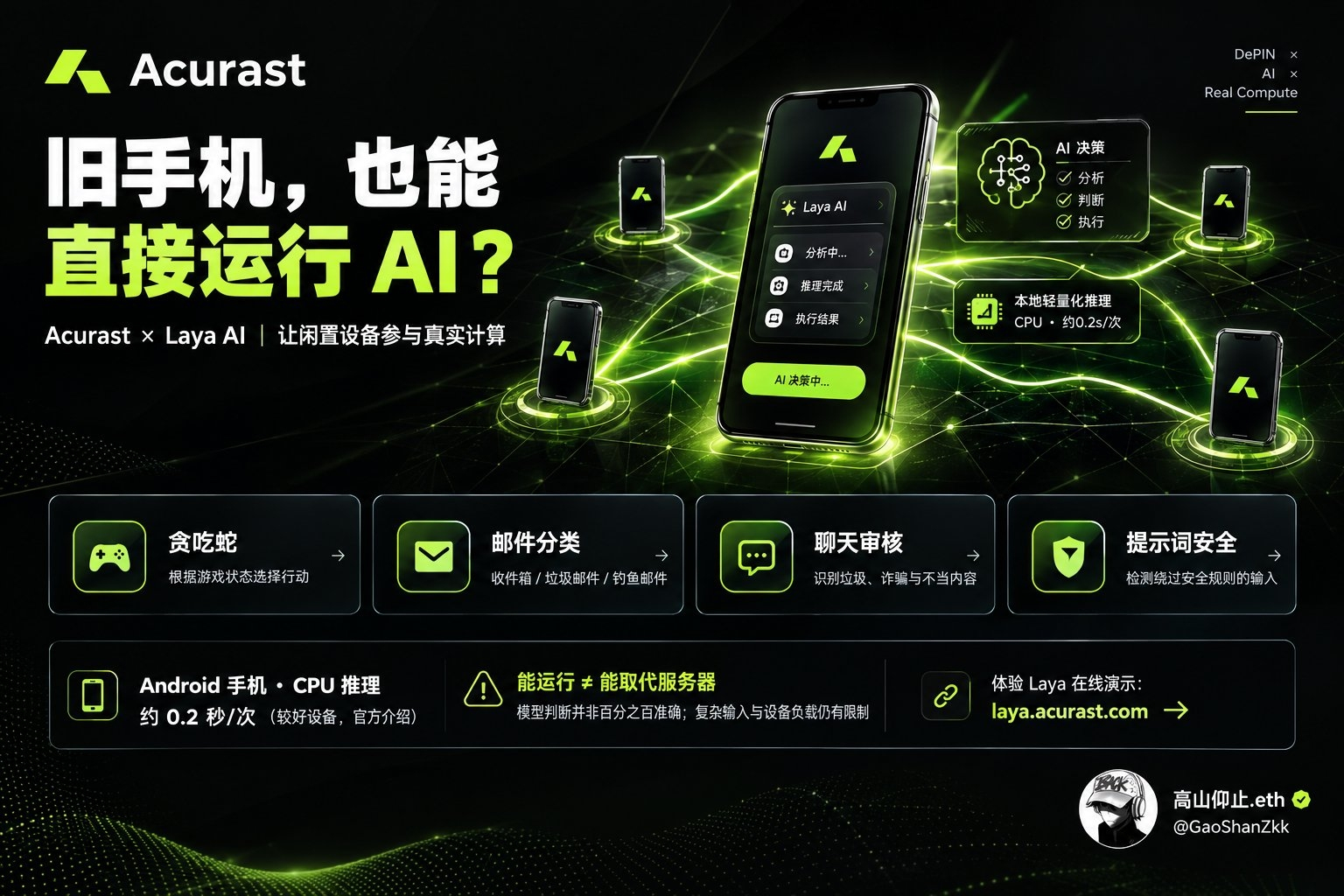
I recently came across a demo of Laya AI showcased by @Acurast and discovered an interesting possibility: old phones can not only contribute computing power through the Acurast network, but also use that computing power directly to run AI models!
This means a phone’s value may go beyond simply being a node in the network—it could also take part in real-world AI tasks.
Laya is an open-source AI model with several online demos covering different types of decision-making scenarios:
➣ Snake: Choose the next move based on the game state.
➣ Email classification: Determine whether an email belongs in the inbox, spam, or phishing folder.
➣ Chat moderation: Identify spam, scams, and inappropriate language.
➣ Prompt safety detection: Determine whether the input contains an attack attempting to bypass AI safety rules.
These demos have something in common: AI doesn’t always need to generate a long piece of text. It can also make a decision from a set of given options based on the current situation.
According to the official introduction, Laya can run directly on Android phones in the Acurast network, using the CPU for inference. On higher-performance devices, each decision takes about 0.2 seconds.
It got me thinking: do AI tasks really need large servers to be completed?
For complex AI models, large amounts of GPU power are still indispensable. But tasks like spam classification, content moderation, and simple safety checks don’t necessarily need to call a large model every time.
If these kinds of tasks can be distributed across different phones, then idle devices could become part of real-world applications, rather than just another node in the network.
Of course, that doesn’t mean phones can replace traditional servers just yet.
The official team also noted Laya’s limitations: the email classification test isn’t 100% accurate, complex or adversarial inputs can still lead to incorrect judgments, and a single phone can only handle a limited number of tasks.
So what interests me isn’t the hype around whether phones can run AI, but this:
Once these distributed devices are actually contributing to computation, can developers use them to accomplish tasks with real-world value?
For #Acurast, this may be more worth watching in the long term than simply increasing the number of nodes.
If you’d like to see how it works, try the official Laya online demo 👇:
laya.acurast.com