
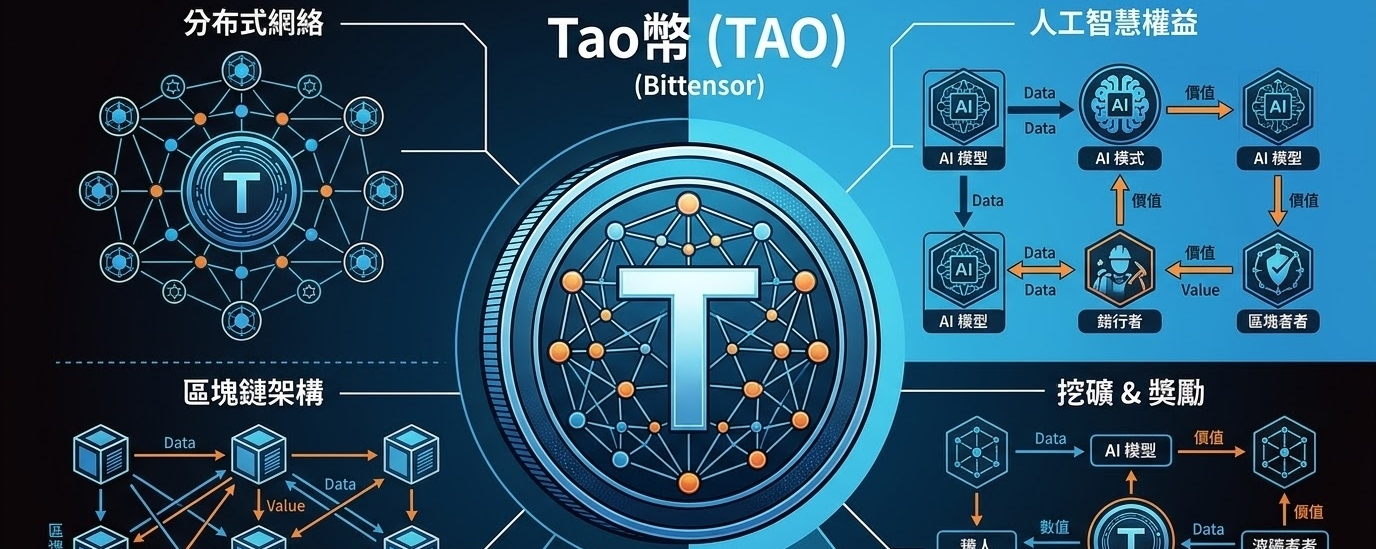

Bittensor is a decentralized market for machine intelligence (an open market for intelligence), aiming to turn AI computing, model training, inference, data, and more into tradable commodities.
At its core, the network consists of multiple **subnets**, each focused on a specific AI task (such as inference, pretraining, trading, weather forecasting, or robotics data). Miners provide services (computing power or model outputs), while validators assess quality and assign scores. Rewards are distributed through Yuma Consensus (or, optionally, Null Consensus). TAO is the network’s base currency and anchor of value.
It is regarded as “Bitcoin for AI”—using incentives to bring contributors around the world together to build decentralized AI infrastructure, rather than relying on centralized players such as OpenAI or Google.
Technical and Economic Mechanisms
Dynamic TAO (dTAO), launched in February 2025, is a key upgrade: each subnet has its own Alpha token, paired with TAO in an AMM liquidity pool. Staking TAO to a subnet earns you that subnet’s Alpha, whose price reflects market expectations for the subnet.
The standard reward distribution is roughly 41% to miners, 41% to validators and stakers, and 18% to subnet owners. Recent upgrades include:
eTAO (spec 480): Subnet owners can adjust reward proportions (miners ≥33%, validators ≤50%, owners ≤33%), while protecting the base share of Root TAO stakers.
Null Consensus: An optional single-validator mode that expands subnet capacity to 2,500 UIDs and supports PoW registration (without burning TAO).
Tokenomics: The maximum supply is fixed at 21 million TAO (modeled after Bitcoin). Approximately 11.3–11.6 million are currently in circulation (about 54%). The first halving was completed in December 2025; the current reward is 0.5 TAO per block (about 3,600 TAO per day). No premine, no ICO, and a fair launch.
Current Market Data
The price is around $266–270, with a market capitalization of approximately $3.0–3.2 billion and a fully diluted valuation of about $5.6–5.7 billion. 24-hour trading volume is approximately $110–200 million, and it ranks around 36th by market capitalization. Its all-time high was $757.60 in March 2024, putting it about 64–65% below its ATH. It is up roughly 16% over the past 30 days but down about 27% over the past year. Recently, the price has fluctuated between $260 and $300.
Ecosystem and Real-World Adoption
There are currently about 128 active subnets (the maximum capacity). Annualized revenue earned by subnets from external customers has grown rapidly, from around $32–35 million to $50–65 million, driven mainly by computing and inference services. Some subnets have begun buying back their own Alpha tokens, and enterprise use cases have emerged, including financial cybersecurity and surveillance. Grayscale has launched a decentralized AI fund that includes TAO, and related institutions are also taking notice.
Technical Team and Founders
Bittensor was co-founded in 2019 by Jacob Robert Steeves (known in the community as Const) and Ala Shaabana (known as ShibShib). The nonprofit Opentensor Foundation led its early development and maintenance.
Jacob Steeves: Core architect and principal author of the white paper. He holds a bachelor’s degree in Mathematics and Computer Science from Simon Fraser University and worked as a machine learning engineer at Google Brain (2016–2018), focusing on large-scale machine learning systems. He remains active in on-chain development and subnet building, and is CEO of the Affine subnet, which focuses on reinforcement learning.
Ala Shaabana: Has a strong academic background, with a PhD in Computing and Software from McMaster University. He conducted research at the University of Toronto and the University of Waterloo and has experience in distributed systems at companies including VMware and Instacart.
In February 2026, the two founders formally stepped down as CEO and COO of the Opentensor Foundation to accelerate decentralization and reduce reliance on any single person or organization. They continue to contribute to ecosystem development and the community, but no longer hold formal legal authority. Other early core members include CTO Garrett Oetken and CIO Paul Swaim. Core protocol development is now becoming more distributed across entities such as the Rao Foundation, while the SDK and documentation are maintained by independent teams such as Latent Holdings.
Shareholder Structure and Ownership
Bittensor had a fair launch, with no premine, no ICO, and no initial allocation to the team or investors. All TAO is generated through participation in the network (mining, validating, and staking); the founders and team also acquired their tokens through the same mechanisms.
Early development funding came mainly from the founders selling some of the TAO they had mined through OTC transactions with institutions such as Firstmark, DCG, and Polychain, around 2021–2023. As a result, there is no “shareholder structure” or equity allocation table in the traditional sense. Control is distributed across multiple layers: protocol upgrades, code repositories, validators, subnet owners, TAO stakers, and market participants all influence the network’s direction. The Opentensor Foundation previously played an important stewardship role, but the project is now moving toward further decentralization, with the goal of reducing dependence on any single entity.
Advantages
Real revenue is beginning to emerge, marking a shift from pure incentives to paying customers—a relatively uncommon development among crypto AI projects. Supply has tightened following the halving. The long-term AI narrative is strong, and decentralized AI infrastructure has enormous potential if it can capture demand for open models and computing. Ongoing mechanism improvements (eTAO, Null Consensus, and others) signal active development. Institutional interest is growing.
Risks and Challenges
Competition is intense, both from other crypto AI projects and centralized AI giants. Subnet quality varies, and some may simply chase emissions rather than create real value. The mechanisms are complex (dTAO, Alpha, Root, eTAO, and others), creating a steep learning curve for typical investors. The price is highly volatile and clearly affected by broader crypto market movements and shifts in the AI narrative. The pace of regulation and large-scale enterprise adoption remains to be seen. Emissions are still ongoing.
Summary
Bittensor is currently one of the most fully developed projects in decentralized AI in terms of its mechanisms, and one that has demonstrated early real-world revenue. It has moved beyond the early “concept stock” stage into a phase of “revenue validation,” though it remains some distance from large-scale commercialization. The founders have strong credentials (Google Brain and academic AI research) and have proactively advanced decentralization. Its fair-launch token distribution is also relatively clean. It may suit investors who believe in the long-term decentralized AI narrative, can tolerate high volatility, and are willing to study subnet economics in depth; it is not suitable for those seeking stable returns or rapid short-term gains.
