
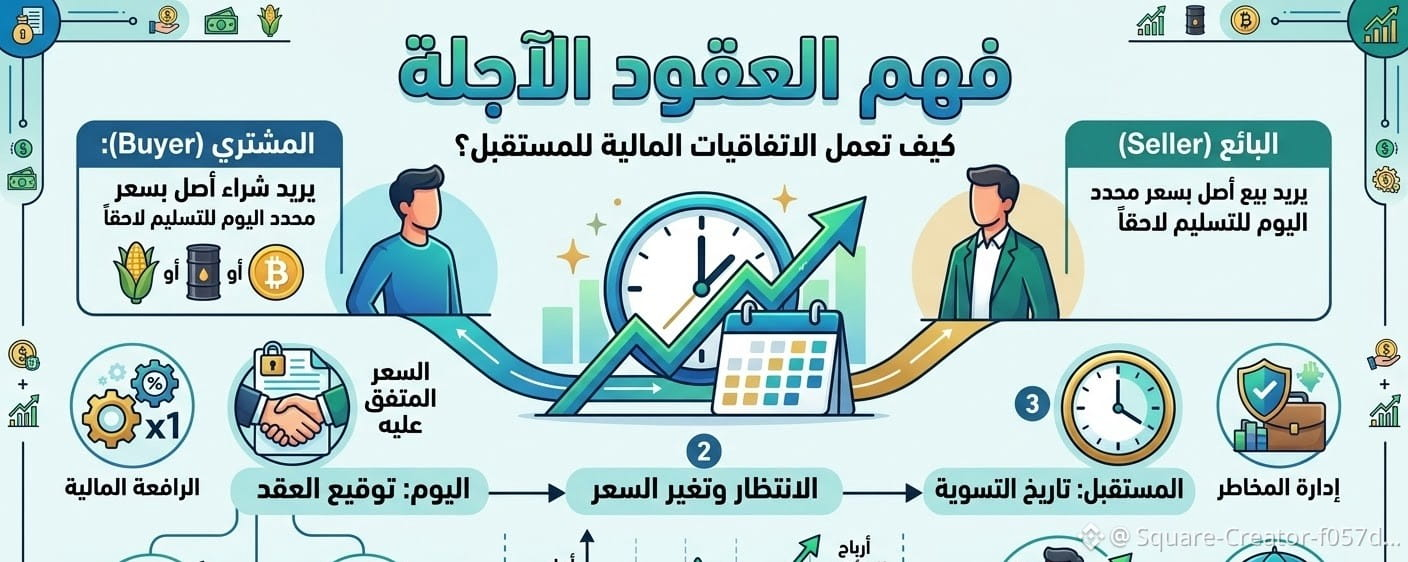

Futures contracts are simply a legal agreement to sell or buy a specific asset (such as cryptocurrencies, gold, oil, or stocks) at a price set today, with delivery and payment to take place at a later date in the future.
Here is a detailed and simplified explanation of its key concepts:
1. How do futures contracts work? (A simplified example)
Imagine a farmer who grows wheat and expects the price of wheat to fall several months later at harvest, while a bakery owner fears the price will rise
Today, the two parties agree that the bakery owner will buy the farmer’s wheat crop in 3 months at a fixed price they agree on now (for example, $100 per ton), regardless of whether the market price rises or falls by the time of delivery.
This contract protects the farmer from falling prices and the bakery owner from rising prices.
2. Main types and uses
In traditional markets (such as commodities and stock exchanges): They are used as in the previous example to protect producers and consumers from sudden price fluctuations (this is called risk management or hedging).
In financial markets and cryptocurrencies (Crypto): Most futures contracts today are used for speculation and making profits from price movements up or down without needing to own the underlying asset.
3. Key concepts in futures trading
Leverage: A feature that lets you open positions worth much more than your actual capital (such as using 10x or 50x leverage). It is a double-edged sword: it can greatly multiply profits, but it also multiplies losses and can quickly lead to the loss of all your capital.
Expiry date: Some contracts have a set date on which they expire, while cryptocurrency markets also offer contracts called “perpetual futures” that have no expiry date and let you hold a position for as long as possible, as long as your account can cover the margin requirements for losses.
Long position: A bet that the price will rise (buy).
Short position: A bet that the price will fall (sell).
💡 Summary and advice
Futures are an advanced and powerful financial instrument, but they carry very high risks (especially when using high leverage in highly volatile markets such as cryptocurrencies). Without a good grasp of risk management and setting stop-losses, a person can incur rapid financial losses.
Would you like me to explain a particular point, such as the difference between futures and spot trading?