

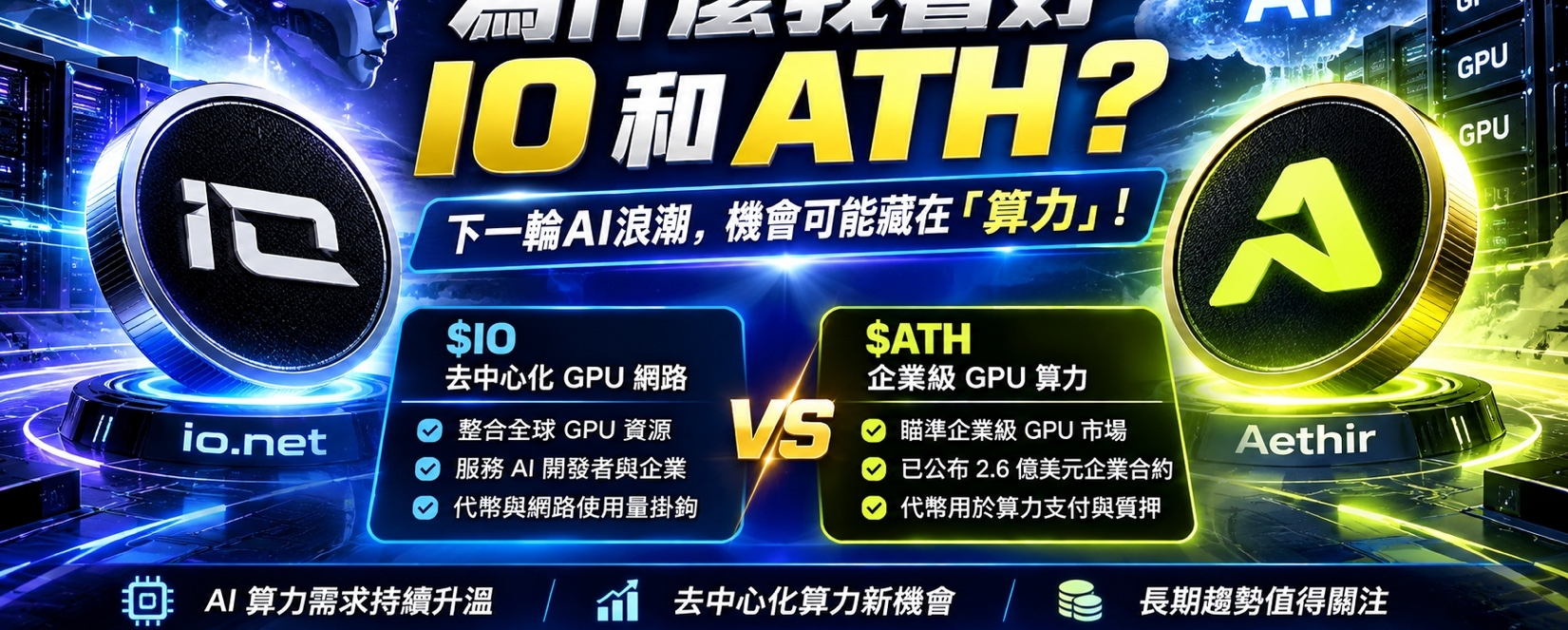
The truly indispensable resource behind AI—GPU computing power.
AI models need training, AI applications need inference, and enterprises need infrastructure to deploy AI. As AI applications continue to develop, demand for computing power is also likely to expand further.
That’s why I’ve put $IO and $ATH on my key watchlist.
What I’m optimistic about is not just the two tokens, but the same long-term trend they are trying to tap into: decentralized computing power and AI infrastructure.
🔥 1. $IO: Why I’m optimistic about the potential of decentralized GPU networks
io.net’s core direction is to integrate distributed GPU resources and provide computing power services for AI and machine learning workloads.
I’m focused on IO for three main reasons:
1️⃣ AI computing power demand is worth tracking over the long term
As more enterprises and developers invest in AI, the cost of accessing GPUs, supply efficiency, and flexibility of use could all become important issues. The ability to effectively integrate computing resources is a market opportunity worth watching.
2️⃣ Decentralized computing power has its own market position
Traditional cloud services are already quite mature, but the market is still looking for different models of computing power supply. io.net aims to participate through a decentralized GPU network. Whether it can continue attracting providers and genuine users will be key.
3️⃣ Token economics are worth continuing to monitor
IO’s value shouldn’t rely solely on the AI narrative. Network usage, revenue, token demand, and changes in supply also matter. Sustained improvement in these fundamentals would offer stronger support for long-term growth.
My outlook for IO is this: if decentralized computing power can truly carve out a place in the AI market, it could benefit from this trend.
⚡ II. $ATH: I’m optimistic about the opportunity to commercialize enterprise-grade GPU computing power
Aethir’s direction is also worth researching, but what draws my attention most is its enterprise-grade GPU cloud infrastructure and the commercialization of large-scale computing demand.
1️⃣ Look beyond the concept and consider enterprise orders
Aethir announced a multi-year enterprise GPU contract with Axe Compute worth a total of $260 million. In 2026, it also announced that it had received the first $43 million payment and begun related deployments.
This kind of progress is worth watching because it gives the market a chance to see whether enterprise demand can translate into actual revenue and sustained operations.
2️⃣ AI infrastructure could be a long-term competition
AI needs more than just chips; it also needs data centers, electricity, deployment capabilities, and a stable supply of computing power. Whether Aethir can continue expanding its enterprise customer base, increase GPU utilization, and grow revenue is a key reason I’m watching it.
3️⃣ The key for ATH is whether ecosystem demand can drive token value
ATH has use cases including computing power payments, staking, and ecosystem participation. However, platform growth doesn’t necessarily mean the token price will rise. Token demand, circulating supply, unlock schedules, and market valuation still need to be monitored.
My outlook for ATH is this: if enterprise demand for computing power continues to grow and Aethir can turn business progress into sustained ecosystem usage, it will be worth continuing to watch.
🧠 III. Why do I want to follow both IO and ATH?
I don’t want to bet on just one project. Instead, I’m watching different developments within the same industry trend.
IO: Focuses on the integration of decentralized GPU resources and the development of computing networks.
ATH: Focuses on enterprise-grade GPU infrastructure, customer demand, and commercialization progress.
They face different competitive landscapes, token economics, and execution risks, but both make me think about one question:
As AI moves from a hot topic to real-world applications, could projects providing the underlying computing power become beneficiaries of the next phase?
I believe this is a direction worth researching.
📈 IV. What I’m really watching isn’t short-term price movements
I won’t assume a project is bound to rise just because it carries an AI or DePIN label.
For IO, I’ll be watching network usage, GPU supply and demand, revenue, and token supply.
For ATH, I’ll be watching the execution of enterprise contracts, computing power deployment, revenue growth, and token unlocks.
If these metrics continue to improve, there will be reason to reassess their long-term potential.
Conversely, if demand doesn’t meet expectations, token prices could still fall, no matter how hot the industry narrative is.
🎯 Conclusion: AI’s next step makes computing power worth watching!
I’m optimistic about IO and ATH not because I can predict when they’ll surge, but because I believe AI computing power is an industry worth researching over the long term.
When the market chases the next hot narrative, I’d rather understand: Who has real demand? Who can turn that demand into revenue? Whose token mechanics can create a more reasonable link between ecosystem growth and token value?
That’s why I continue to follow IO and ATH.
If the next wave of AI continues to expand, which are you more optimistic about: $IO or $ATH? Why?
Share your thoughts in the comments. 👇
#IO #ATH #Aethir #ioNET #AI #DePIN #Crypto #BinanceSquare $ATH $IO
This article reflects personal research and opinions and does not constitute investment advice. Crypto assets are highly volatile; tokens may fall sharply or even lose all their value. Please do your own research and carefully assess the risks.