


Recently market volatility has intensified, and many brothers are asking whether now is a good time to buy the dip. My suggestion is: first check the distribution of holdings (chip distribution), then talk about direction; first look at the macro backdrop, then decide on a strategy.
Today we’ll set aside those obscure coins and only talk about BTC, ETH, and SOL—these three bellwethers. Based on the latest derivatives liquidation data and the macro news backdrop, let’s see what the main players are really thinking.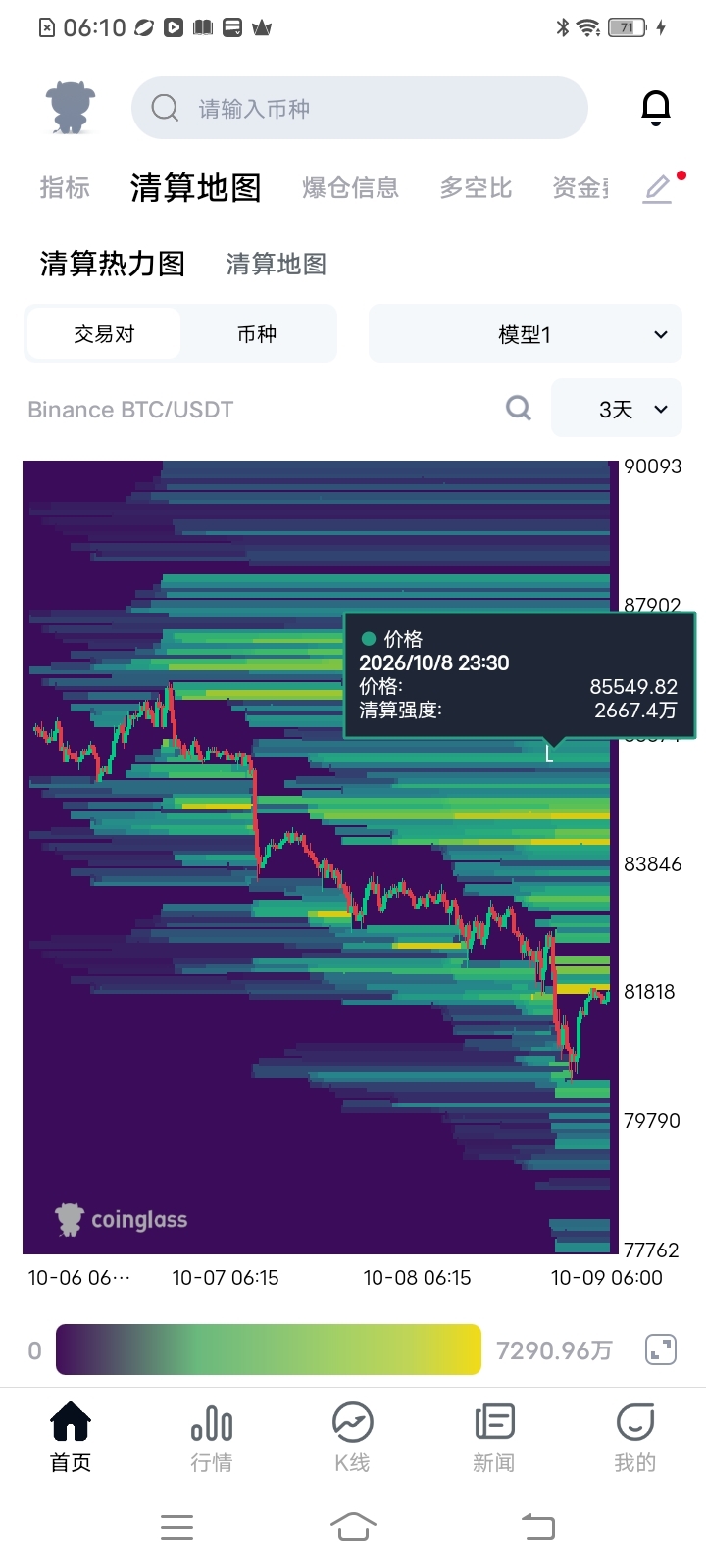
1. BTC: a "high-volume test" under a macro headwind
I just took a look at the latest BTC data, and the technical indicators and news signals are starting to converge:
Technical breakdown: on the daily timeframe, price has already fallen below the Bollinger middle band (about 84,200) and is currently testing support at the lower band (about 81,100). The key point is that this sell-off is accompanied by higher volume, which suggests heavy selling pressure.
Liquidation heatmap warning: Look at this 3-day liquidation chart (see below). A large amount of long liquidation liquidity is clustered in the 81,800–82,000 range. If the price continues to drift lower and breaks through this area, it could easily trigger a cascade of liquidations, sending it down to test the strong support zone around 79,700.
Convergence of news catalysts (key point):
ETF fund flows: Recent spot ETF data shows that inflows have slowed and even turned into net outflows. This suggests that buyers from traditional financial markets are becoming hesitant at these high levels, with a lack of new capital to absorb selling pressure.
Macro liquidity: The US Dollar Index has been strong recently, while US Treasury yields remain elevated, directly weighing on risk assets, including cryptocurrencies. In this macro environment, large investors tend to be cautious, resulting in futures trading at a discount to spot (futures cheaper than spot) and making traders reluctant to take bullish positions.
Conclusion: BTC has not yet found a short-term bottom, and 81,000 is a critical make-or-break level for the bulls. Don’t blindly try to call the bottom before it holds above that level.
2. ETH: A lull in ecosystem catalysts, awaiting a “catch-up signal”
ETH is not only falling along with BTC; it also faces its own awkward situation:
News backdrop: The Ethereum ecosystem is currently in a relative “lull,” lacking major positive catalysts like the previous Dencun upgrade. Although the growth of Layer 2 has boosted activity, it has also diverted gas fee revenue from the mainnet, weakening ETH’s deflationary effect and even occasionally turning it inflationary.
Trading logic: ETH is currently moving largely in lockstep with BTC. If BTC can stabilize and rebound at 81,000, ETH will usually see a catch-up bounce.
Indicator to watch: Keep a close eye on the ETH/BTC pair. Only when the exchange rate stops falling and starts rising will it indicate that capital is beginning to rotate from BTC into ETH—that’s when an independent rally in ETH may begin. Current strategy: Use ETH as a secondary indicator alongside BTC; don’t take a large position in ETH on its own.
3. SOL: A high-beta “sentiment amplifier”
As a strong performer in this market cycle, SOL is characterized by “sharp rallies and sharp drops.” It acts as an amplifier of market sentiment:
News backdrop: As a strong performer in this market cycle, SolSOL is characterized by “sharp rallies and sharp drops.” It acts as an amplifier of market sentiment:
News backdrop: The Solana ecosystem is active (with frequent meme coin launches), but network congestion and the final unwinding of the FTX estate remain concerns. More importantly, SOL is extremely sensitive to liquidity. When macro news (such as Fed remarks or CPI data) is bearish, SOL is often among the hardest hit.
Risks and opportunities: When major cryptocurrencies pull back, SOL’s decline is typically about 1.5 times larger than BTC’s. But if market sentiment improves (for example, following favorable macroeconomic data), SOL is also likely to rebound the most sharply.
Trading recommendation: SOL is only worth trading for a short-term breakout once BTC has confirmed that it has stabilized (for example, by closing back above the daily chart’s middle Bollinger Band) and there is no major negative macro news. At this stage, watch more and trade less to avoid getting stopped out by sharp moves in either direction.$BTC