
Recently, friends around me have started mentioning @Acurast. Since I’ve worked on related DePIN projects before, it prompted me to look into it again.
After reading about it, I started noticing a problem:
As AI becomes more widespread, what will truly be scarce in the future?
I think one answer is computing resources.
These days, when the market talks about AI infrastructure, much of the attention is focused on large data centers.
But I started thinking about something else:
That is, many earlier DePIN projects mainly leveraged devices such as computers to contribute idle hardware resources.
Acurast has set its sights on the vast amount of existing mobile computing resources around the world that are not being fully utilized.
This is worth exploring in depth.
═══════════════════════════════════
Acurast reorganizes distributed mobile computing power
Acurast’s approach is straightforward.
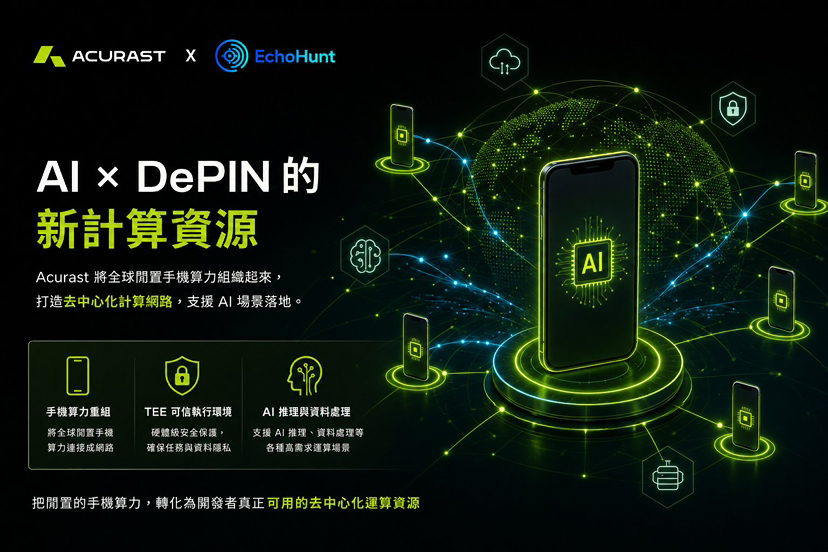
Rather than building another large data center, it aims to organize phones distributed around the world into a decentralized computing network.
Users connect their phones to the network through Processor, becoming computing resource providers. Developers can submit computing tasks, and the network then matches them with suitable devices.
What I find interesting about this model is that it puts existing hardware to use in a new way.
Phones are constantly being upgraded, and the computing power of many devices is not being fully utilized.
If these idle resources can be standardized and verified, then made available to developers, they become more than just a DePIN concept—they represent a new way of organizing computing resources.
═══════════════════════════════════
TEE gives mobile computing power more room for applications
Another thing that makes Acurast interesting to me is that it doesn’t simply treat phones as a source of low-cost computing power.
It uses the TEE (Trusted Execution Environment) built into the phone hardware, allowing computing tasks to run in a protected hardware environment.
Combined with device verification and execution-result verification, this allows devices in different locations to take part in computing that requires a certain level of security and privacy.
This is especially worth watching in AI applications.
That’s because future AI workloads won’t necessarily involve only public data.
As model inference and data processing begin to involve user data or sensitive information, where computation takes place and how data is protected become important questions in their own right.
And this is exactly where Acurast can make a difference.
═══════════════════════════════════
Promising areas to watch in the future of AI × DePIN
For now, my interest in Acurast is focused mainly on AI.
As AI applications continue to grow, demand for computing will grow too.
At the same time, edge devices like phones contain enormous distributed computing resources.
If the two can truly connect, workloads such as AI agents, AI inference, and content processing could all become use cases for decentralized computing networks.
So Acurast shouldn’t be viewed simply as a DePIN project at this point.
Rather, the question is whether it can turn scattered, idle mobile computing power into computing resources that developers are genuinely willing to use.
═══════════════════════════════════
In the end, it still comes down to whether anyone is actually using it.
After researching Acurast, I’ve come to feel that the number of phones is not the most important thing.
Having many devices only shows that supply exists.
Ultimately, it comes down to whether demand, real-world tasks, and AI workloads can actually put mobile computing power to use.
If Acurast can turn large amounts of distributed mobile computing power into computing resources that developers are genuinely willing to use.
Only then will its position in the AI × DePIN space become increasingly clear.
Another key question is whether $ACU can generate stronger economic demand as the network sees real-world use.
🔗How to participate: hub.acurast.com/rebellion?ref=…
🔗 Invitation code: 5rj2kh