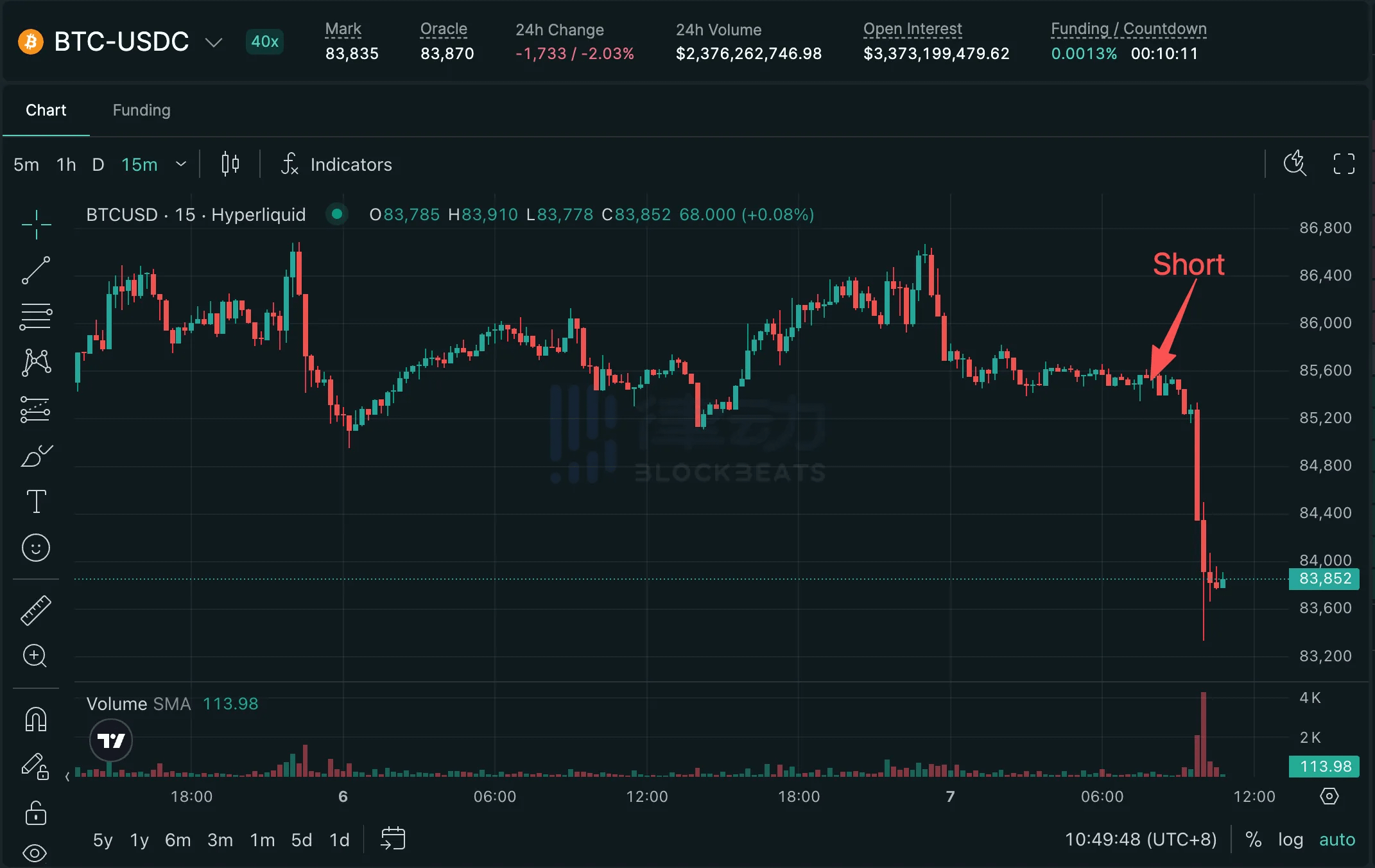


This morning, BTC was still above 85,000.
4 wallets, all created within the past 24 hours.
They deposited a total of 1 million USDC and opened short positions totaling 148.49 BTC with 40x leverage, worth $12.5 million in notional value.
One hour later, BTC fell below 84,000.
In the past hour, $410 million in positions were liquidated across the market, including $398 million in long positions. The largest single liquidation was a $26.64 million Ethereum long.
Shorting BTC with 40x leverage means that if BTC rises just 2.5% against you, you get liquidated.
In other words, these 4 addresses were willing to open short positions with 40x leverage near 85,000 for one reason only: they were almost certain BTC would fall.
Anyone who trades knows that 40x leverage doesn't mean “I like this direction.” It means “I'm certain I can't be wrong.”
This isn't a bet. It's knowing.
On-chain sleuths can see the addresses, but not the people behind them.
Four new wallets, created at the same time, all taking the same side, with perfect timing and 40x leverage.
Statistically, that's less likely than flipping a coin and getting heads 10 times in a row.
This isn't the first time Hyperliquid has been embroiled in controversy over “perfectly timed shorts.”
In October 2025, one minute before Trump announced 100% tariffs on China, a wallet on Hyperliquid precisely increased its short position, ultimately making more than $150 million. The largest short position tracked that day involved approximately $1.1 billion worth of Bitcoin and Ethereum.
The incident made it to Congress. House Oversight Committee Chairman Comer formally wrote to Hyperliquid, demanding KYC information and records of suspicious-trade detection, and asking one central question: Why has a decentralized platform become a breeding ground for insider trading?
Comer's exact words at the time were that the trade was “precisely timed to a nonpublic government decision”—perfectly aligned with a government decision that hadn't been made public.
A year later, the same thing happened again.
They made money. And you can't even find out who they are.
Every Hyperliquid trade is recorded on-chain, in full public view. Addresses are visible, positions are visible, and profits and losses are visible.
But the people behind the addresses are invisible.
The platform has no KYC mechanism, so it cannot refer the parties involved to law enforcement.
All your positions, stop-losses, and liquidation levels are transparent on-chain. But those who know the news in advance, hidden behind anonymous wallets, calmly collect their winnings just above your stop-loss orders.
Information asymmetry has been amplified to the extreme on-chain.
After this morning's crash, BTC funding rates have turned negative, reaching -0.012%. Open interest remains at $45.7 billion, up 1.5% over 24 hours.
Negative funding rates mean shorts are starting to dominate, while longs are paying to hold their positions.
And those four addresses were already waiting on the other side—before funding rates turned negative, while everyone else was still bullish.
Those four addresses this morning may be just the tip of the iceberg.
After that $1.1 billion short in October 2025, Congress investigated for a year and questioned everyone. And what came of it?
On-chain analysts linked the wallet behind that trade to Garrett Jin, the former CEO of BitForex. Jin denied insider trading, saying he was “serving clients.”
And then? Nothing.
Hyperliquid has no KYC, and the identities behind the addresses remain a mystery to this day. Congress has sent a letter, and the investigation is ongoing—but that $150 million has already been made.
Rules can't keep up with anonymity. Regulators can't keep up with on-chain activity.
They didn't “predict” the direction before the crash. They “knew” the direction before the crash.
While you were studying technical indicators, they were looking at the calendar.
While you were setting your stop-loss, they were counting down to your liquidation.
While you were studying support and resistance levels, they were studying when you'd panic.
They didn't make money from the market. They made money from information.
And you are the last link in the information chain.