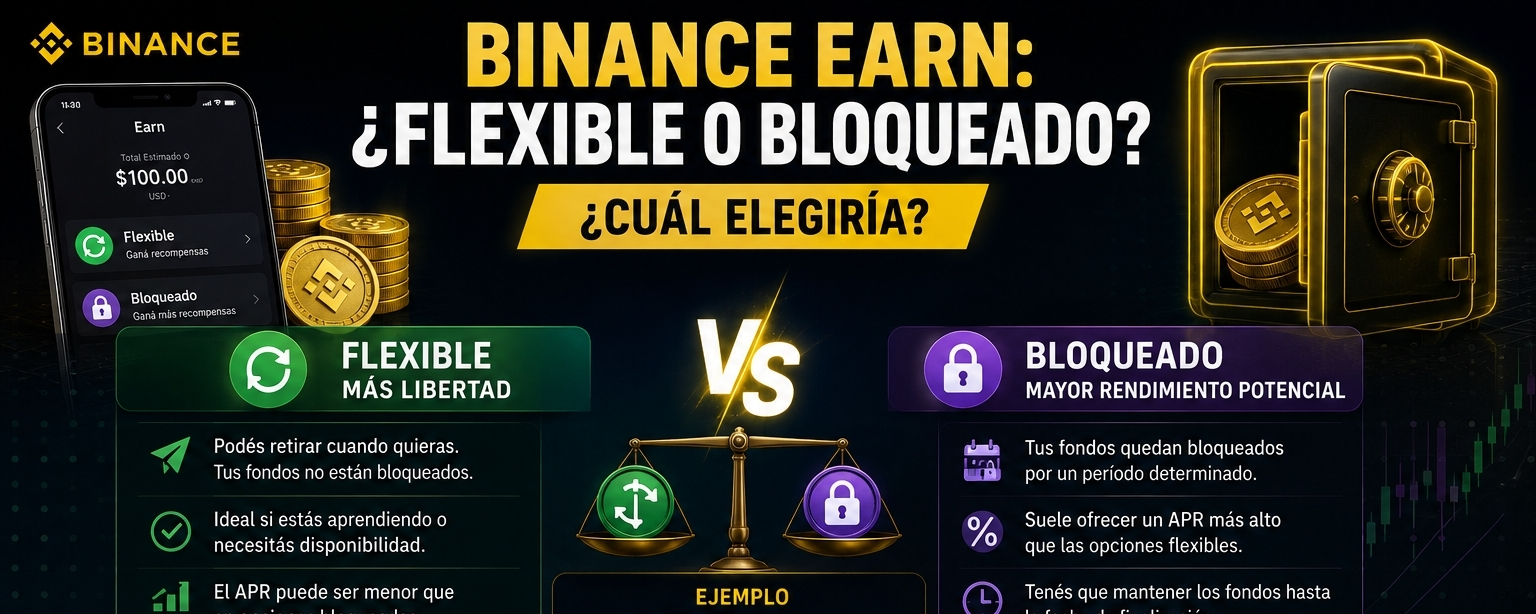

When you log into Binance Earn, one of the first things you can find is a difference that seems simple at first:
🟢 Flexible
🔒 Locked
And here appears an important question:
Is it better to choose the one that pays more, or the one that lets you access your money?
The answer isn’t as simple as just looking at the APR.
🟢 1️⃣ What does Flexible mean?
The main idea is flexibility.
With a flexible product, you usually have more freedom to manage your funds than with one that requires you to keep them for a certain period.
This might be interesting if:
you’re learning;
you don’t know how long you’ll keep the asset;
you want to have greater availability;
or you simply don’t want to commit your funds for a term.
But pay attention:
Flexible doesn’t mean risk-free.
The yield can change, and the value of the asset you deposit can also go up or down.
🔒 2️⃣ What does Locked mean?
Here, the concept is different.
You agree to keep your funds under certain conditions for a set period in exchange for a reward that may be different from the reward of a flexible option.
So, before choosing, I wouldn’t look only at:
“Which one has the highest APR?”
I’d also ask:
👉 How long do I have to leave my money there?
💰 3️⃣ Let’s do a simple example
Let’s imagine you have:
US$100 in a stablecoin
You find two options:
🟢 Flexible → 8% APR
🔒 Locked → 10% APR
At first glance, it seems obvious:
“10%! I’ll go with the locked one.”
But there’s one question missing:
Do I need to be able to access those US$100 during that period?
If the answer is yes, those extra 2 APR points probably aren’t the most important thing for you.
🧠 4️⃣ The mistake is looking only at the percentage
This is something I’ve been repeating in my articles:
Higher APR ≠ automatically the better option.
Before entering a product, I would check:
📌 What asset am I using?
📌 Current APR and whether it can change.
📌 Flexible or Locked.
📌 Length of the lock
📌 Rescue conditions.
📌 What asset do I receive the reward in?
📌 What risks am I taking?
Because a percentage doesn’t tell the whole story.
🎯 5️⃣ So, which would I choose?
There is no one-size-fits-all answer.
If you prioritize availability and flexibility, it probably makes more sense to look at flexible options first.
If you know you won’t need those funds during a certain period and the product’s conditions are convenient for you, you can consider a locked option.
The key is that the decision comes after understanding the conditions, not just after seeing the biggest number.
💡 And here’s my personal rule
If you’re still learning:
first understand the product → then look at the yield → only at the very end decide.
No, the other way around.
Because entering just because it says “10%” can make you forget something much more important:
What am I doing with my money and what am I accepting in return for that yield?
👇 Now I want to know what you would do
You have US$100 and you find:
🟢 Flexible — 8%
🔒 Locked — 10%
Which would you choose?
That’s why I want to know the reason:
Would you rather earn a little more or have your money available? 👇
#Binance #BinanceEarn #Crypto #USDC #USDT $BTC $TRX $USDT