


Just look at how sovereign states respond to their sense of crisis, and then consider how the current risk markets are being suppressed by macro factors—it’s not hard to understand.
On September 30, South Korea disclosed the news that the Bank of Korea will restart physical gold purchases in December, the first time since 2013.
This is only a reported disclosure of the news. In fact, the Bank of Korea already decided in August to restore the channel for purchasing physical gold, and September 30 was merely the disclosure time + scale. Clearly, the South Korean government was not acting on a whim.
Actually, earlier this year in the second quarter, the Bank of Korea first bought $250 million worth of gold ETFs. Then in August it began planning to purchase physical gold. According to the plan, in December this year the Bank of Korea will buy about 1 ton of gold produced domestically, worth about 200 billion won.
Although this time the Bank of Korea’s purchase of gold is not large—just 1 ton, accounting for 2.2% of South Korea’s annual domestic gold production—the policy-signal significance is very big #美联储10月加息概率降至17% .
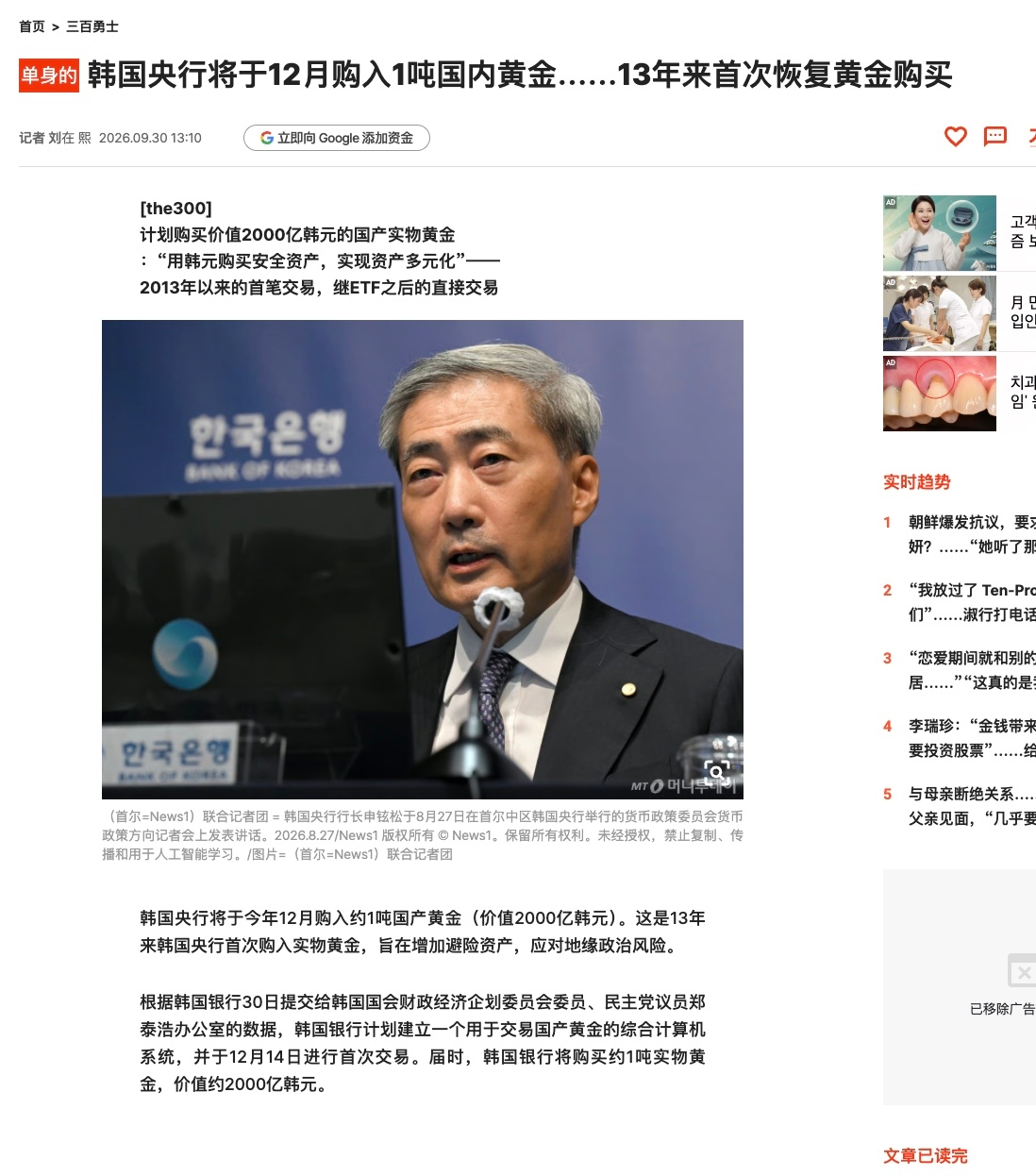
The reason given by the Bank of Korea this time is that by purchasing physical gold, it can diversify the structure of foreign-exchange reserves. Since geopolitical risks are affecting it, this kind of decision was made.
Actually, what Korea is expressing is still somewhat implicit. At the macro level, the country is facing not only geopolitical risks, but also inflation risks brought on by rising global energy prices—extending to economic risks. There are also debt/credit risks stemming from highly deficit-driven global government finances, as well as technology-stock risks that keep expanding under ongoing macro pressure, and more.
The risks mentioned by the South Korean government are not many, but in reality there are many issues to deal with. These risks don’t necessarily mean they will definitely erupt, but for sovereign states—or for some large institutions—where there is risk, there must be corresponding preventive measures.
As for us personally, if you’re worried about these risks but don’t want to miss future asset growth opportunities in a risk environment, allocating some gold is indeed a good option. Of course, this option is not suitable for everyone!
PS: By the way, a quick gripe—last time South Korea stopped buying gold was because it bought at a high point. The government was questioned by the people, so it stopped buying. But this time, Lee Jae-myung’s ability, political tactics, and vision should be better than the previous South Korean presidents!