


A terrifyingly quiet weekend—America-Iran tensions are now shrouded in even more complex clouds of war!
There was very little news about the U.S. and Iran all day Saturday. The only important item was that on Friday, Vice President Vance held a high-level security meeting at Camp David that reportedly continued for several hours and remained undisclosed.
#美俄乌谈判据报涉Lukoil石油交易 #比特币冲击8.7万美元遇阻回落
Besides Vance, today’s meeting also included Secretary of State Rubio, Defense Secretary Hegseth, the Middle East envoy Vikkterf, and the current CIA director. The core of the meeting was the next steps regarding a war with Iran, as well as security discussions about the conflict between Saudi forces and the Houthi armed groups.
Later, the White House refused to comment on this meeting, and to date it still hasn’t made any official military appointments. But taken together with this week’s events—such as the U.S. preparing to dispatch its third aircraft carrier and deploying air-defense facilities in the Middle East—it’s easy to infer that it could be preparing to launch an attack on Iran.
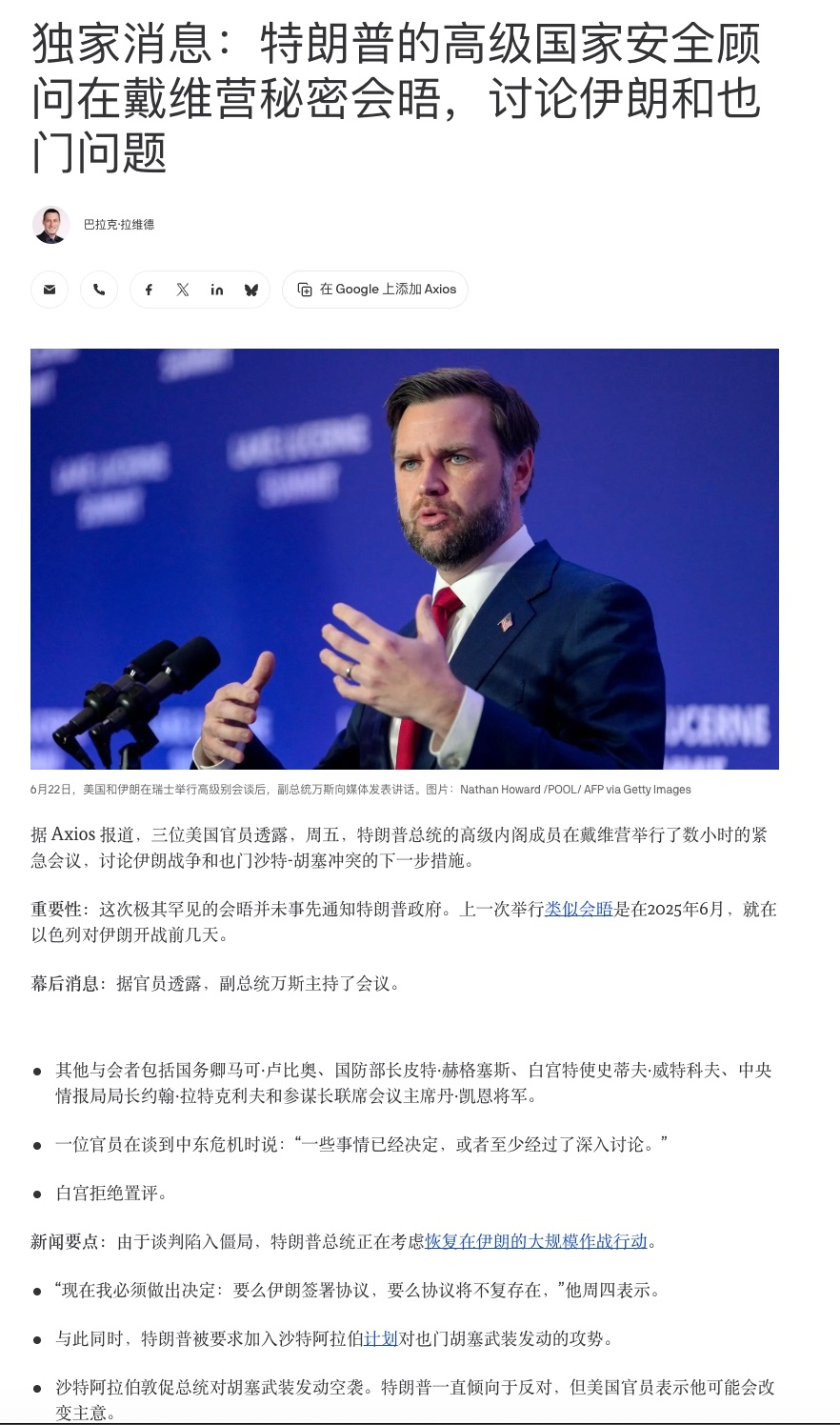
This meeting basically brought together all the top insiders from within Trump’s term. Among these people, Vance and Hegseth are the negotiation faction: they advocate short-term military pressure and the use of force as deterrence, but oppose a long-term war.
As for Rubio, the CIA director, and Hegseth, they belong to the hardline faction in diplomacy, the questioning faction, and the hardline faction in the military, respectively.
Obviously, this is a process of weighing the pros and cons of a war in the Middle East. I think this move is both a warning to Iran and a preparation of Plan B. If Iran doesn’t follow the results the U.S. wants, the combat plan could become the main course of action—this is the most dangerous signal.
Regarding Iran, it has been relatively silent for now, and on October 3, the Strait of Hormuz also saw no new attacks on cargo ships. This may be a sign of de-escalation. Of course, there are also major political contradictions within Iran itself.
Inside Iran, the speaker, the president, and the foreign minister are the negotiation faction; the revolutionary senior leadership is the hardline faction. In September alone, both sides repeatedly questioned whether the other was attempting a political coup. The hardliners want to take down the speaker, the president, and the foreign minister. Meanwhile, the negotiation faction accuses the hardliners of staging a coup and impeaching the president.
So, this weekend’s silence looks peaceful, but it’s a bit terrifyingly quiet. Based on the stance the U.S. has shown so far, if Iran can’t meet the conditions the U.S. demands, Trump may very well go ahead with his own agenda and launch another large-scale attack.
As for Vance, although he’s part of the negotiation faction, he doesn’t oppose short-term military pressure and the use of force for deterrence—so it’s not in conflict with Trump’s thinking. Right now, there’s just too little effective information, so we can only wait quietly for more open-source updates!
PS: The first to leak details about Vance’s meeting at Camp David was still A, and in this U.S.-Iran war, A can basically be considered the media mouthpiece of the Trump faction!