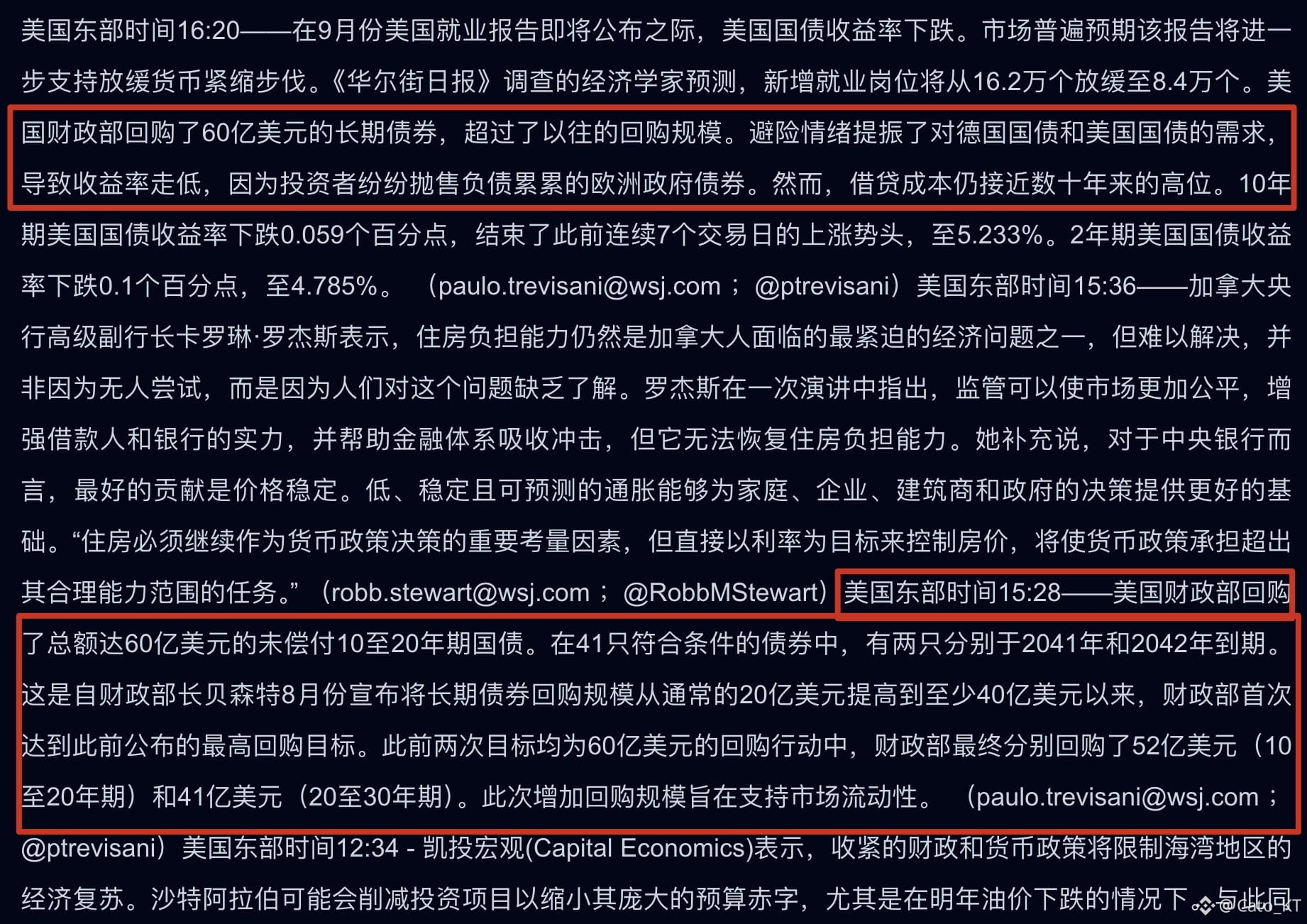
Let’s talk again about the Ministry of Finance repurchasing long-term bonds. Previously, the Ministry’s力度 (effort/intensity) wasn’t strong enough. The agreed RMB 6 billion hadn’t been fully bought up. Now it’s quite possible that they don’t want the market to interpret it as the Ministry of Finance providing a backstop for long-term bonds—something that could end up encouraging long-term bond selling to get too aggressive.
As Bessent said, the Ministry of Finance increases repurchases to provide liquidity, not to suppress yields and backstop long-term bonds (the real purpose is actually very clear). That’s why the Ministry’s repurchases follow a gradual pace, only reaching the full RMB 6 billion on October 1.
However, it still didn’t boost market confidence very much. In the October 1 repurchase operation, the Ministry first fully bought the RMB 6 billion quota, but the sell-side quotas submitted by the market surged to RMB 46.4 billion—7.7 times the repurchase quota. Clearly, sell orders in the bond market were stronger.
This repurchase has an unusual structure. Among the long-term bond sellers, 41 eligible institutions qualified, but the Ministry of Finance chose only 2 of them to repurchase. Although the repurchase amount was capped at the full RMB 6 billion, the actual cash payment was only RMB 4.47 billion (because of coupon interest calculations in the repurchase).
In other words, with only RMB 4.47 billion, the Ministry of Finance effectively removed about RMB 6 billion of debt. This indicates that the Ministry has pricing discretion in the repurchase process.
So the question is: sellers want to sell at higher prices, while the Ministry wants to clear the debt at lower prices. In the short term, the suppression of long-term bond yields is limited. To improve the long-end bond market environment through repurchases will require more time. I think the deadline for the RMB-supplemental repurchase scheduled for November 4 may be extended.
From the Ministry of Finance’s repurchase rhythm, the goal isn’t to directly suppress bond market yields, but rather to stabilize and improve conditions over the long term—and they won’t buy in a disorderly way. It’s a form of fiscal supply-side policy control. This approach is beneficial in the medium to long run, but it’s slow to show results in the short run—like traditional Chinese medicine: it treats the root causes, but for risk markets, during the early treatment phase they have to bear a longer-lasting environment of high-yield suppression! #美国9月非农仅增2.9万人失业率升至4.2%
As Bessent said, the Ministry of Finance increases repurchases to provide liquidity, not to suppress yields and backstop long-term bonds (the real purpose is actually very clear). That’s why the Ministry’s repurchases follow a gradual pace, only reaching the full RMB 6 billion on October 1.
However, it still didn’t boost market confidence very much. In the October 1 repurchase operation, the Ministry first fully bought the RMB 6 billion quota, but the sell-side quotas submitted by the market surged to RMB 46.4 billion—7.7 times the repurchase quota. Clearly, sell orders in the bond market were stronger.
This repurchase has an unusual structure. Among the long-term bond sellers, 41 eligible institutions qualified, but the Ministry of Finance chose only 2 of them to repurchase. Although the repurchase amount was capped at the full RMB 6 billion, the actual cash payment was only RMB 4.47 billion (because of coupon interest calculations in the repurchase).
In other words, with only RMB 4.47 billion, the Ministry of Finance effectively removed about RMB 6 billion of debt. This indicates that the Ministry has pricing discretion in the repurchase process.
So the question is: sellers want to sell at higher prices, while the Ministry wants to clear the debt at lower prices. In the short term, the suppression of long-term bond yields is limited. To improve the long-end bond market environment through repurchases will require more time. I think the deadline for the RMB-supplemental repurchase scheduled for November 4 may be extended.
From the Ministry of Finance’s repurchase rhythm, the goal isn’t to directly suppress bond market yields, but rather to stabilize and improve conditions over the long term—and they won’t buy in a disorderly way. It’s a form of fiscal supply-side policy control. This approach is beneficial in the medium to long run, but it’s slow to show results in the short run—like traditional Chinese medicine: it treats the root causes, but for risk markets, during the early treatment phase they have to bear a longer-lasting environment of high-yield suppression! #美国9月非农仅增2.9万人失业率升至4.2%