

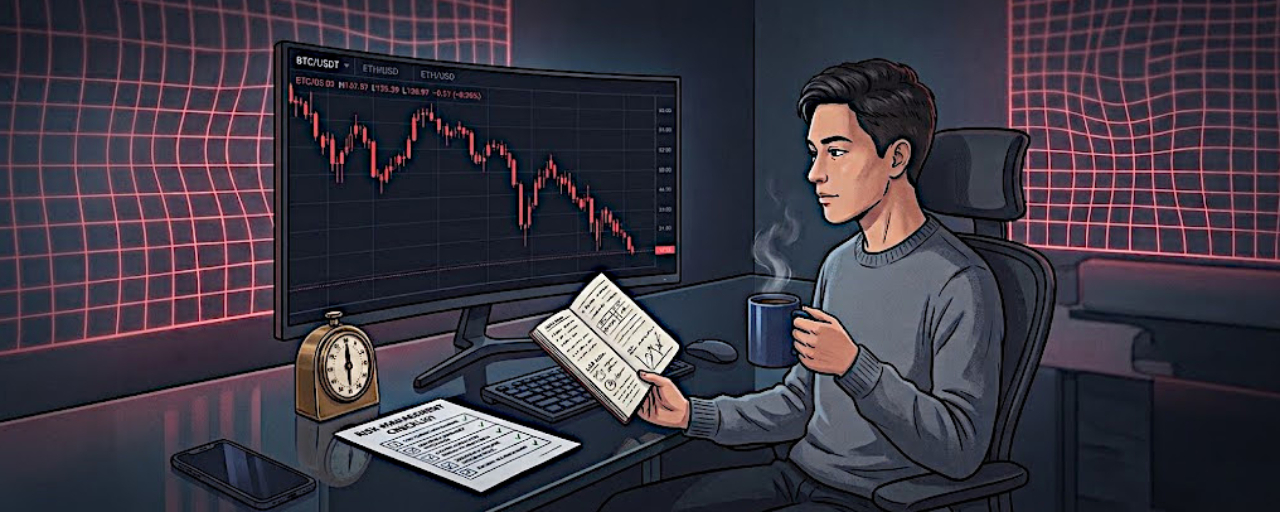

The first serious drawdown is the moment when romantic trading—with dreams of effortless passive income—turns into a harsh drama. Yesterday your portfolio was blooming and smelling sweet; you were imagining yourself as a young Wall Street genius. And today the charts have turned crimson, while an unrealized loss is devouring the profit from the last two months.
The main problem with a drawdown isn’t the loss of money itself, but the instant psychological paralysis. In the vast majority of cases, people are physically unable to admit they were wrong, because every mistake is subconsciously experienced as a painful blow to their ego and self-esteem. In trying to protect their sense of self and frantically “fix” the situation, traders turn an ordinary trading loss into a final margin call.
Let’s look at the three main tricks our wounded self-esteem plays on us during a market downturn, and figure out how to armor ourselves against our own psychological meltdown.
1. Denial Syndrome and the “Blessed” Stop-Loss
When a position is plunging, the ego kicks in with a brilliant defense: “If I haven’t closed it, it’s not a loss—I’m still right!” The trader watches the stop get closer and, instead of admitting a mistake in their analysis, keeps moving it lower and lower, whispering pleas to the chart. In the end, a modest 2% technical stop turns into a catastrophic loss of 40% of the account—at least their self-esteem is “saved” right up until liquidation.
2. Emotional Martingale (Averaging Down on a Falling Knife)
Trying to “buy more at the absolute bottom” without any setup, just to prove the market wrong and get back to breakeven faster. The trader congratulates themselves on “improving their average price,” adding to the position with excessive leverage on every dip. Without confirmation of a reversal, averaging down during a drawdown isn’t investing—it’s an attempt to avoid admitting a mistake by voluntarily jumping into a cascade of liquidations.
3. Overprotectiveness and Micromanagement
Frantically checking your phone every 30 seconds (including in the shower and while waiting at a red light). Every tiny price fluctuation triggers a spike in cortisol, burning out your nervous system. By evening, the exhausted trader has completely lost perspective and closes the trade at the absolute low—one second before the reversal upward, finishing off both their account and their ego.
The voice of reason:
If your account has gone into a deep dive, stop the emotional chaos and apply these three crisis-management rules:
Set a daily “circuit breaker” (Daily Loss Limit): Decide in advance on your maximum loss for the day (for example, 3% of your capital). Hit the limit? Close your laptop, don’t open the exchange app until morning, and go get some fresh air. Your ego will be in better shape, and the market isn’t going anywhere.
Accept that making mistakes is normal: Remember, an “unrealized loss” is still a loss. If your original scenario is invalidated, cut your position. Taking a loss is a sign of strength and maturity, not weakness. It’s better to preserve 95% of your account and reassess with a clear head than to sit there holding your breath and hoping for a miracle.
Cut your position size by a factor of 3: After a string of losses, rebuild your discipline and confidence only with micro-sized positions. Your goal is to get back to being systematic, not to try to “win it all back” with one frantic trade just to soothe your pride.
#Трейдинг #BinanceSquare #ПсихологияТрейдинга #УправлениеРисками #Write2Earn