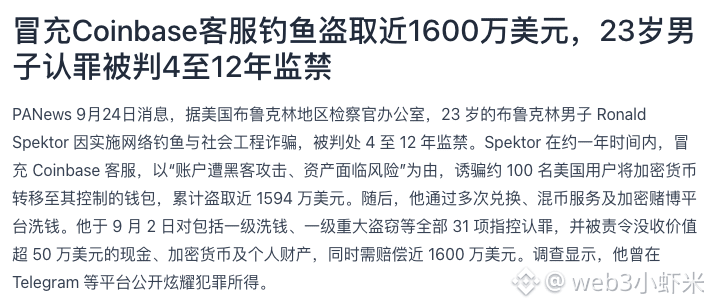
The Brooklyn District Attorney’s Office disclosed that 23-year-old Ronald Spektor was sentenced to 4 to 12 years in prison for phishing and social-engineering scams after impersonating Coinbase customer support. Within about a year, he lured roughly 100 U.S. users into transferring cryptocurrency to wallets he controlled by claiming that their accounts had been “hacked” and their assets were at risk. He stole a total of nearly $15.94 million. On September 2, he pleaded guilty to all 31 counts, including first-degree money laundering and first-degree grand larceny, and was ordered to forfeit more than $500,000 in cash, cryptocurrency, and property, as well as to pay nearly $16 million in restitution. The proceeds were then laundered through multiple rounds of exchange, mixing services, and crypto gambling platforms, and he even publicly bragged about his take on Telegram.
Cases like this are worth watching—not because of the amount itself, but because the perpetrators’ methods rely on almost no technical vulnerabilities. The attackers are exploiting users’ trust in “official customer support” and the sense of urgency created by panic after an asset is stolen. For exchanges, this means risk controls and user education remain long-term costs; for holders, any customer-service contact that initiates a transfer of assets to a “safe wallet” should be viewed with suspicion.
In terms of market transmission, a single criminal case is likely to have limited direct impact on prices and liquidity, and it remains unclear whether it will change the pace of regulation. However, it will be added to the U.S. law-enforcement posture toward crypto fraud and mixing tools, indirectly shaping the boundaries between compliant platforms and anonymous services. The variables to watch next are: whether prosecutors further follow the trail to disclose more co-conspirators or the flow of funds, and whether exchanges introduce clearer mechanisms for customer-support identity verification.
#crypto market
Cases like this are worth watching—not because of the amount itself, but because the perpetrators’ methods rely on almost no technical vulnerabilities. The attackers are exploiting users’ trust in “official customer support” and the sense of urgency created by panic after an asset is stolen. For exchanges, this means risk controls and user education remain long-term costs; for holders, any customer-service contact that initiates a transfer of assets to a “safe wallet” should be viewed with suspicion.
In terms of market transmission, a single criminal case is likely to have limited direct impact on prices and liquidity, and it remains unclear whether it will change the pace of regulation. However, it will be added to the U.S. law-enforcement posture toward crypto fraud and mixing tools, indirectly shaping the boundaries between compliant platforms and anonymous services. The variables to watch next are: whether prosecutors further follow the trail to disclose more co-conspirators or the flow of funds, and whether exchanges introduce clearer mechanisms for customer-support identity verification.
#crypto market