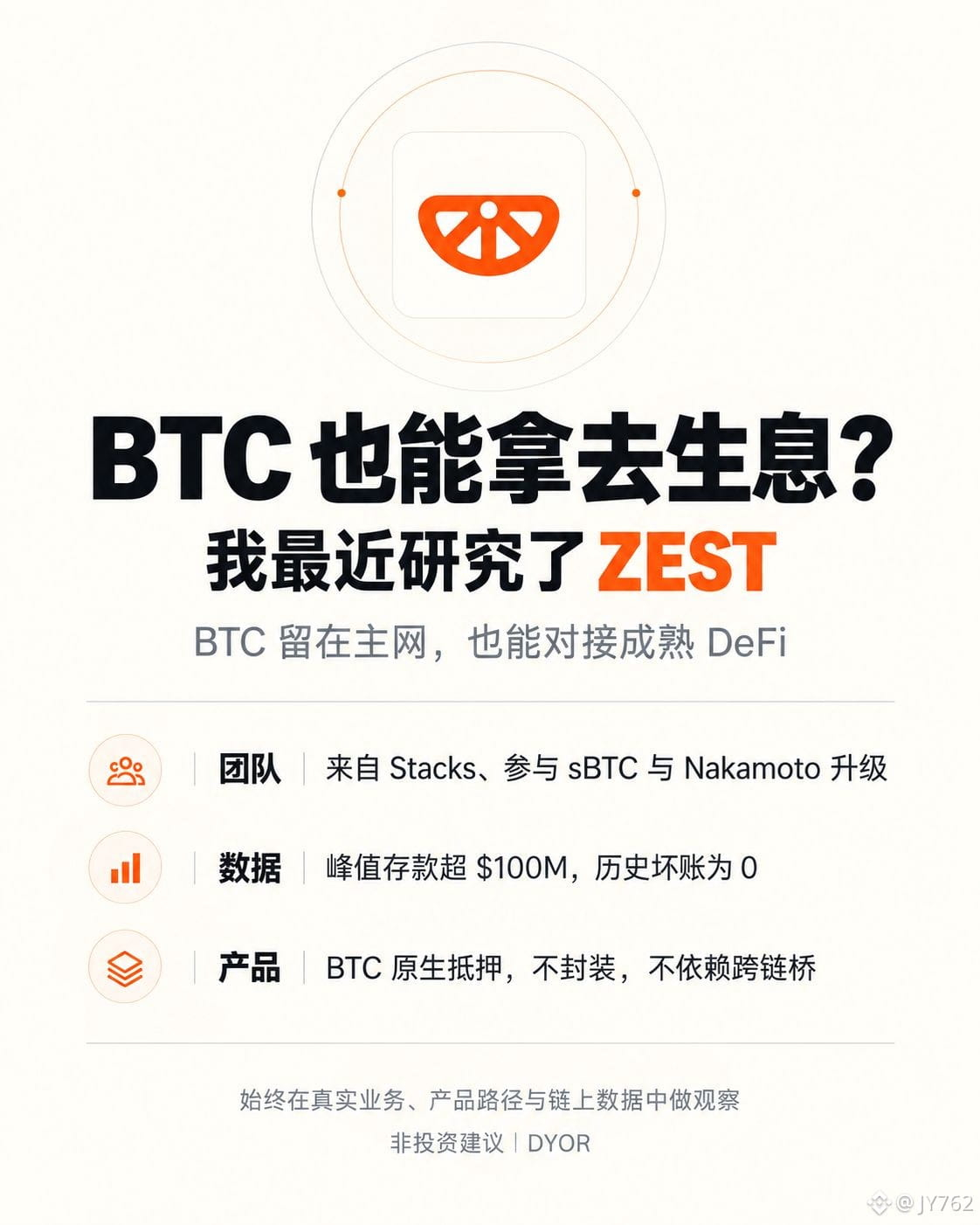
Can Bitcoin also be put to work for yield? Recently, I researched the ZEST project.
In the community, people constantly chant “Bitcoin finance,” but ZEST is different—because the people behind it and the data it has produced are quite unlike most projects that mostly tell stories.
The founder came out of Stacks and was involved in sBTC and the Nakamoto upgrade. After years of work, their conclusion is: L2 may be going down a narrow path. What Bitcoin finance should truly do is to directly connect BTC that stays on the Bitcoin network to mature DeFi, rather than moving both people and capital to another L2. So ZEST is more like a continuation of the STX logic, not another
Bitcoin L2 token. The seed round was led by Tim Draper’s Draper Associates, with YZi Labs (formerly Binance Labs) participating. Now let’s talk about the data. On Stacks, their previous lending market saw August peak deposits over $100M, with borrowings around $10M. Stablecoin liquidity exceeded $9M, over 1,500 liquidations occurred, bad debt was zero, and the protocol relied on interest-splitting for real revenue.
What they’re building now is Bitcoin Collateral Vaults: BTC is directly locked in a Bitcoin mainnet vault—no wrapping, no cross-chain bridge. You can borrow stablecoins on the EVM chain; during the borrowing period, BTC doesn’t move unless it’s liquidated.
Lending is just the first step. What they want to build is a foundation that can support all kinds of financial applications. On valuation: ZEST’s circulating market cap isn’t large yet, but both Binance Alpha and contracts are already live. Alpha’s first-day close on May 19 was $0.1446; on June 9 it surged to $0.3497, and then it pulled back a bit.
Stacks’ peak circulating market cap reached $4.83B. This is just a scale reference—not to imply ZEST should be fitted to that number right now. But at least it shows the “programmable Bitcoin” narrative has been validated by the market.
This combination—small market cap plus real business—is not very common. The mainnet demo already lets you experience borrowing stablecoins against BTC collateral. Whether it can really scale depends on product delivery and whether there are people who keep using the spot market. Not investment advice—there are risks in the market, so do your own research.
In the community, people constantly chant “Bitcoin finance,” but ZEST is different—because the people behind it and the data it has produced are quite unlike most projects that mostly tell stories.
The founder came out of Stacks and was involved in sBTC and the Nakamoto upgrade. After years of work, their conclusion is: L2 may be going down a narrow path. What Bitcoin finance should truly do is to directly connect BTC that stays on the Bitcoin network to mature DeFi, rather than moving both people and capital to another L2. So ZEST is more like a continuation of the STX logic, not another
Bitcoin L2 token. The seed round was led by Tim Draper’s Draper Associates, with YZi Labs (formerly Binance Labs) participating. Now let’s talk about the data. On Stacks, their previous lending market saw August peak deposits over $100M, with borrowings around $10M. Stablecoin liquidity exceeded $9M, over 1,500 liquidations occurred, bad debt was zero, and the protocol relied on interest-splitting for real revenue.
What they’re building now is Bitcoin Collateral Vaults: BTC is directly locked in a Bitcoin mainnet vault—no wrapping, no cross-chain bridge. You can borrow stablecoins on the EVM chain; during the borrowing period, BTC doesn’t move unless it’s liquidated.
Lending is just the first step. What they want to build is a foundation that can support all kinds of financial applications. On valuation: ZEST’s circulating market cap isn’t large yet, but both Binance Alpha and contracts are already live. Alpha’s first-day close on May 19 was $0.1446; on June 9 it surged to $0.3497, and then it pulled back a bit.
Stacks’ peak circulating market cap reached $4.83B. This is just a scale reference—not to imply ZEST should be fitted to that number right now. But at least it shows the “programmable Bitcoin” narrative has been validated by the market.
This combination—small market cap plus real business—is not very common. The mainnet demo already lets you experience borrowing stablecoins against BTC collateral. Whether it can really scale depends on product delivery and whether there are people who keep using the spot market. Not investment advice—there are risks in the market, so do your own research.