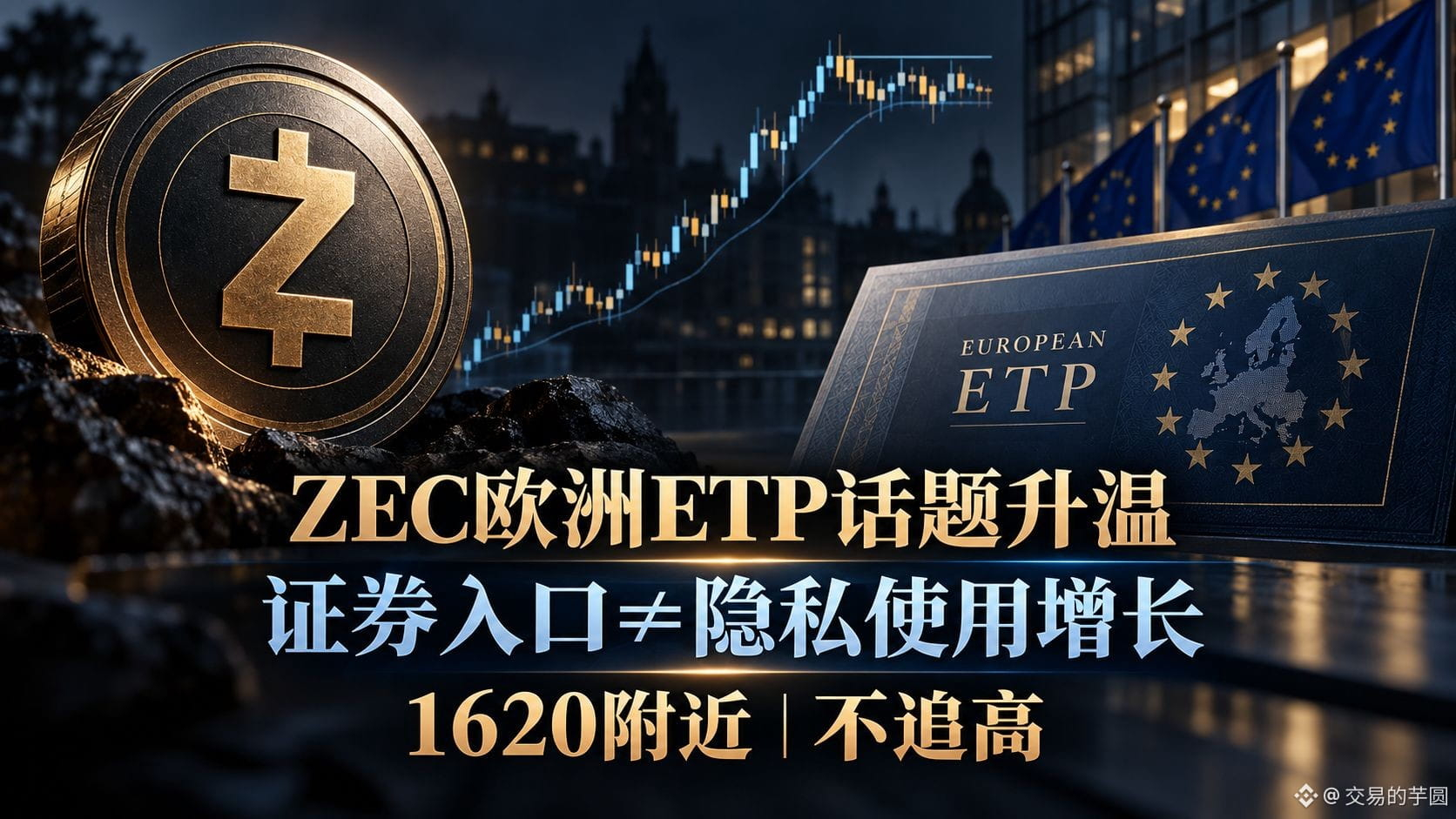
The ZEC Europe ETP topic continues to rise|A securities account entry doesn’t equal privacy-use growth|Around 1620, I’m not chasing
My stance is cautious: I’m not treating the product listing as if a privacy-payment demand has already been fulfilled. The accurate topic tag for Binance Square right now is #21SharesLaunchesEuropesFirstZcashETP. The number of people discussing it has increased compared with the previous round; but “Europe’s first” only refers to the listing scope that 21Shares disclosed for Europe—it doesn’t mean there were no ZEC investment vehicles before globally. The issuer’s Sept 22 announcement and the product page show that ZCASH is a physically backed European ETP, with the underlying held by the custodian. The annual fee is 2.5%, and at the time the product page showed an initial size of around $100,000. It gives people who use securities accounts price exposure; it doesn’t mean every unit holder is using privacy addresses on-chain, and it certainly isn’t evidence that large net subscriptions have already appeared today.
This news should be transmitted to the market in two layers. The first is distribution: if the number of shares and the amount of coins held keep increasing in the future, then market-making and subscription/redemption activity may create trackable incremental ZEC demand. Looking only at product listing and AUM isn’t enough, because price increases also raise AUM. The second layer is usage: the Zcash protocol allows transparent and shielded value pools to coexist. Shielded-address transactions can conceal counterparties and amounts, but securities-account ETP holders won’t automatically become shielded-transaction users. To validate a longer-term privacy narrative, you should look at wallet usability, changes in shielded-pool balances, and real transaction usage—not treat the securities wrapper itself as adoption rate. The issuer’s product-page description of privacy is an investment thesis, not independently audited incremental data for that day.
Price has already moved ahead of the narrative. KuCoin’s ZEC perpetual is currently around $1622; the 24-hour high is about $1685 and the low about $1497, with a gain of nearly 7%. This indicates large short-term volatility, so it can’t prove that the rise is entirely driven by the ETP. My key levels are 1600 as the support to hold and 1685 as the prior high. If it falls below 1600 and then rallies back without reclaiming it, the short-term reason to chase the price would be invalidated. Conversely, if the product later discloses that shares and actual ZEC holdings keep growing, and the price continues to pull back to 1600 and still holds, then there would be more reason to upgrade the assessment of the sustainability of fund inflows.
If I were trading it myself: I wouldn’t participate now. The plan would be only to look for long entries aligned with the spot trend, without chasing with high leverage. First, wait for two complete 15-minute candlesticks to close above 1640; then, if it pulls back to 1630–1640 and holds, and the volume doesn’t clearly fade, I’d deploy at most 0.3% of total capital. Cut the position in half around 1660, and close the remaining position in the 1680–1685 range. Hard stop-loss is below 1590. After entering, if the next two 15-minute candles close back below 1620, exit early. Before entering: if it breaks below 1600 and the rebound fails, cancel the long plan. If it quickly spikes above 1685 but there’s no pullback confirmation, I’d rather miss it. Position sizing refers to the share of total assets, not the contract margin ratio.
#21SharesLaunchesEuropesFirstZcashETP #ZEC
The above is only my personal market observations and does not constitute investment advice.
My stance is cautious: I’m not treating the product listing as if a privacy-payment demand has already been fulfilled. The accurate topic tag for Binance Square right now is #21SharesLaunchesEuropesFirstZcashETP. The number of people discussing it has increased compared with the previous round; but “Europe’s first” only refers to the listing scope that 21Shares disclosed for Europe—it doesn’t mean there were no ZEC investment vehicles before globally. The issuer’s Sept 22 announcement and the product page show that ZCASH is a physically backed European ETP, with the underlying held by the custodian. The annual fee is 2.5%, and at the time the product page showed an initial size of around $100,000. It gives people who use securities accounts price exposure; it doesn’t mean every unit holder is using privacy addresses on-chain, and it certainly isn’t evidence that large net subscriptions have already appeared today.
This news should be transmitted to the market in two layers. The first is distribution: if the number of shares and the amount of coins held keep increasing in the future, then market-making and subscription/redemption activity may create trackable incremental ZEC demand. Looking only at product listing and AUM isn’t enough, because price increases also raise AUM. The second layer is usage: the Zcash protocol allows transparent and shielded value pools to coexist. Shielded-address transactions can conceal counterparties and amounts, but securities-account ETP holders won’t automatically become shielded-transaction users. To validate a longer-term privacy narrative, you should look at wallet usability, changes in shielded-pool balances, and real transaction usage—not treat the securities wrapper itself as adoption rate. The issuer’s product-page description of privacy is an investment thesis, not independently audited incremental data for that day.
Price has already moved ahead of the narrative. KuCoin’s ZEC perpetual is currently around $1622; the 24-hour high is about $1685 and the low about $1497, with a gain of nearly 7%. This indicates large short-term volatility, so it can’t prove that the rise is entirely driven by the ETP. My key levels are 1600 as the support to hold and 1685 as the prior high. If it falls below 1600 and then rallies back without reclaiming it, the short-term reason to chase the price would be invalidated. Conversely, if the product later discloses that shares and actual ZEC holdings keep growing, and the price continues to pull back to 1600 and still holds, then there would be more reason to upgrade the assessment of the sustainability of fund inflows.
If I were trading it myself: I wouldn’t participate now. The plan would be only to look for long entries aligned with the spot trend, without chasing with high leverage. First, wait for two complete 15-minute candlesticks to close above 1640; then, if it pulls back to 1630–1640 and holds, and the volume doesn’t clearly fade, I’d deploy at most 0.3% of total capital. Cut the position in half around 1660, and close the remaining position in the 1680–1685 range. Hard stop-loss is below 1590. After entering, if the next two 15-minute candles close back below 1620, exit early. Before entering: if it breaks below 1600 and the rebound fails, cancel the long plan. If it quickly spikes above 1685 but there’s no pullback confirmation, I’d rather miss it. Position sizing refers to the share of total assets, not the contract margin ratio.
#21SharesLaunchesEuropesFirstZcashETP #ZEC
The above is only my personal market observations and does not constitute investment advice.