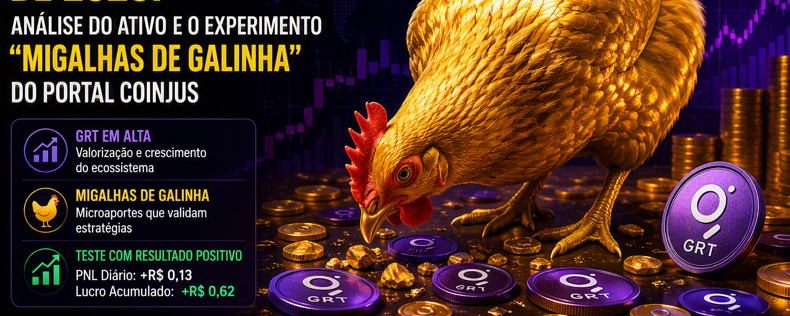

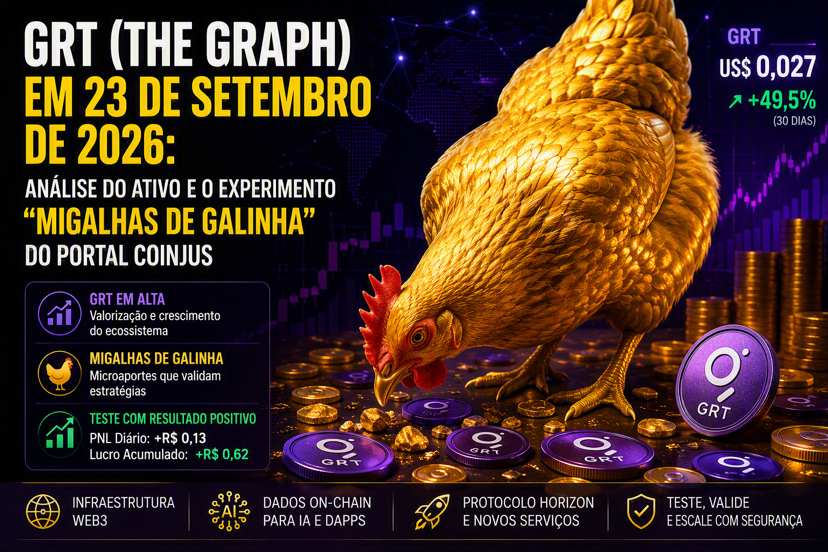
GRT (The Graph) on September 23, 2026: Asset Analysis and the “Chicken Scraps” Experiment from the CoinJus Portal;
Let’s move on $GRT
Introduction:
The GRT cryptocurrency (The Graph) remains one of the most relevant projects in the Web3 infrastructure. Unlike assets focused exclusively on payments or smart contracts, The Graph works as a data indexing and query layer for the blockchain, enabling decentralized applications to retrieve information quickly and efficiently.
In September 2026, the project continues expanding its usefulness through solutions focused on artificial intelligence, decentralized APIs, and modular data services, strengthening its position within the blockchain ecosystem.
At the same time, practical market experiences—such as the micro-deposit tests known by Portal CoinJus as “chicken feed”—show how small applications can be used to validate operational strategies before allocating more substantial financial volumes.
Current Situation of GRT on September 23, 2026:
On September 23, 2026, GRT was trading near the US$ 0.027 range, recording significant gains compared to earlier periods.
Market data indicated significant growth over the previous 30 days, along with an increase in trading volume.
Among the factors that contribute to the asset’s performance are the continuous expansion of The Graph ecosystem, increased demand for Web3 solutions, the integration of resources geared toward artificial intelligence, and the evolution of the Horizon protocol, which expands the network’s data indexing and query capabilities.
Despite the positive outlook, investors continue to consider factors such as liquidity and volatility—features inherent to the crypto-assets market.
Some exchanges made adjustments to certain trading pairs involving GRT during September 2026, an element that may influence the asset’s behavior in the short term.
Even so, many market participants believe that the project maintains solid fundamentals due to the strategic role it plays in global blockchain infrastructure.
The “Chicken Feed Test” Concept 🐓:
Portal CoinJus uses the expression “chicken feed” to identify extremely reduced deposits made for experimental purposes.
The methodology consists of applying a minimum value, monitoring the asset’s behavior, evaluating the efficiency of the adopted strategy, measuring the PNL result (Profit and Loss), and then analyzing the possibility of scalability for larger operations.
The main goal is to reduce initial risks and obtain practical validation before making more robust investments.
Analysis of the Published Test:
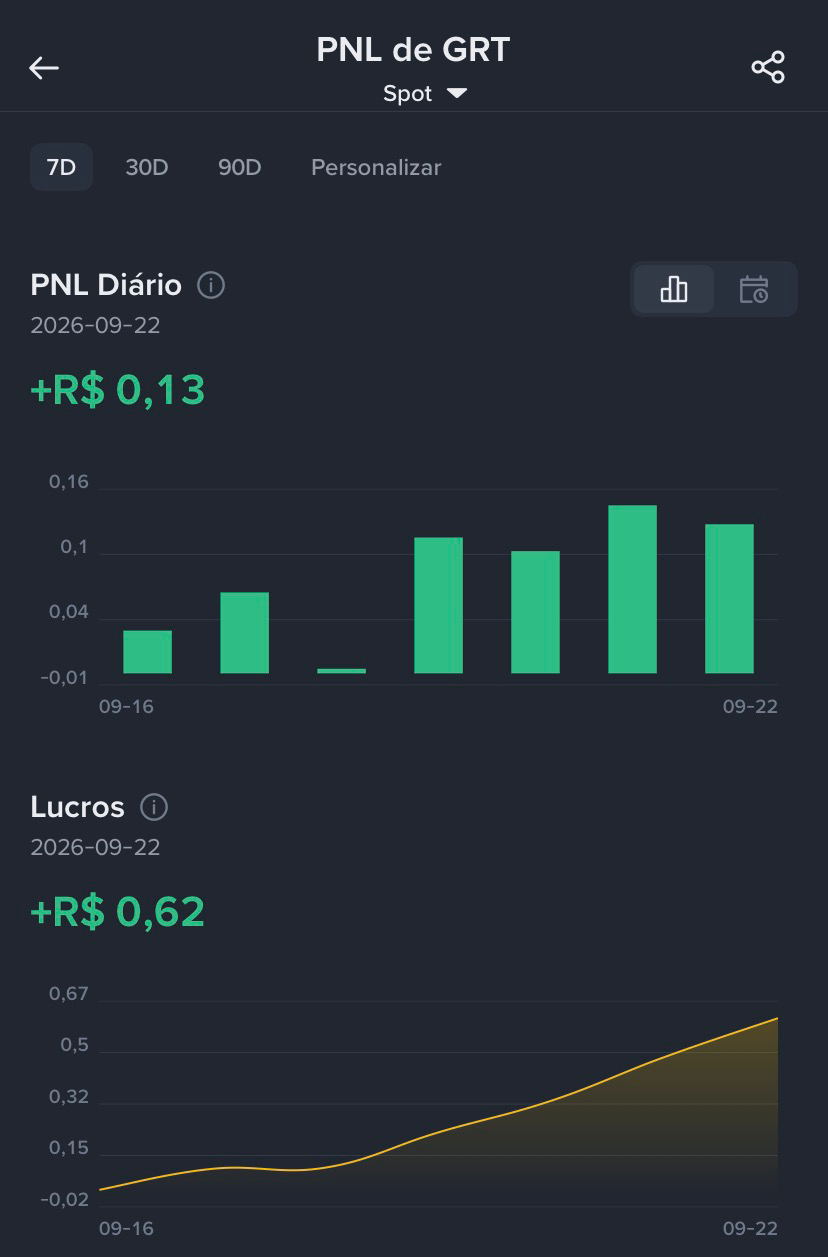
In the image released by Portal CoinJus, referring to the period ending on September 22, 2026, it is possible to see a positive daily PNL of R$ 0.13 and accumulated profit of R$ 0.62.
The chart shows a predominantly upward trajectory over the week, suggesting gradual growth in results and maintenance of a positive balance during the analyzed period.
Although the financial value is low, the focus of the experiment is not on the absolute amount obtained, but on the operational validation of the strategy. In this context, the test showed that the applied methodology produced positive net return.
Under a simplified statistical analysis, the experiment can be considered successful, since the capital employed ended the period showing gains and consistent evolution of results.
The Principle of Proportional Equity:
One of the most interesting observations drawn from the experiment is the application of the principle of economic proportionality.
In theory, when an operation produces positive return and operating costs remain proportional, the performance percentage tends to maintain a similar pattern even when the invested capital is increased.
This means that, if a given strategy demonstrates efficiency in a micro-deposit, there is a possibility of obtaining proportionally equivalent results in larger deposits, as long as factors such as liquidity, entry price, volatility, and operating costs remain relatively stable.
This concept is often associated with the so-called proportional return scalability, used by investors to assess the practical viability of strategies before expanding financial exposure.
Arithmetic Example:
Taking as reference the accumulated profit of R$ 0.62 recorded in the test, it is possible to carry out a simple mathematical projection based on proportionality.
If an operation equivalent to the original scale generated R$ 0.62 in profit, an operation ten times larger could produce approximately R$ 6.20. At a scale one hundred times larger, the projected result would reach about R$ 62.00. And a position one thousand times larger could represent a profit close to R$ 620.00.
Naturally, this projection is intended exclusively for illustrative and mathematical purposes.
The future performance of any investment depends on factors such as market liquidity, price volatility, operating fees, and general economic conditions.
Even so, the exercise shows that a strategy validated through a micro-deposit can serve as a reference for future scalability analyses.
The Conversion Generated Profits:
The data observed in the experiment point to an objective conclusion: the conversion carried out in GRT resulted in positive profit during the analyzed period.
The evolution shown in the chart demonstrates a positive balance, continuous growth of PNL, and accumulated profit at the end of the week. In addition, no relevant signs of deterioration in the performance curve were observed during the analyzed cycle.
Within the experimental methodology known as “chicken feed,” the results indicate that the strategy achieved its main purpose: to validate an operation using a minimal deposit and to verify its ability to generate financial return.
Conclusion:
On September 23, 2026, GRT had relevant technological fundamentals and a recovery phase supported by the advancement of The Graph ecosystem, the expansion of the Web3 universe, and the growing integration of solutions focused on artificial intelligence.
At the same time, the micro-deposit experiment conducted by Portal CoinJus recorded positive performance, closing the period with R$ 0.62 in accumulated profit and consistent PNL growth.
From the perspective of arithmetic proportionality, the test reinforces the use of micro-deposits as a tool for strategic validation.
Although they do not guarantee future results, experiences of this kind make it possible to observe the practical behavior of an operation before making more significant investments.
In this context, the concept of “chicken feed” demonstrates that small transactions can work as a real financial lab, providing concrete data for evaluating opportunities in the crypto-assets market.
Risk Notice:
This content is exclusively for informational, educational, and journalistic purposes and does not constitute investment advice, an offer to buy or sell digital assets. Crypto-assets are high-risk investments and may present high volatility, including the possibility of partial or total loss of the invested capital.
The results presented in the experiment called “chicken feed” reflect exclusively the performance observed during the analyzed period and do not represent a guarantee of future profitability. Arithmetic scalability projections are illustrative in nature and were used only to demonstrate mathematical proportionality and should not be interpreted as a promise of financial return.
Before investing in cryptocurrencies, each investor is advised to conduct their own analysis, assess their risk profile, and, if necessary, consult qualified professionals in the financial, accounting, and legal fields.
Portal CoinJus is not responsible for investment decisions made based on the information presented in this article. Past returns do not guarantee future returns.
Hugs to our readers at PORTAL COINJUS.