



Author: Gemini, Deep Tide TechFlow
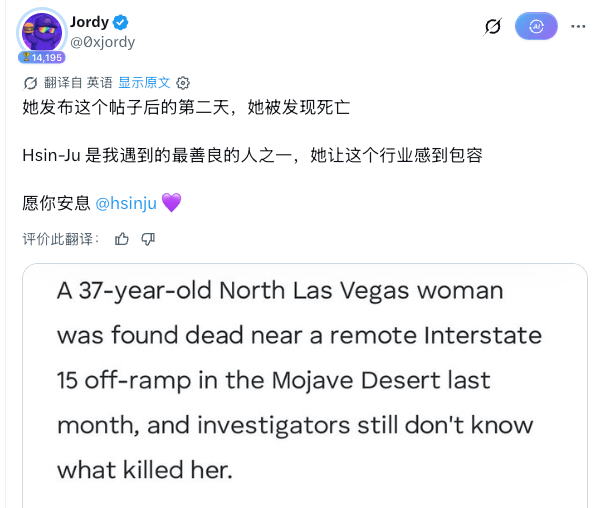
Over the past month, the entire overseas crypto community was unaware of a murder case until, only in the past few days, the belated tributes from industry peers completely detonated the shockwave on social media timelines.
An industry veteran with nine years of experience—formerly a partner at Hack VC who helped drive the growth of early projects such as Solana—Hsin-Ju Chuang died mysteriously in the deserts of California on the eve of an exposé that would reveal various issues involving her former employer.
Readers should remember the other crypto OG article written earlier about a bizarre fall from a building, for reference: (Naked fall of a crypto OG: Ye Junde’s wealth, gambling, and the final early-morning hours).
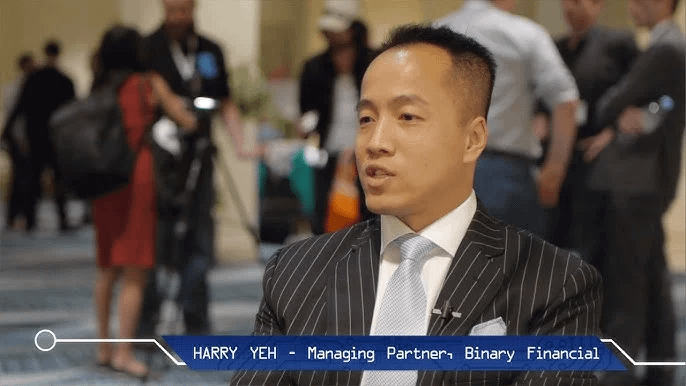
First, Harry Yeh—an on-chain whale—in a horrifying fall from a luxury home in Paraguay. Now again, an industry veteran dies mysteriously in the desert; within just a month, two abnormal deaths of seasoned practitioners leave people feeling surrounded by unanswered questions.
The fatal 72 hours—and the “whistle” that never came to anything
Hsin-Ju’s final trace left in the digital world was a public letter—desperate, yet resolute.
On August 23, she tweeted to break ties with her former employer, Hack VC, saying she would rather give up any compensation—not even a single cent—and would never sign any settlement agreement containing a confidentiality clause.
In a public letter on social media, she accused that even though she was suffering from severe hyperthyroidism and serious insomnia, she was still forced to work at high intensity six days a week, and was even threatened with being blacklisted in the industry.
The immense physical and psychological torment caused her to write, “The conditions got so bad I attempted suicide.”
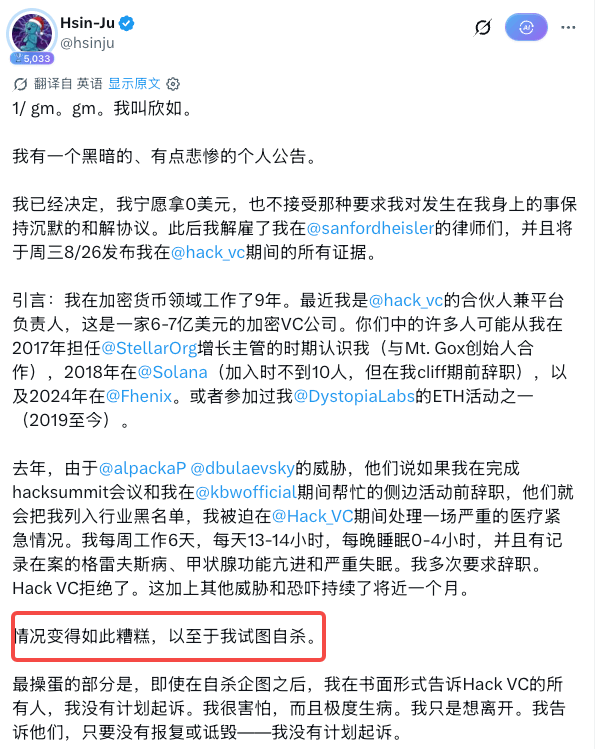
At the very end of this tweet, she left a countdown: she would release all evidence on August 26, saying, “Let all privacy go to hell,” with a clear sense of a no-turning-back, dead-or-alive tone.
We don’t know the details of the specific financial disputes, but what we can be sure of is that she didn’t make it to that day.
According to local media such as Hoodline and police records, at around 9 p.m. on August 24, California Highway Patrol officers, while conducting a Welfare Check, drove into a car next to an extremely remote on-ramp on I-15 in the heart of the Mojave Desert. They found Hsin-Ju, 37, with no vital signs.
So the complete timeline is:
On August 23, she publicly posted and severed ties with her former employer, clearly announcing that she would release all evidence on August 26.
The evening of August 24, the day after the post, she was found dead beside a road on-ramp in the Mojave Desert in California.
The cause of death is still unknown. Yet this news somehow lay quietly within the community for a full 30 days, only surfacing today after a fellow industry person reposted it to pay tribute.
According to reports from foreign media, on the day of the incident, the area’s highest temperatures in that desert nearly reached 42 degrees Celsius (108°F). Was it an acute sudden illness, extreme heat, or some other more hidden kind of external intervention? The real cause may have to wait months for forensic toxicology testing to determine.
But on the eve of the hammer being dropped, a whistleblower died mysteriously in the desert—such a chilling coincidence makes it impossible not to wonder.
A body that cannot be protected by a private key
This wasn’t the only tragedy in August. Two weeks earlier, on August 7, Harry Yeh—an early whale who had been deeply involved in the Fantom ecosystem—died after falling naked from the 30th floor of a luxury apartment in Paraguay’s capital.
The most unsettling detail is this: when the police arrived, the door of his upscale residence was left wide open. Inside, everything was in disarray, suggesting he had just been subjected to a highly violent robbery, while the partner living in the same building claimed to have no idea.
These two deaths are like two sharp knives, piercing the long-standing “security illusion” in the crypto industry.
We focus more on the security of our crypto assets, believing that as long as the private key isn’t exposed, everything will run safely. Yet we rarely consider personal safety and health issues.
But can disputes truly stay hidden forever behind code and anonymous profile pictures? When massive wealth, disputes, and the redistribution of interests on the chain go beyond the scope of a private key, the intensity of real-world power struggles, the complexity of human nature, and the malicious use of publicly available information by bad actors to lock onto locations are often far beyond what people imagine in ordinary times.
In addition, from the long-term pressure and somatic (body-centered) symptoms Hsin-Ju disclosed before her death, to the industry’s widespread practice of nonstop screen-staring 24/7, crypto is full of myths about getting rich—but it’s also the easiest to consume specific “people.”
Where money moves fastest, warmth is often the first expendable product to be cashed out.
When physical and mental health turns red, or when the workplace/investment environment has evolved into pure psychological exhaustion, cutting ties in time and protecting yourself was never a failure.
Market cycles rise and fall, seasons turn and repeat. In this long and merciless dark forest, staying alive is always the premise of every story.
May the departed rest in peace, and may the truth be revealed soon. And may every fellow traveler who has been making their way through this cycle not only win the chips in the market, but also make it to the end safely and in good health.