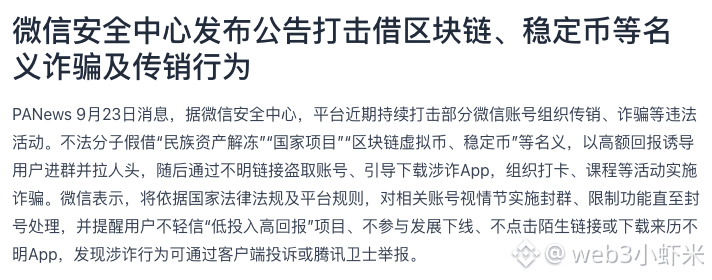
WeChat Security Center released an announcement on September 23 stating that it has been continuously cracking down on certain accounts and organizations involved in pyramid schemes and scams. The shams listed in the announcement include “the unfreezing of ethnic assets,” “national projects,” as well as “blockchain virtual coins” and “stablecoins.” The tactics are nothing new: they lure users into joining groups with promises of high returns, recruit people underneath them, then steal accounts using unclear links, or lead victims to download apps involved in wrongdoing—working together with activities such as check-ins and courses to complete the scam. In terms of handling, WeChat says it will, in accordance with laws and regulations and platform rules, determine appropriate measures such as blocking or restricting groups, limiting functions, and possibly suspending accounts depending on the circumstances. It also reminds users not to believe offers of low investment and high returns, not to develop downline members, and not to click on unfamiliar links.
What’s worth paying attention to in this announcement is not simply “WeChat is again cracking down on scams,” but the fact that stablecoins are explicitly included in the scam-speech checklist. Stablecoins are originally payment and settlement tools. Over the past year, discussions about them in cross-border scenarios have increased, and scammers have conveniently packaged them as “evidence of returns from national projects,” leveraging the heat of popular concepts rather than the technology itself. For the industry, cases like this will likely reinforce the direction of regulation and platform risk control: compliant discussions will continue to advance, while gray-market customer-acquisition channels will be further tightened.
The transmission chain is roughly: the platform increases account bans —> the ecosystem of coin-related communities and the funneling paths shrink —> with fewer entry points for retail users to access high-risk projects, short-term speculative sentiment may be suppressed. However, these actions are anti-fraud measures; they do not change the compliant issuance and payment-application progress of stablecoins, nor can they be used to judge the direction of coin prices.
Next, two things can be observed: whether WeChat publishes specific disposal data or typical cases in the future, and whether similar platforms will follow suit by listing “stablecoins” as a scam keyword.
#stablecoin
What’s worth paying attention to in this announcement is not simply “WeChat is again cracking down on scams,” but the fact that stablecoins are explicitly included in the scam-speech checklist. Stablecoins are originally payment and settlement tools. Over the past year, discussions about them in cross-border scenarios have increased, and scammers have conveniently packaged them as “evidence of returns from national projects,” leveraging the heat of popular concepts rather than the technology itself. For the industry, cases like this will likely reinforce the direction of regulation and platform risk control: compliant discussions will continue to advance, while gray-market customer-acquisition channels will be further tightened.
The transmission chain is roughly: the platform increases account bans —> the ecosystem of coin-related communities and the funneling paths shrink —> with fewer entry points for retail users to access high-risk projects, short-term speculative sentiment may be suppressed. However, these actions are anti-fraud measures; they do not change the compliant issuance and payment-application progress of stablecoins, nor can they be used to judge the direction of coin prices.
Next, two things can be observed: whether WeChat publishes specific disposal data or typical cases in the future, and whether similar platforms will follow suit by listing “stablecoins” as a scam keyword.
#stablecoin