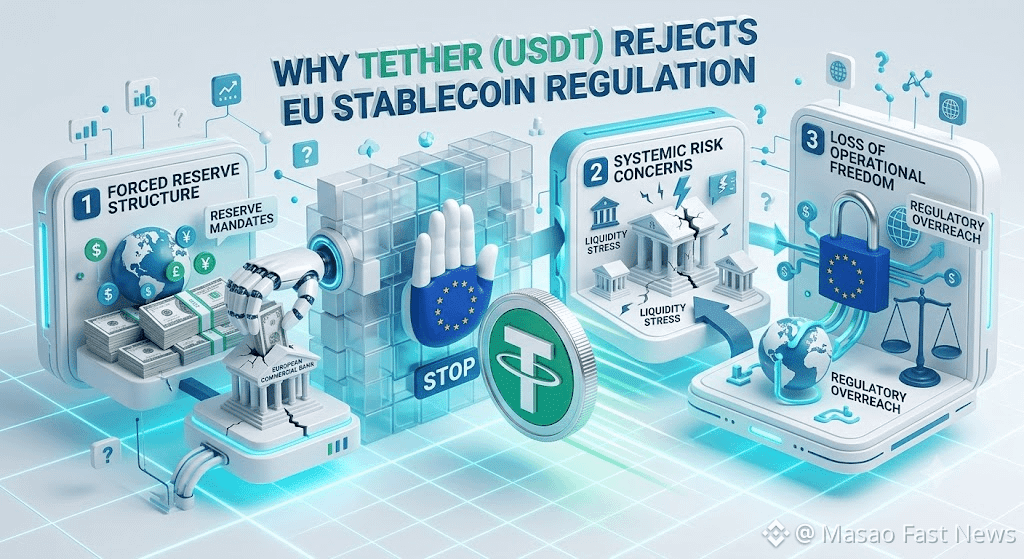
🚨 WHY DOES TETHER REFUSE EUROPE'S STABLECOIN REGULATIONS?
Tether CEO Paolo Ardoino said the company will not apply for a MiCA license because it disagrees with the requirement for large stablecoins to keep 60% of reserves at credit institutions.
Under the current MiCA rules, this ratio applies to stablecoins classified as “significant,” while the remaining reserves may be held in highly liquid financial assets such as government bonds.
Ardoino argues that concentrating large amounts of money in banks could create additional counterparty risk, while Tether currently primarily uses assets supported by the U.S. government and short-term liquidity instruments for its reserves.
Notably, the ECB and other EU central banks have just proposed removing the 60% threshold for bank deposits, replacing it with a requirement that reserves be concentrated in assets that can mature within 1–5 days.
Personal viewpoint:
What’s interesting is that this debate is not simply about Tether “not wanting to comply” with MiCA, but about how the reserve assets are designed.
MiCA wants to ensure that stablecoins have enough liquidity to meet redemption demand, while Tether believes that being forced to put too much money into banks creates additional counterparty risk.
The fact that the ECB is now also proposing changes to the 60% rule shows that this is truly a policy-level issue being debated.
👇 HOT COINS TRADING HERE 👇
$MUBARAK
$KERNEL
$NIL
Tether CEO Paolo Ardoino said the company will not apply for a MiCA license because it disagrees with the requirement for large stablecoins to keep 60% of reserves at credit institutions.
Under the current MiCA rules, this ratio applies to stablecoins classified as “significant,” while the remaining reserves may be held in highly liquid financial assets such as government bonds.
Ardoino argues that concentrating large amounts of money in banks could create additional counterparty risk, while Tether currently primarily uses assets supported by the U.S. government and short-term liquidity instruments for its reserves.
Notably, the ECB and other EU central banks have just proposed removing the 60% threshold for bank deposits, replacing it with a requirement that reserves be concentrated in assets that can mature within 1–5 days.
Personal viewpoint:
What’s interesting is that this debate is not simply about Tether “not wanting to comply” with MiCA, but about how the reserve assets are designed.
MiCA wants to ensure that stablecoins have enough liquidity to meet redemption demand, while Tether believes that being forced to put too much money into banks creates additional counterparty risk.
The fact that the ECB is now also proposing changes to the 60% rule shows that this is truly a policy-level issue being debated.
👇 HOT COINS TRADING HERE 👇
$MUBARAK
$KERNEL
$NIL