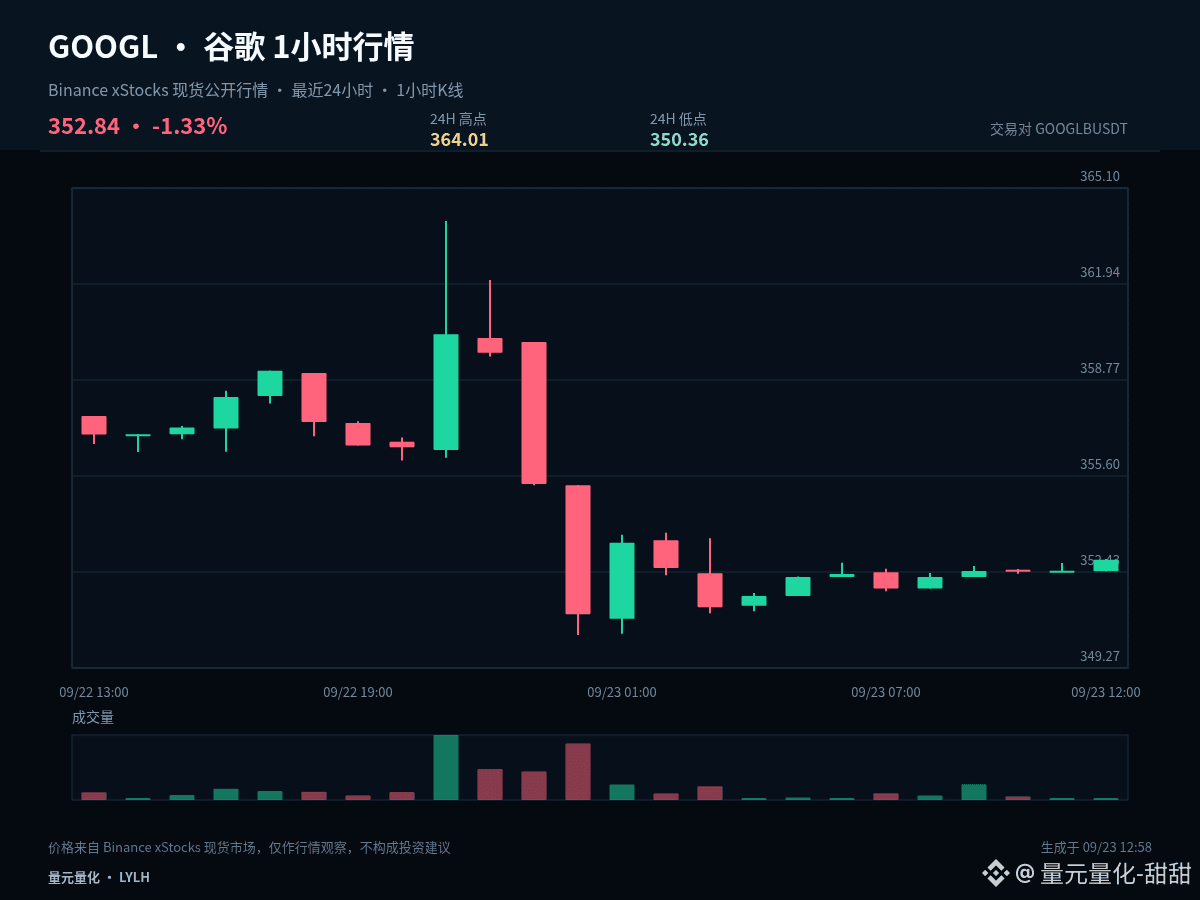
$GOOGLB #GOOGL It is currently more suitable to first do a rebound confirmation rather than defining a reversal in advance. Current price is 352.84; 1 hour: +0.10%, 24 hours: -1.30%. Whether the two cycles align again in the same direction will be the focus going forward.
At present, 1 hour is +0.10% and 24 hours is -1.30%, but the two cycles have not formed a sufficiently clear same-direction alignment. In a range-bound market, the tolerance for chasing highs and selling lows is low. It is better to confirm the direction using the upper band, confirm support using the lower band, and use the midline only as the strong/weak boundary.
If the rebound can reclaim 357.185 and further hold above 364.01, it indicates that buyer sentiment is starting to change from the prior weakness. If price rises to the midline and then falls back again—especially if it drops back toward 350.36—it is more like a failed repair and should not continue to rely on a strengthening expectation.
Even if the rebound fails, evidence is required. Do not immediately chase a short just because there was one spike and then a pullback. A more reasonable sequence is to observe whether the resistance zone is rejected, whether the lows move down again, and then decide actions based on whether subsequent rebounds reclaim key levels.
Existing positions can be handled in segments according to key levels to avoid making an all-at-once decision. Those with no position should wait for confirmation of a breakout or for pullback stabilization. For US market instruments, also watch for volatility caused by trading session transitions; the plan should be based on price conditions, and emotions should not replace execution.
The key for short-term positions is not to predict every individual candlestick. Instead, ensure that entries, partial reductions, and exits have a basis. If there is no confirmation, do less. If key levels fail, redo the plan—first control single-trade risk, then talk about potential upside/downside space.
#BNBMarketCapPassesBNYMellon
At present, 1 hour is +0.10% and 24 hours is -1.30%, but the two cycles have not formed a sufficiently clear same-direction alignment. In a range-bound market, the tolerance for chasing highs and selling lows is low. It is better to confirm the direction using the upper band, confirm support using the lower band, and use the midline only as the strong/weak boundary.
If the rebound can reclaim 357.185 and further hold above 364.01, it indicates that buyer sentiment is starting to change from the prior weakness. If price rises to the midline and then falls back again—especially if it drops back toward 350.36—it is more like a failed repair and should not continue to rely on a strengthening expectation.
Even if the rebound fails, evidence is required. Do not immediately chase a short just because there was one spike and then a pullback. A more reasonable sequence is to observe whether the resistance zone is rejected, whether the lows move down again, and then decide actions based on whether subsequent rebounds reclaim key levels.
Existing positions can be handled in segments according to key levels to avoid making an all-at-once decision. Those with no position should wait for confirmation of a breakout or for pullback stabilization. For US market instruments, also watch for volatility caused by trading session transitions; the plan should be based on price conditions, and emotions should not replace execution.
The key for short-term positions is not to predict every individual candlestick. Instead, ensure that entries, partial reductions, and exits have a basis. If there is no confirmation, do less. If key levels fail, redo the plan—first control single-trade risk, then talk about potential upside/downside space.
#BNBMarketCapPassesBNYMellon