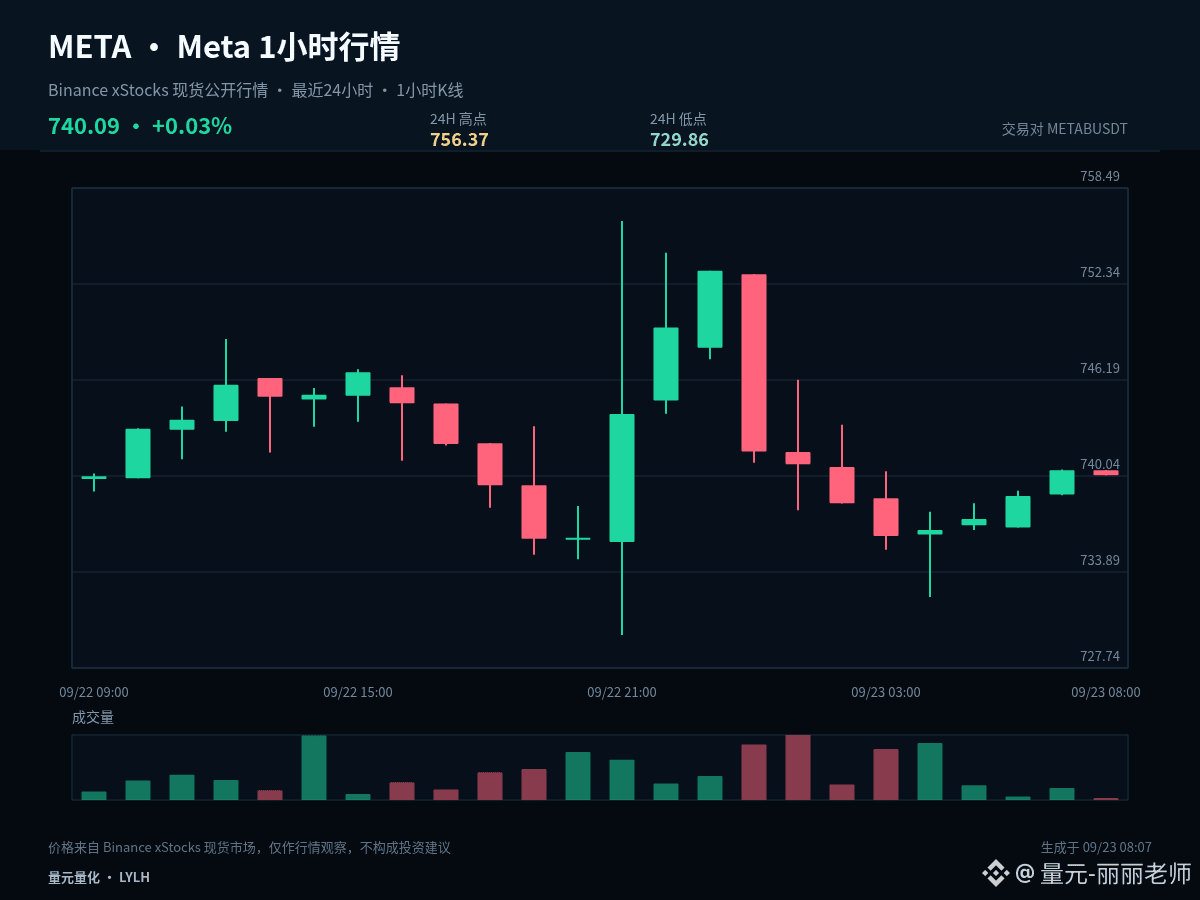
$METAB #META Drawdowns in a strong trend are often more revealing of the true order flow than a sudden acceleration rally. The current 1-hour change is -0.04%, and the 24-hour change is +0.10%. We need to judge whether this is a normal cooling-off or a structural weakening.
The current 1-hour -0.04% and 24-hour +0.10% show that the two timeframes have not formed sufficiently clear alignment in the same direction. In a range-bound market, the tolerance for chasing and killing trades is lower. It is more suitable to confirm direction with the upper boundary and confirm support with the lower boundary, while the midline should only be used as the line separating strength from weakness.
The 1-hour timeframe has already seen a pullback. First, check whether 729.86 forms stable support. If price can quickly reclaim 743.115, it indicates the pullback is still controllable. If the rebound lacks strength and the low continues to move lower, then you cannot keep using the strong-trend logic.
There are three ways forward: If upward movement is valid and holds above 756.37, wait for a pullback that doesn’t break before reassessing the continuation. If price breaks down through 729.86, prioritize risk control and wait for new support. If it continues to consolidate around 743.115, treat it as range turnover and do not repeatedly chase direction from the middle position.
For existing positions, you can handle them in segments according to key levels to avoid making all decisions at once. For those with no position, wait for confirmation of a breakout or a pullback that stabilizes. For US stock-related assets, also pay attention to volatility caused by trading session switches—your plan should be based on price conditions, not emotions driving execution.
Risk control still comes before any conclusion: execute only when conditions appear, and reassess immediately if the price invalidates the thesis. The higher the volatility, the more restrained each single position should be. The above is an outlook based on the current 1-hour and 24-hour data from the order book; it does not constitute a guarantee of returns.
#TokenizedStockPlatformsCouldLaunchNextQuarter
The current 1-hour -0.04% and 24-hour +0.10% show that the two timeframes have not formed sufficiently clear alignment in the same direction. In a range-bound market, the tolerance for chasing and killing trades is lower. It is more suitable to confirm direction with the upper boundary and confirm support with the lower boundary, while the midline should only be used as the line separating strength from weakness.
The 1-hour timeframe has already seen a pullback. First, check whether 729.86 forms stable support. If price can quickly reclaim 743.115, it indicates the pullback is still controllable. If the rebound lacks strength and the low continues to move lower, then you cannot keep using the strong-trend logic.
There are three ways forward: If upward movement is valid and holds above 756.37, wait for a pullback that doesn’t break before reassessing the continuation. If price breaks down through 729.86, prioritize risk control and wait for new support. If it continues to consolidate around 743.115, treat it as range turnover and do not repeatedly chase direction from the middle position.
For existing positions, you can handle them in segments according to key levels to avoid making all decisions at once. For those with no position, wait for confirmation of a breakout or a pullback that stabilizes. For US stock-related assets, also pay attention to volatility caused by trading session switches—your plan should be based on price conditions, not emotions driving execution.
Risk control still comes before any conclusion: execute only when conditions appear, and reassess immediately if the price invalidates the thesis. The higher the volatility, the more restrained each single position should be. The above is an outlook based on the current 1-hour and 24-hour data from the order book; it does not constitute a guarantee of returns.
#TokenizedStockPlatformsCouldLaunchNextQuarter