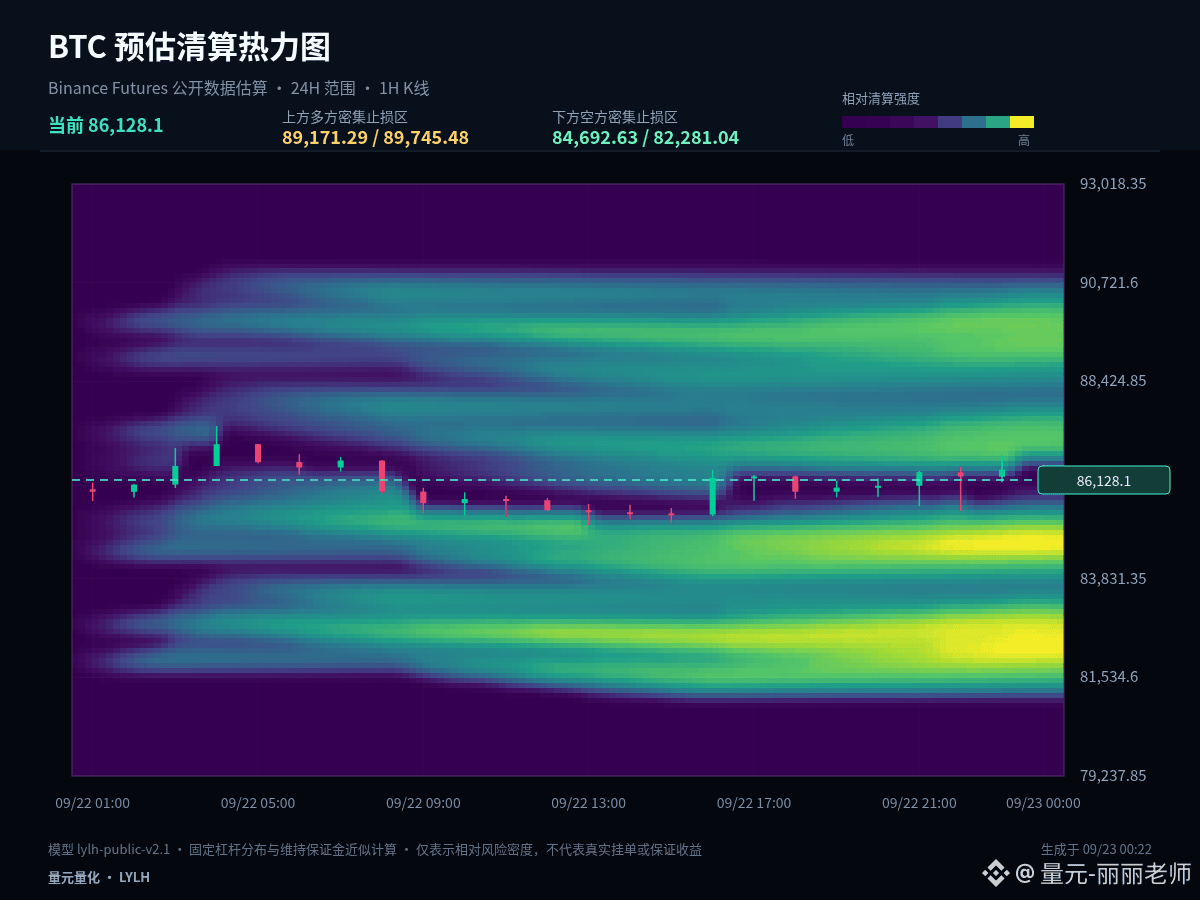
$BTC #BTC Drawdowns in a strong market are often more revealing of true absorption than a rapid acceleration rally. Current 1-hour: -0.28%, 24-hour: +0.36%. We need to judge whether this is normal cooling off or a structural weakening.
Current 1-hour: -0.28%, 24-hour: +0.36%—the two timeframes have not yet formed a sufficiently clear alignment in the same direction. In a range-bound market, the margin for error when chasing or selling is low. It’s more suitable to confirm direction using the upper boundary and confirm absorption using the lower boundary, while the midline is only used as the line between strength and weakness.
The 1-hour timeframe has already shown a pullback. First, watch whether 85,114 can form stable absorption. If the price can quickly reclaim 86,254.84, it suggests the pullback is still controllable. If the rebound lacks strength and the low continues to move lower, then you can no longer use the strong-market logic.
There are three ways to handle the next path: If price effectively holds above 87,395.67, wait to see whether the subsequent pullback holds before assessing continuation. If it breaks down below 85,114, prioritize risk control and wait for new support. If it continues to oscillate around 86,254.84, treat it as range rotation and don’t repeatedly chase direction from the middle.
For those already holding positions, the key is to manage based on whether support is invalidated—not to be carried along by every fluctuation. For those with no position, prioritize waiting for a breakout with a pullback or for support confirmation. Spot positions can be built in batches; for derivatives, shorten the decision chain: first determine the stop-loss level, then decide whether to participate.
Risk control still comes before the conclusion: execute only when conditions are met, and if the price fails, reassess promptly. The greater the volatility, the more restrained you must be with each position size. The above is a scenario walkthrough based on the current 1-hour and 24-hour data and does not constitute any promise of returns.
#TokenizedStockPlatformsCouldLaunchNextQuarter
Current 1-hour: -0.28%, 24-hour: +0.36%—the two timeframes have not yet formed a sufficiently clear alignment in the same direction. In a range-bound market, the margin for error when chasing or selling is low. It’s more suitable to confirm direction using the upper boundary and confirm absorption using the lower boundary, while the midline is only used as the line between strength and weakness.
The 1-hour timeframe has already shown a pullback. First, watch whether 85,114 can form stable absorption. If the price can quickly reclaim 86,254.84, it suggests the pullback is still controllable. If the rebound lacks strength and the low continues to move lower, then you can no longer use the strong-market logic.
There are three ways to handle the next path: If price effectively holds above 87,395.67, wait to see whether the subsequent pullback holds before assessing continuation. If it breaks down below 85,114, prioritize risk control and wait for new support. If it continues to oscillate around 86,254.84, treat it as range rotation and don’t repeatedly chase direction from the middle.
For those already holding positions, the key is to manage based on whether support is invalidated—not to be carried along by every fluctuation. For those with no position, prioritize waiting for a breakout with a pullback or for support confirmation. Spot positions can be built in batches; for derivatives, shorten the decision chain: first determine the stop-loss level, then decide whether to participate.
Risk control still comes before the conclusion: execute only when conditions are met, and if the price fails, reassess promptly. The greater the volatility, the more restrained you must be with each position size. The above is a scenario walkthrough based on the current 1-hour and 24-hour data and does not constitute any promise of returns.
#TokenizedStockPlatformsCouldLaunchNextQuarter