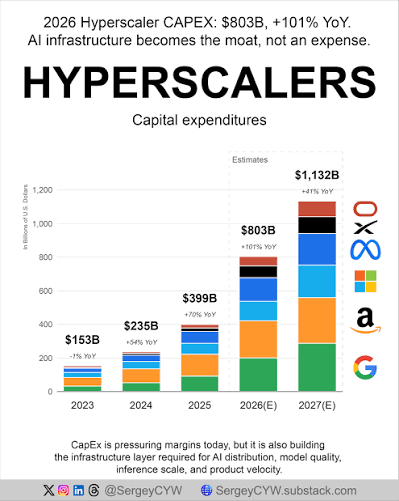

Nvidia announces a doubling of chip sales expected next year. The hyperscalers (Microsoft, Google, Amazon, Meta) publish record revenues quarter after quarter, while also announcing capex figures on computing that are ever more dizzying—sometimes several tens of billions of dollars per quarter just for AI infrastructure. The question that divides investors: is this a genuine structural break in demand, or an investment cycle that far outstrips real monetization?
The bullish thesis is based on the idea that enterprise adoption of generative AI is only at its beginnings, that productivity gains will gradually justify today’s spending, and that political support—such as talk of a U.S. “AI Force” and projections framing AI as a growing share of GDP—could extend the cycle by several years.
The bearish thesis points to stretched valuations, an extreme concentration of the market in a handful of stocks, and the fact that some sector leaders themselves are calling for slowing down development—potentially a sign that even insiders doubt the current pace. A prolonged mismatch between massive capex and real returns on investment could trigger a severe correction.
Beyond the already-known AI mega-caps, several angles deserve to be monitored: energy and electrical infrastructure providers, because training and inference consume considerable amounts of electricity; semiconductor equipment makers upstream of Nvidia (lithography, advanced packaging); cybersecurity, driven by the growing attack surface associated with AI; and “adopting” companies that integrate AI to gain operational efficiency rather than those that sell AI directly.