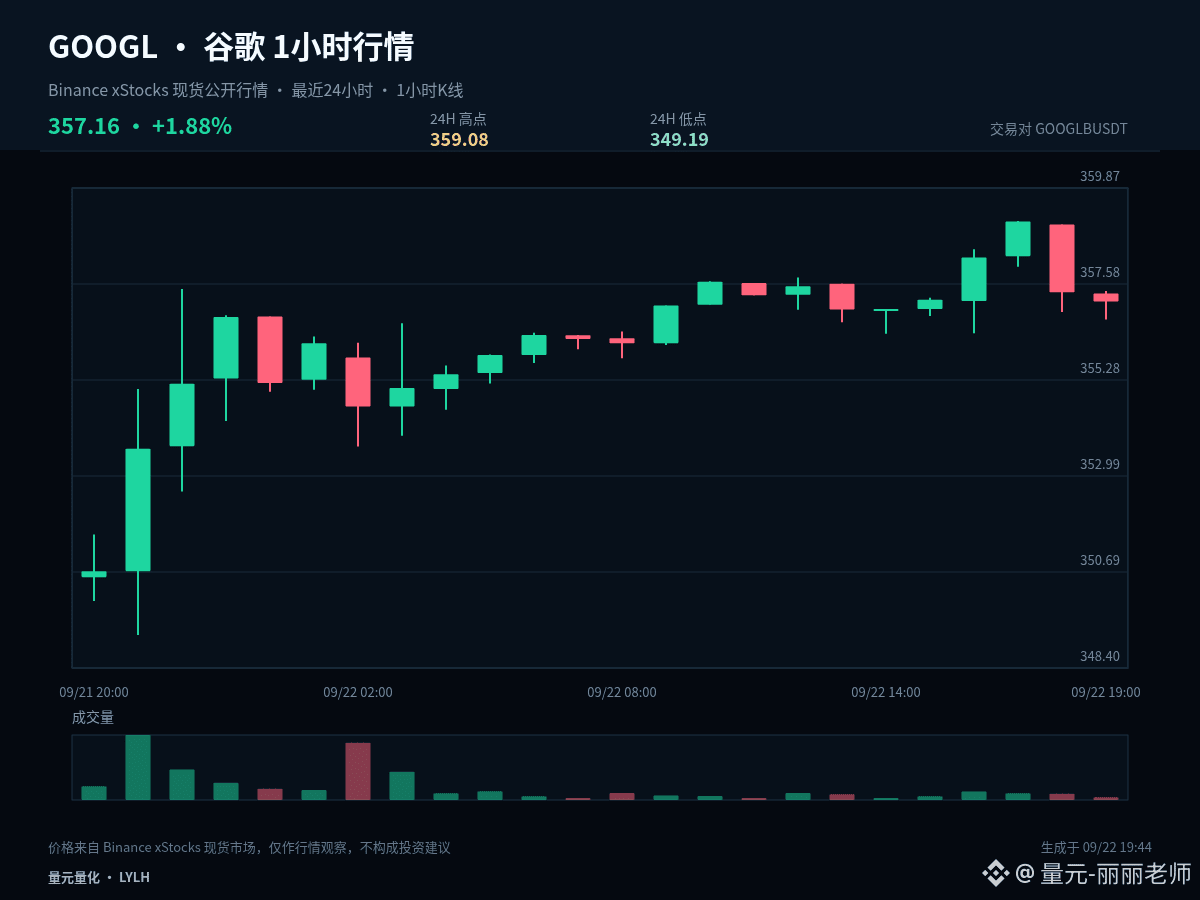
$GOOGLB #GOOGL Can this market move continue? It doesn’t depend on how much it has already risen beforehand—it depends on whether the trend can complete the sequence of “advance, consolidation, and then re-confirmation.” Current 1-hour: -0.06%, 24-hour: +1.85%.
At present, the 1-hour (-0.06%) and 24-hour (+1.85%) periods have not formed enough clear same-direction coordination. In a range-bound market, the tolerance for chasing breakouts or cutting at the wrong time is low. It’s more suitable to confirm the direction using the upper boundary, confirm the hold using the lower boundary, and treat the midline only as a line that separates strength and weakness.
The first condition for a continued structure is that 354.135 is not broken down effectively. The second condition is that the price can re-test and regain stability above 359.08. If, after the advance, the market stays below the midline for a long time, it indicates the proactive buying pressure has weakened. If it further loses 349.19, the original continuation assumption needs to be cancelled.
My scenario analysis isn’t betting on a single direction. If the price breaks above 359.08 and holds, it means upside room has been reopened. If it breaks below 349.19 but fails to reclaim afterward, the structure is further weakening. If it moves between the two, continue observing the closing positions on both sides of 354.135.
Position management should distinguish between the swing/medium-term and the short-term. For existing swing positions, first check whether the structure is broken; don’t let repeated signals from a single 1-hour candlestick constantly influence you. For short-term positions, execute decisions around support, resistance, and confirmation from closes. Those who are currently in cash don’t need to chase price in the middle of the range—waiting for a clearer location usually offers an advantage.
The focus of short-term positioning is not to predict every single K-line, but to ensure there is a rationale for entry, trimming, and exiting. Do less when there is no confirmation. When key levels fail, redo the plan—control single-trade risk first, then talk about potential space.
#StrategyAdds950Bitcoin
At present, the 1-hour (-0.06%) and 24-hour (+1.85%) periods have not formed enough clear same-direction coordination. In a range-bound market, the tolerance for chasing breakouts or cutting at the wrong time is low. It’s more suitable to confirm the direction using the upper boundary, confirm the hold using the lower boundary, and treat the midline only as a line that separates strength and weakness.
The first condition for a continued structure is that 354.135 is not broken down effectively. The second condition is that the price can re-test and regain stability above 359.08. If, after the advance, the market stays below the midline for a long time, it indicates the proactive buying pressure has weakened. If it further loses 349.19, the original continuation assumption needs to be cancelled.
My scenario analysis isn’t betting on a single direction. If the price breaks above 359.08 and holds, it means upside room has been reopened. If it breaks below 349.19 but fails to reclaim afterward, the structure is further weakening. If it moves between the two, continue observing the closing positions on both sides of 354.135.
Position management should distinguish between the swing/medium-term and the short-term. For existing swing positions, first check whether the structure is broken; don’t let repeated signals from a single 1-hour candlestick constantly influence you. For short-term positions, execute decisions around support, resistance, and confirmation from closes. Those who are currently in cash don’t need to chase price in the middle of the range—waiting for a clearer location usually offers an advantage.
The focus of short-term positioning is not to predict every single K-line, but to ensure there is a rationale for entry, trimming, and exiting. Do less when there is no confirmation. When key levels fail, redo the plan—control single-trade risk first, then talk about potential space.
#StrategyAdds950Bitcoin