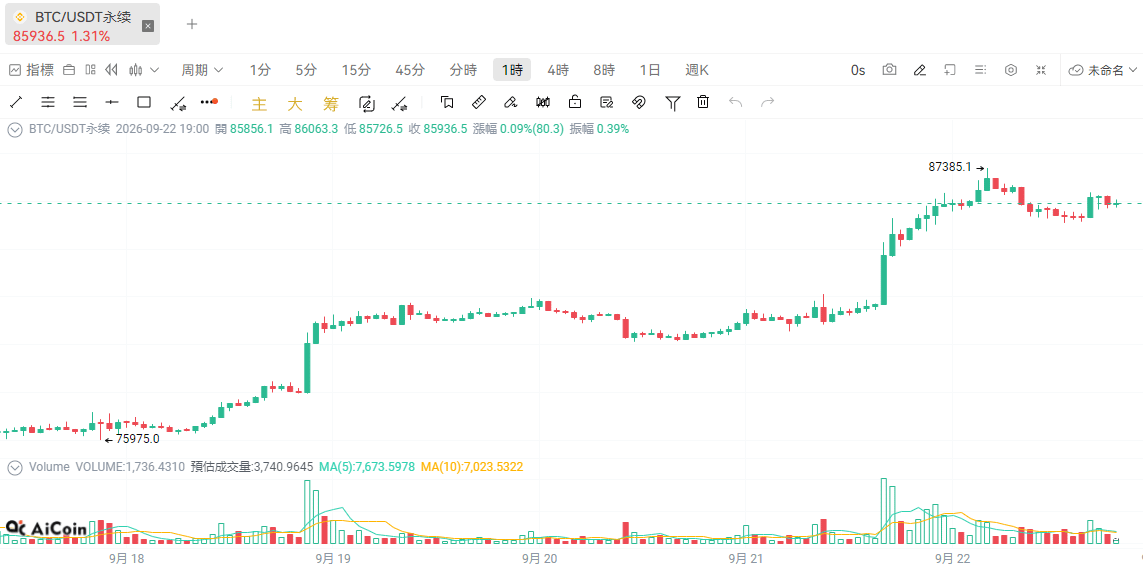
After a rebound from last week’s low of around $75K–$76K, BTC rose to as high as $87.3K yesterday. The single-day gain was nearly 7%, reaching the highest level since late January this year.
This sudden surge is by no means driven by a single positive catalyst. What exactly happened in the market over just a few days?
1. A bearish development landed, but the $75K level was successfully held
Last week, multiple bearish developments came to fruition:
On September 15, the CLARITY Act could not advance in a procedural vote in the Senate;
On September 16, the US Federal Reserve raised rates by 25 basis points;
On September 18, the Bank of Japan also raised rates by 25 basis points.
In theory, the regulatory bill being stalled—combined with the major central banks raising interest rates one after another—should put pressure on BTC’s risk appetite. However, the related outcomes are basically in line with market expectations, and some bearish factors have already been priced in by the market.
Although BTC briefly fell to around $75K at the time, it did not break down further. Instead, it regained stability and gradually bounced back. Market expectations for the outlook naturally started to shift again, which also became an important foundation for this rebound.
2. Geopolitical tension expectations cool off; oil prices fall
After negative news was gradually absorbed, the macro environment also started to change. Recently, expectations for U.S.-Iran diplomatic contact warmed up, and with part of Saudi Arabia’s oil exports gradually resuming, some geopolitical and supply-risk premium that had been embedded in oil prices began to decline.
On September 21, Brent crude dropped by about 3.4% to $100.34 per barrel, and WTI fell even more by 4.5% to $95.78 per barrel, marking a fourth consecutive day of declines.
Oil prices falling is not only about lower energy costs; more importantly, market expectations for inflation pressure have eased, which in turn reduces upward pressure on interest rates and bond yields, improving overall risk appetite.
And as BTC is a high-volatility risk asset, it naturally benefits when overall risk appetite rises.
3. Spot demand rebounds; capital returns to the market
On September 18, U.S. spot BTC ETFs recorded approximately $433M in net inflows, which was among the stronger single-day inflows recently, and it also caused the ETF fund flows for the entire trading week to turn back to a slight net inflow. After earlier outflows, the market began to show more obvious spot absorption.
In addition, the latest Strategy disclosure shows that the company bought 950 BTC between September 14 and 20, totaling about $75.7M, with an average price of about $79,670, bringing total holdings up to 846,000 BTC.
This actual increase in holdings shows that even after BTC has risen to relatively high levels, large companies are still willing to continue allocating to BTC, reflecting that long-term demand at the corporate level has not disappeared entirely.
With the macro environment improving, alongside ETF fund returning and ongoing corporate accumulation, market confidence in spot demand has also increased.
4. Technical breakout ignites further amplification of short liquidations
After negative catalysts are gradually digested, the macro environment improves, and spot demand begins to recover, the BTC price structure itself also starts to strengthen.
The $80K level, which had been repeatedly tested by the market, gradually shifted from being a major resistance to becoming support. After the breakout was confirmed, technical buy orders began to enter, trend traders followed suit, and some sidelined capital was reallocated as well, pushing BTC further to break through key levels such as $82K and $85K.
Once the price breaks through a key resistance level, the short-squeeze effect also begins to emerge.
Short positions that had been betting on a BTC pullback triggered stop-losses and forced liquidations one after another; and once the shorts were liquidated, they would turn into passive buying pressure, further pushing up the price.
On September 21, the entire crypto market saw the liquidation of short positions worth hundreds of millions of dollars, with the BTC short liquidation amount at approximately $557M.
Therefore, improved spot demand provides underlying support. The $80K breakout triggers technical buying, while short-squeeze dynamics further amplify the upward move. It shows that this round of market action is driven jointly by the macro environment, spot demand, technical breakouts, and leverage unwind/liquidations. As long as no major negative catalyst appears next, ETF flows do not show a clear weakening, and overall market risk appetite does not reverse, this upward momentum still has a chance to last for some time.
In the short term, you can first watch for pullbacks and support/resumption around the $84K–$85K area; if the decline extends further, then observe whether $82K–$83K can hold.
*The above is for personal market observations only and does not constitute investment advice.
#Strategy增持950枚BTC #比特币现货ETF净流入9.99亿美元