📰 Overseas AI capex may be slowing down, but this time the impact won’t spread to China’s market all at once.
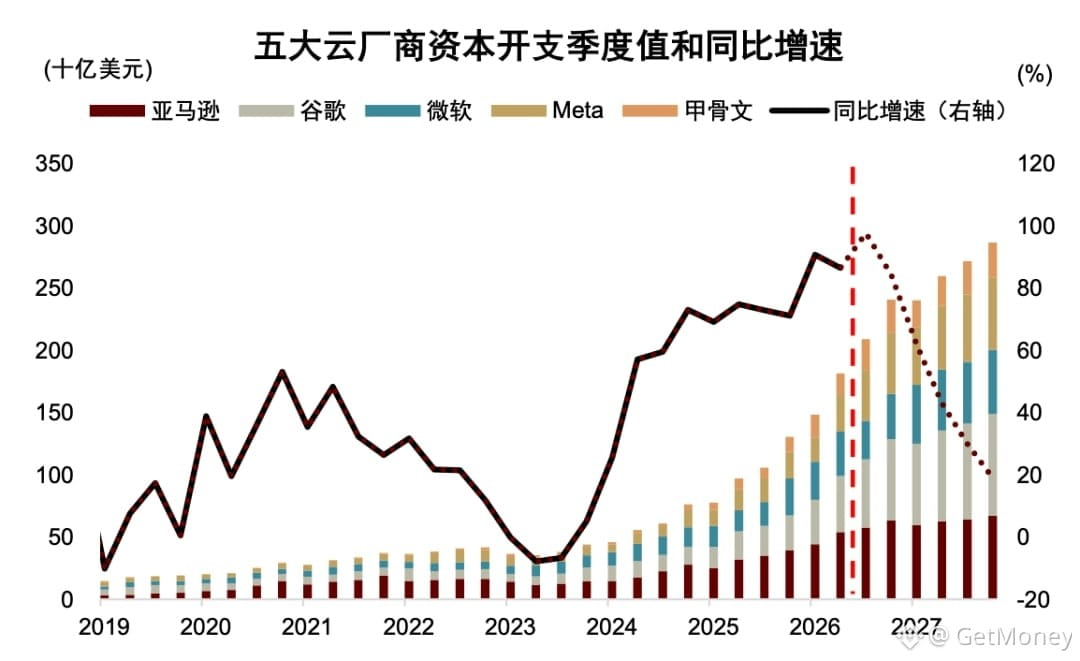
In Q2 2026, the capital expenditures of five cloud providers—Amazon, Alphabet, Microsoft, Meta, and Oracle—grew year over year by 86.5%, and expansion is still ongoing. However, according to market expectations, the year-over-year growth rate of AI-related cloud capex at major cloud providers may drop from 89.9% in 2026 to 38.6% in 2027.
🔥 Honestly, a slowdown doesn’t necessarily mean demand suddenly disappears. More often, it’s that financing costs, data center power and water usage, land permitting, and AI safety governance constraints are becoming more pronounced. Compute power and servers were deployed very quickly earlier, and enterprises now need to recalculate their investment returns.
💡 For China’s economy, the export channels will feel it first. Overseas AI capex generally leads China’s exports of AI-chain products by about one quarter. For every additional 10 percentage points in overseas AI capex year-over-year, China’s exports of AI-chain products rise by roughly 2.8 percentage points. Based on current forecasts, the related export growth rate in 2027 may still be positive, but the marginal boost may decline by about 10 percentage points.
👀 On the investment side, the slowdown may not be felt as quickly. Overseas AI capex leads domestic investment in the AI industrial chain by about a year, with a transmission coefficient of around 0.49. That means that in 2026, expansion and equipment investment driven by overseas orders may continue to support 2027. The more noticeable pressure may only become evident in 2028.
🤔 Of course, if domestic cloud providers, compute infrastructure, and homegrown substitution investments continue to expand, they could also offset some of the external slowdown. In this AI investment slowdown cycle, do you think the first area to be affected will be exports, or the expansion plans of companies in the industrial chain?
#AI产业链 #算力 #中国出口 #Macroeconomics
In Q2 2026, the capital expenditures of five cloud providers—Amazon, Alphabet, Microsoft, Meta, and Oracle—grew year over year by 86.5%, and expansion is still ongoing. However, according to market expectations, the year-over-year growth rate of AI-related cloud capex at major cloud providers may drop from 89.9% in 2026 to 38.6% in 2027.
🔥 Honestly, a slowdown doesn’t necessarily mean demand suddenly disappears. More often, it’s that financing costs, data center power and water usage, land permitting, and AI safety governance constraints are becoming more pronounced. Compute power and servers were deployed very quickly earlier, and enterprises now need to recalculate their investment returns.
💡 For China’s economy, the export channels will feel it first. Overseas AI capex generally leads China’s exports of AI-chain products by about one quarter. For every additional 10 percentage points in overseas AI capex year-over-year, China’s exports of AI-chain products rise by roughly 2.8 percentage points. Based on current forecasts, the related export growth rate in 2027 may still be positive, but the marginal boost may decline by about 10 percentage points.
👀 On the investment side, the slowdown may not be felt as quickly. Overseas AI capex leads domestic investment in the AI industrial chain by about a year, with a transmission coefficient of around 0.49. That means that in 2026, expansion and equipment investment driven by overseas orders may continue to support 2027. The more noticeable pressure may only become evident in 2028.
🤔 Of course, if domestic cloud providers, compute infrastructure, and homegrown substitution investments continue to expand, they could also offset some of the external slowdown. In this AI investment slowdown cycle, do you think the first area to be affected will be exports, or the expansion plans of companies in the industrial chain?
#AI产业链 #算力 #中国出口 #Macroeconomics