


AI is entering a phase where the story is no longer just about language models or chatbots.
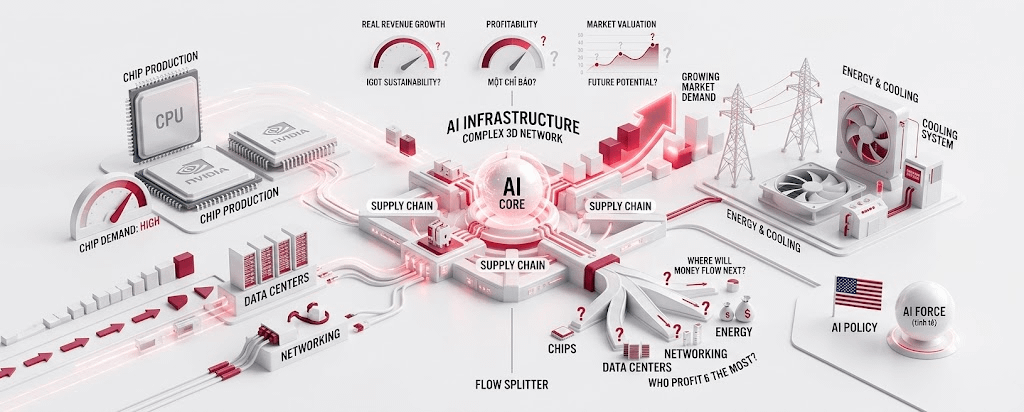
Behind the development of AI is an entire massive infrastructure chain consisting of GPUs, CPUs, networking, data centers, memory, power, and cooling systems.
It is noteworthy that the demand for the entire ecosystem is still increasing as large technology companies continue to expand their computing capacity.
Nvidia is one of the clearest names that reflects this trend.
CEO Jensen Huang said he expects Nvidia’s chip sales to double next year, showing that expectations for AI computing demand are still very high.
But this is also exactly the point that makes me start questioning the next phase.
When AI revenue and demand surged, the stock price had already reflected a very large portion of future expectations.
Therefore, the key question is no longer simply “Will AI keep growing?”
It’s this:
Is the actual growth rate fast enough to keep up with the current valuations?
If companies continue to grow revenue, profits, and strong cash flow, the upward trend of AI stocks has grounds to continue.
Conversely, if the growth rate starts to slow while market expectations remain too high, this stock group could become more sensitive to small changes in business results.
I also noticed that AI cash flow is spreading beyond the chip manufacturing group.
Data centers need more electricity.
Rising networking demand.
Growing demand for storage and memory.
Companies building AI infrastructure also need substantial capital investment.
That creates a broader chain of beneficiaries, but at the same time makes it more important to evaluate each company.
Not every company tagged with the word “AI” has the same growth rate or profit-making ability.
Another point the market is interested in is the US’s policy toward AI.
Donald Trump recently talked about plans to build an “AI Force” and said AI could contribute up to 25% of the US GDP in the future.
This is a direction and political assessment that has been put forward, not a confirmed GDP figure.
However, it shows that AI is increasingly becoming a policy-level priority.
This could create additional momentum for investing in AI infrastructure, but I still believe investors need to separate the policy narrative from each company’s real business results.
Personal view:
I still lean toward AI’s long-term prospects, but I don’t think the simple strategy is to buy whenever AI stocks are going up.
In the current stage, I will focus on three factors more than anything else.
First, whether actual AI revenue can continue to grow strongly.
Second, whether the business can turn that revenue growth into profits and cash flow.
Third, how much of the future growth has already been reflected in the current valuation.
If all three factors are sustained, the upward trend can continue to have a foundation.
But if prices rise faster than improvements in business results, adjustment risk will also increase.
So for me, the current AI story isn’t about whether “AI will keep growing” or not.
The more relevant question is:
Among the many companies benefiting from AI, who is actually generating revenue and profit from this wave?
And if AI keeps growing over the next few years, will the next wave of cash flow go to chips, data centers, networking, energy, or another link in the supply chain?