


🚨 🚨 CRYPTO OF THE DAY: PYTH NETWORK (PYTH) 🔥
Today, I’m keeping Pyth Network (PYTH). And this time, the choice isn’t based solely on the token price.
My reasoning remains the same:
UTILITY → ADOPTION → TECHNOLOGY → VALUE CAPTURE → POTENTIAL
PYTH addresses a fundamental issue in on-chain finance: how to quickly bring reliable market data to blockchains?
💰 Price and availability
PYTH recently traded around $0.06, far below our $50 cap. CoinGecko, for instance, shows a PYTH/USDT market on Binance.
---
🧠 Why is Pyth interesting?
Imagine a DeFi app that wants to know in real time:
the price of Bitcoin ;
the price of a stock ;
the price of gold ;
the EUR/USD exchange rate ;
the price of an ETF ;
or other financial assets.
A blockchain can’t simply go fetch this information from the Internet.
It needs an infrastructure called an oracle.
That is precisely the role of Pyth.
The network retrieves data coming in particular from market participants and distributes it to blockchain applications. Its architecture is especially data-oriented for low-latency financial data.
---
🏦 Pyth wants to become a data infrastructure for finance
That’s where the story gets interesting.
Pyth now says it has more than 138 participating institutions in its data network. Its Pyth Pro offering listed in July 2026 around 3,501 feeds, including 1,901 related to equities.
And it’s not just crypto.
Pyth is working on data concerning, among other things:
Crypto → Stocks → Forex → Commodities → ETFs → Traditional Finance
This directly corresponds to one of the current market trends.
Binance Research indicates that tokenized assets are currently in an activation phase: the RWA market reached approximately $34.18 billion in AUM as of September 15, 2026.
The more traditional assets come on-chain, the more blockchains need reliable financial data.
That’s where Pyth is trying to position itself.
---
⚡ A major change in 2026
Pyth isn’t standing still.
The network completed a major upgrade of Pyth Core on August 26, 2026, including in particular:
more frequent updates ;
more price feeds ;
reduced latency.
Pyth is also evolving its infrastructure around Pyth Lazer, Pyth Pro, and the Data Marketplace, while Pythnet must be gradually retired.
---
💰 And above all: value capture
This is probably the most important part of this analysis.
A protocol can be used extremely widely without its token necessarily benefiting from it.
Pyth is precisely trying to evolve its business model.
According to Pyth, revenues generated by its products feed into a reserve that makes PYTH purchases in the market. The project states that the reserve had already bought around 12 million PYTH with real revenues at the time it published its economic model.
👉 So this is something to watch:
Network usage → revenues → reserve → PYTH purchases
But that absolutely does not mean the token price has to rise.
---
⚠️ The big problem to watch
You shouldn’t fall into the trap:
> “Pyth is being used → so PYTH will inevitably explode.”
No.
The real question is whether the network’s growth creates economic demand that is large enough for the token.
You should also watch for:
competition from Chainlink and other oracles ;
PYTH emissions and distribution ;
sell-side pressure ;
the real growth in revenues ;
the use of the feeds ;
real institutional adoption rather than just announcements.
---
📊 The 3 scenarios
🟢 Bullish scenario
Tokenized assets continue to grow, Pyth is increasing its presence in traditional finance, and its revenues are rising.
In that case, the economic demand around the ecosystem could become an important thing to watch.
🟡 Neutral scenario
The network continues to grow, but token growth remains limited because value capture is still insufficient.
🔴 Bearish scenario
Adoption is slowing down, competition is gaining ground, or emissions create too much pressure on the market.
---
🎯 Why PYTH today?
There is currently a particularly interesting context for this kind of infrastructure.
On September 22, 2026, the SEC’s five-year exemption framework for certain tokenized equity trading projects begins to take effect.
And at the same time, the European Central Bank has just launched Pontes, an infrastructure that connects its payment system to financial markets based on blockchain. Deutsche Bank, Santander, and Clearstream are among the first participants.
In other words:
TradFi → Tokenization → Blockchain → Financial Data
This is exactly the sector in which Pyth is trying to build its infrastructure.
---
🧨 MY MAIN POINT OF CONCERN
PYTH isn’t interesting just because it’s worth a few cents.
$0.06 doesn’t mean the token is “cheap.”
What interests me here is rather the function of the protocol and the possibility that Pyth becomes an important data layer for on-chain finance.
🔥 Watch out for:
Adoption → number of feeds → revenues → real usage → PYTH purchases → tokenomics
It’s this chain that will need to be followed over the coming months.
So PYTH is more of a bet on the blockchain’s financial data infrastructure than a simple bet on a low-priced crypto.
⚠️ This is not financial advice. Cryptocurrencies remain highly volatile and can result in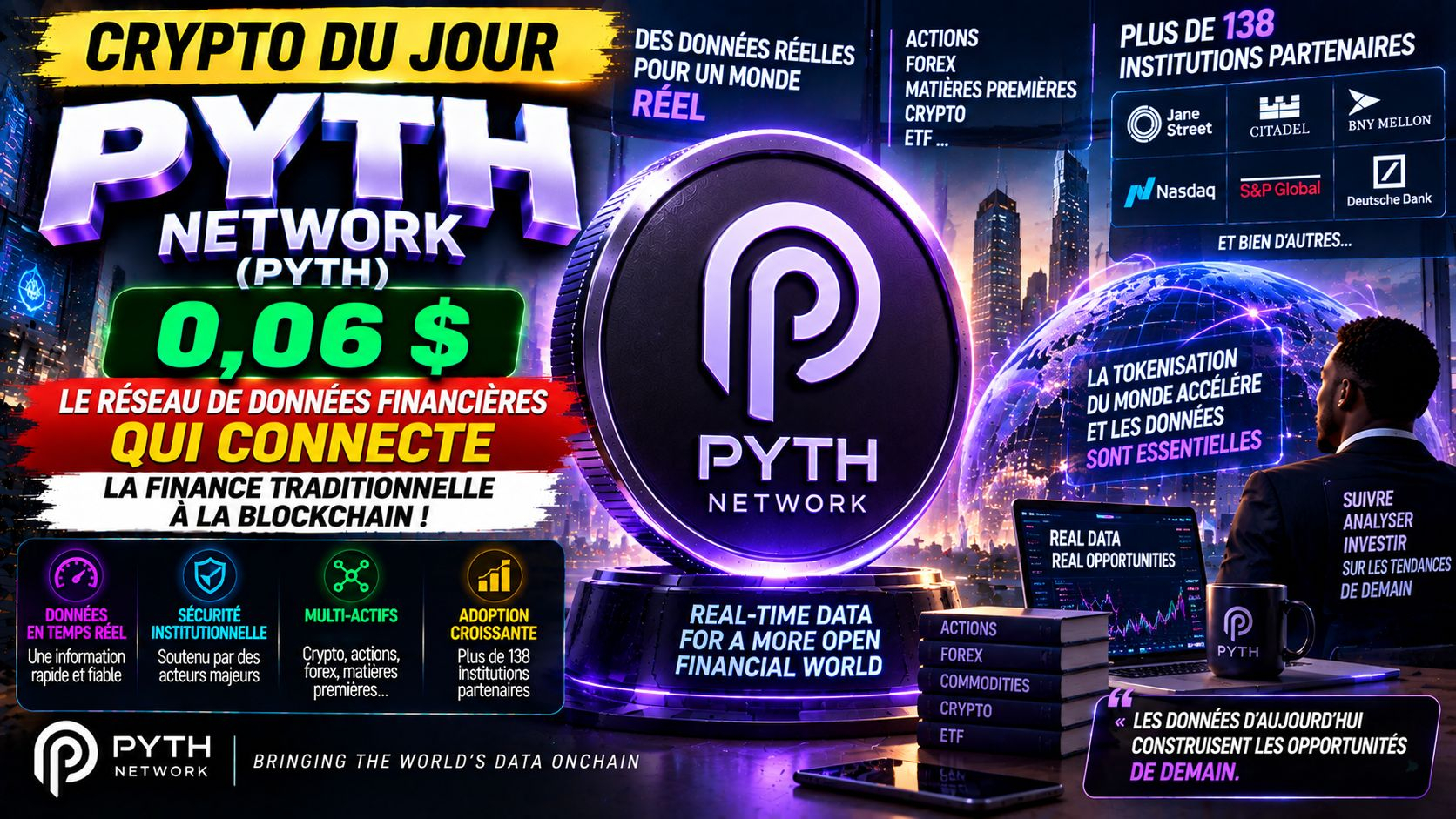 a significant, or even total, loss of capital.
#PYTH #PythNetwork #CryptoDuJour #Binance #Crypto #Blockchain #RWA #Tokenisation #DeFi #Trading #CryptoAfrica #CryptoInvestment