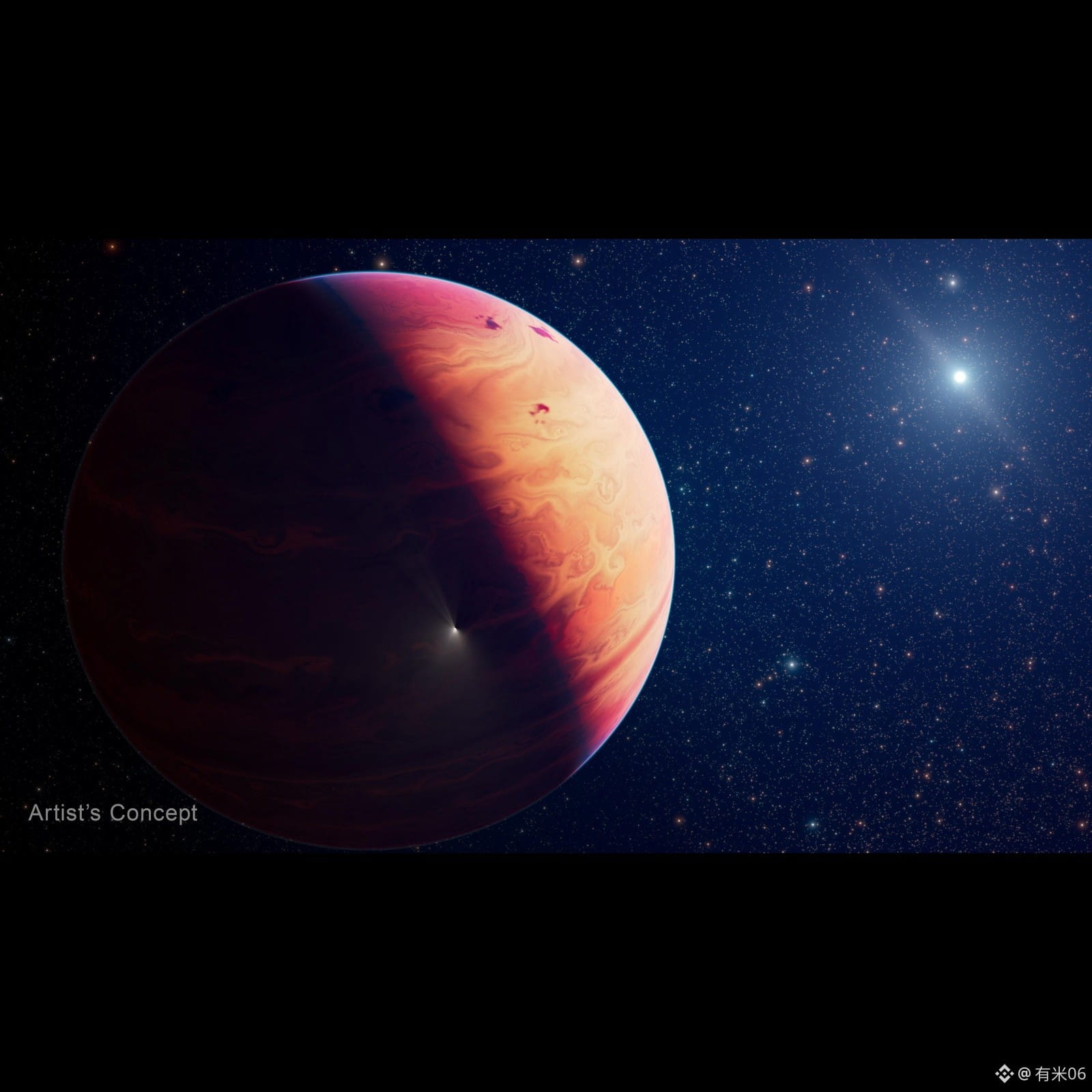
Instant conclusion: 29 Cygni b, with about 15 times Jupiter’s mass, appears more like a planet assembled in a “bottom-up” way than something that “top-down” fragments and collapses like a star.
Based on an ESA/Webb press release weic2607 (2026-04-14) and a related NASA Science story: using Webb’s NIRCam coronagraph mode, the planet-like object near the planet/star boundary is directly imaged. Absorption features from heavy elements in its atmosphere—such as carbon dioxide and carbon monoxide—were detected. Its metal abundance is clearly higher than that of its host star; by a rough mass estimate, the total heavy-element content is about that of 150 Earths. Observations from the ground-based CHARA array also show that its orbit is roughly coplanar with the host star’s rotation. Taken together, this strongly supports the idea that it rapidly accreted metal-rich material in the protoplanetary disk.
Independent verification: The NASA Science / STScI 2026-116 report is consistent with ESA’s description; the paper is published in The Astrophysical Journal Letters.
Image: NASA, ESA, CSA, William Balmer (JHU/STScI), Laurent Pueyo (STScI); image processing by Alyssa Pagan (STScI) — official artistic concept for weic2607a (not a real photograph)
Data as of: ESA/Webb / NASA press release dated 2026-04-14
#JWST #Astronomy