


At the 2026 Hangzhou Yunqi Conference, Alibaba announced a comprehensive upgrade to its AI strategy. It plans to expand the global data center scale to over 20GW by 2032 and train new-generation AI models with 500 billion to 1 trillion parameters. Its subsidiary T-Head released its latest AI chip, Zhenwu V900, delivering three times the compute performance of the previous generation, and allowing a single cluster to scale up to 500,000 cards. Wu Yongming said that the total amount of machine thinking in the future will be more than 1,000 times that of human beings. Shortages in the AI data center supply chain constrain the pace of compute growth, and the supply-demand gap is precisely the core rationale behind Alibaba’s large-scale expansion.
Author and source: Wall Street Insights
Alibaba is betting on artificial intelligence infrastructure with a strategic ambition on the level of the Industrial Revolution.
According to Hard AI, on September 22, at the 2026 Hangzhou Cloud Prunk (Yunqi) Conference, Alibaba Group CEO Wu Yongming issued the clearest signal of AI expansion to date. He positioned machine intelligence as the deepest change to human society after the Industrial Revolution, and anchored a full-stack layout spanning AI models, AI chips, and AI cloud.
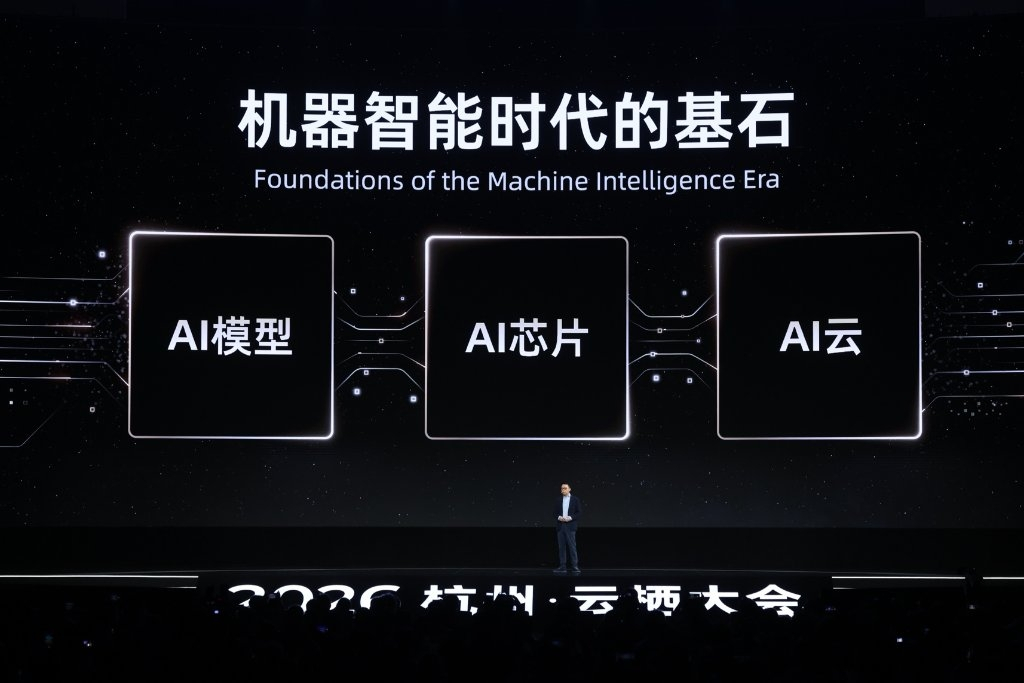
Wu Yongming announced that Alibaba’s goal is to expand the scale of global data centers operated by Alibaba Cloud to more than 20GW by 2032, and also disclosed a plan to train a new generation of AI models with a parameter scale of 5 to 10 trillion.
Meanwhile, its chip division, Pingtouge, released its latest AI chip, Zhenwu V900, on the same day. Computing power is three times higher than the previous-generation M890. A single cluster can be expanded to a scale of 500,000 cards. Alibaba said it expects the annual shipment volume of Pingtouge AI chips will increase significantly.
Wu Yongming judged that in the future, the total amount of machine supply for thinking will reach more than 1,000 times that of humankind. Meanwhile, current mid- to long-term industry demand already far exceeds supply capacity, and the global shortage in supply chains related to AI data centers is constraining the growth rate of computing power. This supply–demand gap is the core basis for Alibaba’s large-scale expansion.
After the news was released, Alibaba’s Hong Kong stock price continued to strengthen, at one point rising more than 4% and hitting a new intramonth high.
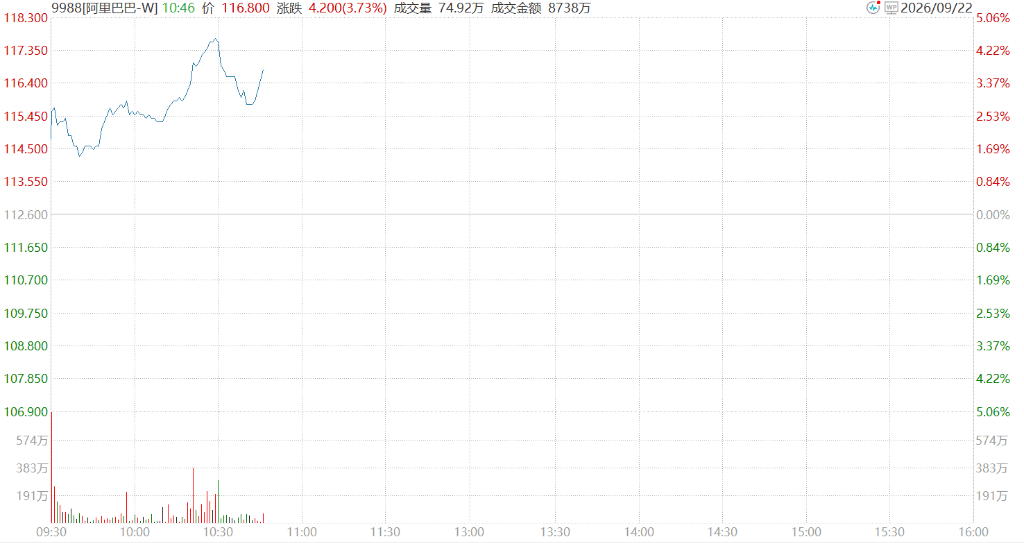
Significant computing power supply–demand gap: set a 20GW data center expansion target
On the commercialization rollout of its cloud business and the order situation, Wu Yongming said the market is currently in a state of supply not meeting demand. He noted that customers’ AI needs are very strong, and Alibaba Cloud is doing everything it can to onboard AI computing power to meet demand, which directly drives Alibaba Cloud’s revenue to keep accelerating.
However, at present, computing power production capacity still faces a bottleneck. Wu Yongming, speaking bluntly, pointed out the state of the supply chain:
We see that the industry’s mid- to long-term demand far exceeds our capacity to supply. At present, there is a global shortage in the supply chain related to AI data centers, which limits the growth rate of our computing power.
Given this huge market imagination space, Alibaba has provided an aggressive infrastructure-building roadmap. Wu Yongming emphasized that Alibaba will steadfastly invest in infrastructure construction represented by AI models, AI chips, and AI cloud.
To build an AI cloud for the era of “machine intelligence,” Alibaba set a long-term goal:
Our goal is for the scale of global data centers operated by Alibaba Cloud to exceed 20GW by 2032, to meet rapidly growing AI demand.
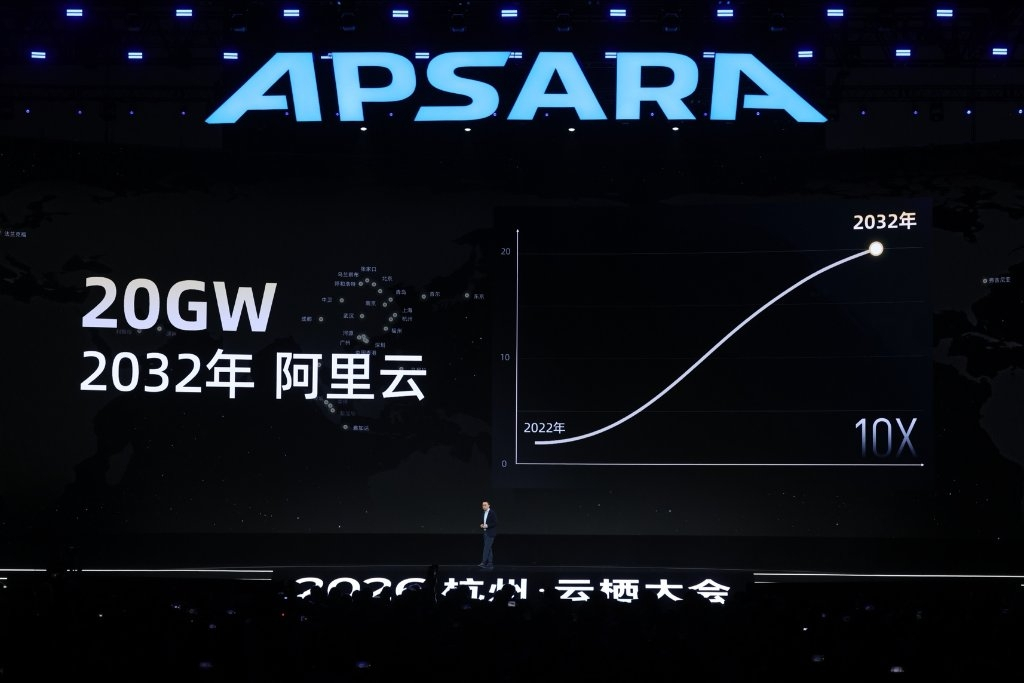
Dual-wheel drive of software and hardware: release the strongest AI chip, develop a 100-trillion-parameter model
As the core link to break the computing power bottleneck, Alibaba’s Pingtouge Wei (Flat-Head Ge) has laid out a clear iteration path and shipment expectations for the underlying hardware.
That day, Pingtouge officially released its new-generation AI chip, “Zhenwu V900.” The chip is positioned as the AI chip with the strongest computing performance in China today, with computing performance reaching three times that of the previous generation Zhenwu M890.
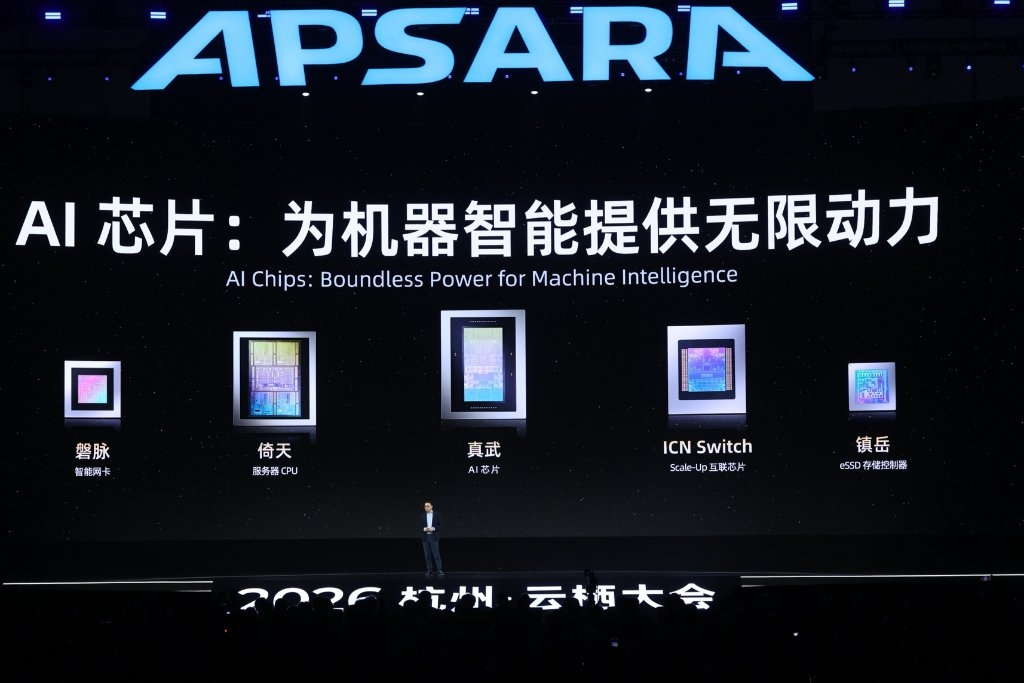
In terms of cluster scalability, a single cluster built on the Zhenwu V900 can be scaled to an astonishing 500,000 cards, sufficient to support training and inference for frontier super models. For future performance guidance, Alibaba expects that as the Pingtouge chip product line matures and becomes widely adopted by customers, the annual shipment volume of its AI chips will rise significantly.
On the progress of large AI models, the Qwen team is exploring specific technical paths toward artificial superintelligence (ASI), namely recursive self-improvement (RSI).
Alibaba disclosed that it plans to train a brand-new model with a parameter scale of 500 to 1 trillion (5 to 10 trillion). The target is to be able to complete more complex, longer-range tasks. At the same time, developing multimodal models with integrated understanding and generation has also become a core R&D direction.
“The total amount of machine thinking will reach 1,000 times that of humankind.” Besides specific business data, Wu Yongming’s macro judgment about the AI industry cycle during his speech also drew market attention. He likened today’s AI development to the early electricity era.
Wu Yongming said:
Machines are becoming the main force for thinking, and intelligence is becoming a scaled commodity. In the future, the total amount of machine thinking will reach more than 1,000 times that of humankind.
He believes that when the supply of machine intelligence becomes infinitely abundant, its significance to human society will far exceed replacing existing mental labor. This change will be even more profound than the Industrial Revolution.
Regarding the various AI applications that are currently drawing widespread attention, Wu Yongming remains calm and objective in his assessment:
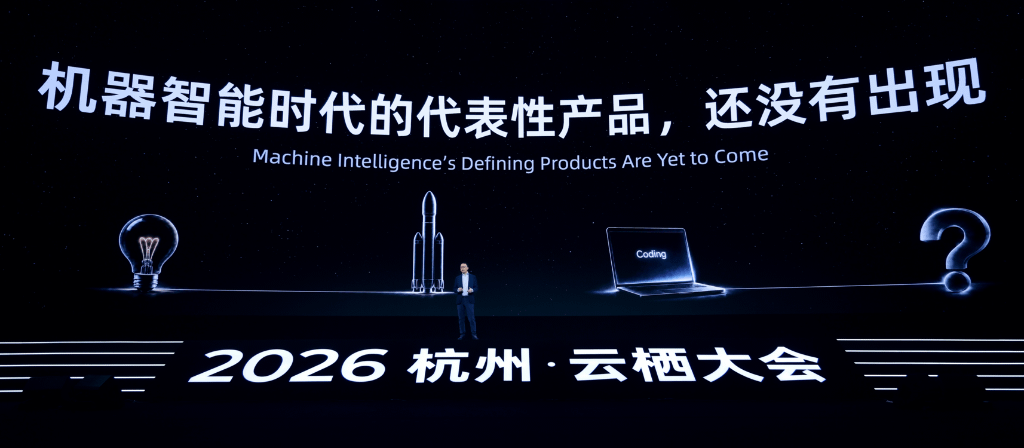
Today’s AI coding is like the electric light in 1882—it replaces existing work, but it is not enough to create a new era. Helping people program and write reports is only the beginner stage of machine intelligence.
Wu Yongming further emphasized:
No matter how many new inventions come later, the first step is to build enough power plants and lay out an adequately wide power grid.
Wu Yongming concluded that in the future era of machine intelligence, thinking will become a scaled commodity supply—just like power. Alibaba’s current strategic focus is to spare no effort to build this “super power grid” that powers the era of machine intelligence.