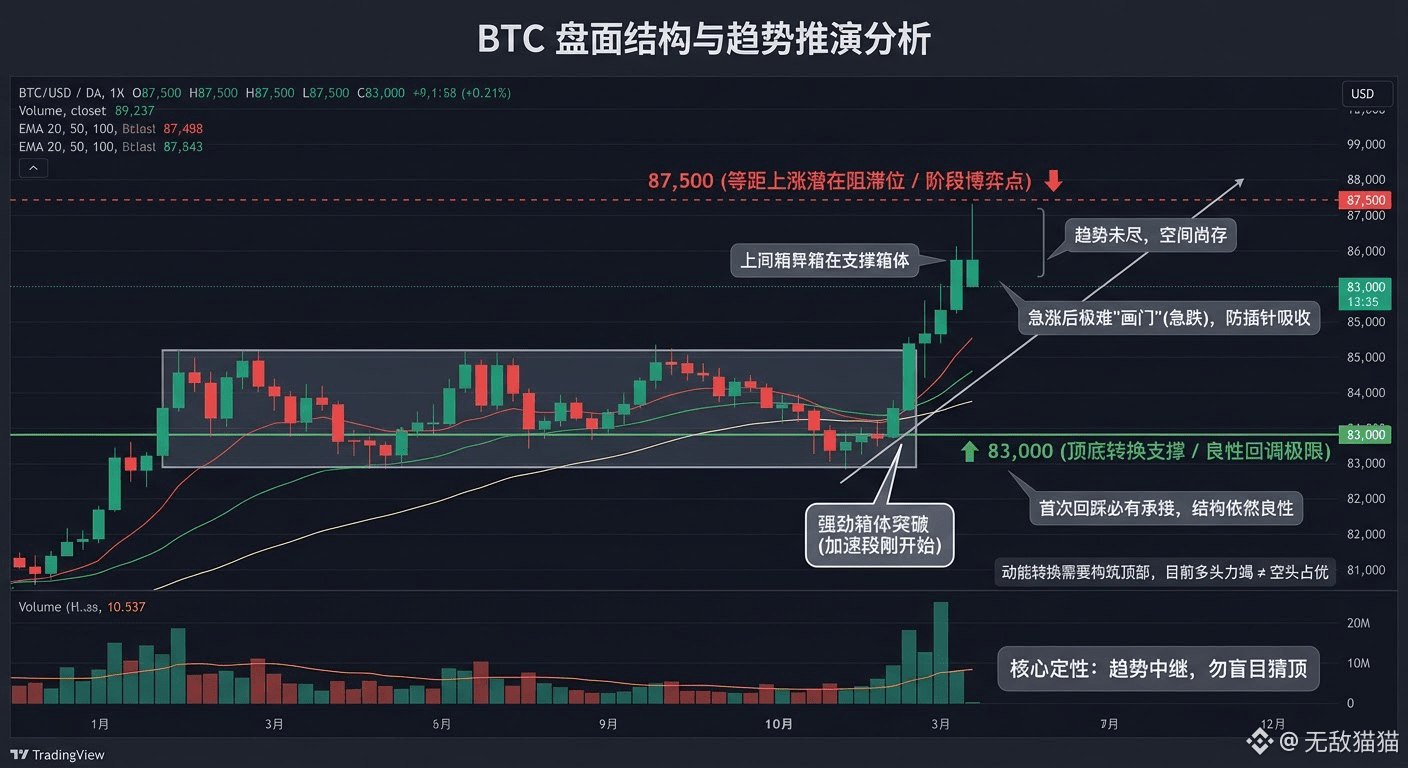
【BTC Market Screen Thoughts: Why It’s Hard to See the Top Directly After Acceleration?】
As the market progresses, BTC is currently in a clear sequence of equidistant upward waves. 87,500 is a potential resistance point from a projection perspective and also a stage-based game zone. But based on the microstructure and trader positioning/“chip” behavior, the current trend has likely not finished yet:
* A breakdown is only just starting—time is not yet enough for a direct reversal
The prior range box has only just completed a valid breakout, and the acceleration leg has lasted just one day. A true trend reversal must form a top—because major players distributing need liquidity, and sentiment shifts as well as supply-demand rotation also require time. In the early stage of a breakout with increased volume, large capital usually lacks a direct counterparty to immediately clear the market in the opposite direction. So the probability of going straight to a single top followed by a one-way selloff is extremely low.
* Micro features of a trending market: it’s very hard to “draw a door”
After a sharp surge, an immediate sharp drop back to the starting point—the so-called “door/ gate” move—is common in liquidity-deficient, range-bound areas. Under the background of an established trend, even with sudden sell pressure, the order book more often absorbs it via fast needle-like wicks rather than a clean reversal.
* The extreme boundary of a benign pullback is 83,000
Even if this acceleration leg pauses temporarily, the pullback depth is typically within 5%. Around 83,000, you have both the support/resistance flip (S/R Flip) after the range breakout, and also the extreme point for a structural adjustment. With the bullish alignment being extremely well formed, the first leg of downward pushing will most likely meet stubborn support from gap-buyers, making it difficult to directly push to lower lows. If the market is to experience a deeper pullback, it must first go through consolidation, grinding adjustment, and a reconfiguration of the bearish alignment.
Core takeaway:
Even if the market shifts from an “acceleration sprint” to “range-bound, slow upward drift,” it’s only a transitional phase of bullish exhaustion. Exhaustion does not automatically mean the bears have the advantage. Without a solid top-building process, every low-volume pullback still belongs to digestion within the ongoing uptrend.