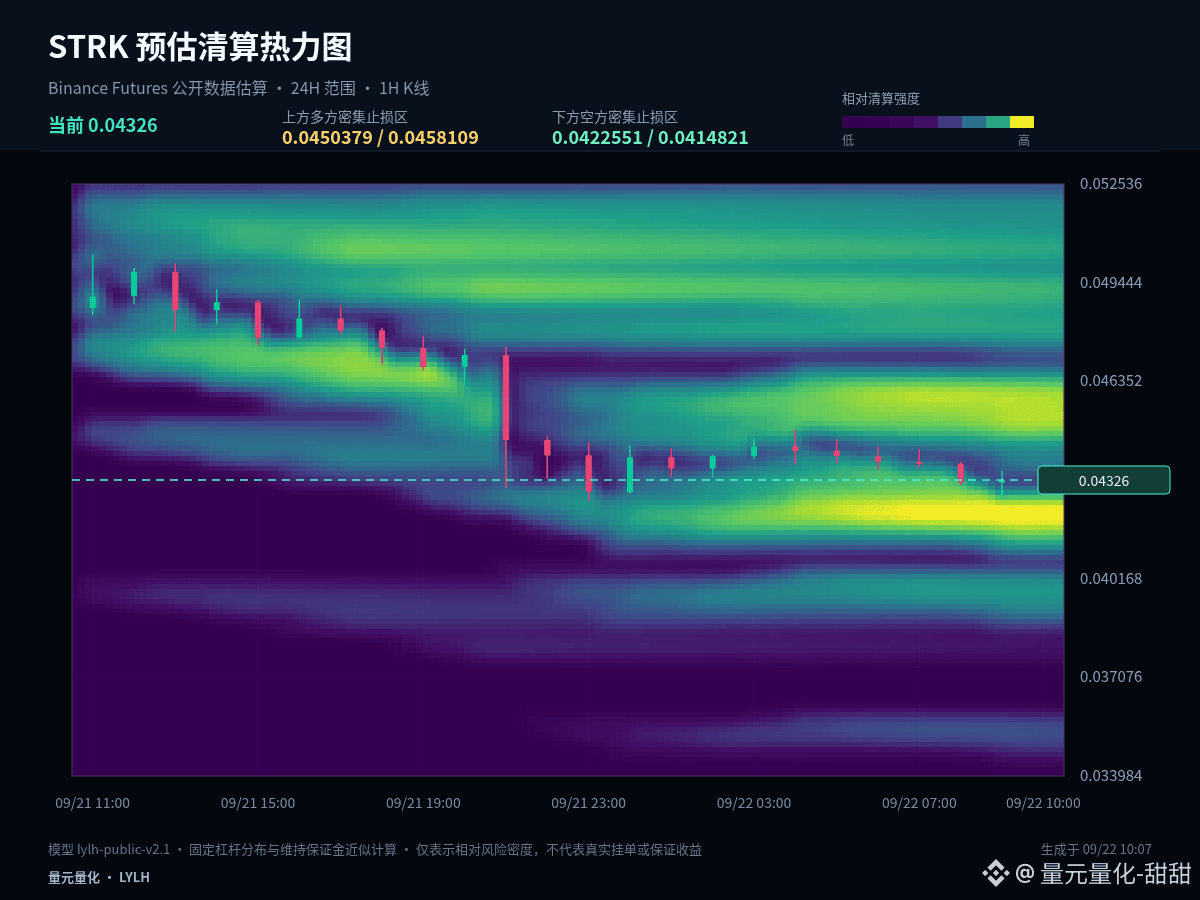
$STRK #STRK This time, I break down the market from a position perspective. In the same chart, the key points you see with existing positions versus being in cash are different. Current price: 0.0433, 1 hour +0.02%, 24 hours -11.7%.
The current price is near the lower bound of the past 24-hour range: 1 hour +0.02%, 24 hours -11.7%. The core of low-level analysis is not trying to bottom-pick early, but observing whether price can quickly reclaim after a break. Being able to reclaim means sell pressure is being absorbed; staying below the lower bound for a sustained period indicates that weakness has not ended.
For those who already hold positions: first, watch whether continuous rejection appears around 0.05026, and use 0.04645 as the protective structure. For those with no position: don’t chase near resistance; wait for pullbacks toward the midline to see acceptance, or for a second confirmation after breaking through resistance.
My scenario analysis isn’t betting on a single direction. A breakout above 0.05026 followed by staying above it suggests that upside room has been reopened. A breakdown below 0.04264 with failure to reclaim indicates further structural weakening. If price moves between the two, continue observing how closes behave on either side of 0.04645.
In terms of positioning, you need to distinguish spot from futures. Existing spot positions can be managed in segments around key levels without frequently flipping direction based on a single 1-hour candlestick. Those with no position should wait for confirmation and scale in more calmly. Futures place more emphasis on the entry level and invalidation conditions. When volatility increases, actively reduce position size to avoid turning short-term judgment into passive holding.
A trading plan must include invalidation conditions. When you’re right, you can realize profits in stages. When you’re wrong, you must also allow yourself to exit—don’t use adding to positions to mask the fact that the original logic has changed. The market will keep updating, and your viewpoint should adjust alongside the price evidence.
#ZetaChainVotesToMigrateZETAToSolana
The current price is near the lower bound of the past 24-hour range: 1 hour +0.02%, 24 hours -11.7%. The core of low-level analysis is not trying to bottom-pick early, but observing whether price can quickly reclaim after a break. Being able to reclaim means sell pressure is being absorbed; staying below the lower bound for a sustained period indicates that weakness has not ended.
For those who already hold positions: first, watch whether continuous rejection appears around 0.05026, and use 0.04645 as the protective structure. For those with no position: don’t chase near resistance; wait for pullbacks toward the midline to see acceptance, or for a second confirmation after breaking through resistance.
My scenario analysis isn’t betting on a single direction. A breakout above 0.05026 followed by staying above it suggests that upside room has been reopened. A breakdown below 0.04264 with failure to reclaim indicates further structural weakening. If price moves between the two, continue observing how closes behave on either side of 0.04645.
In terms of positioning, you need to distinguish spot from futures. Existing spot positions can be managed in segments around key levels without frequently flipping direction based on a single 1-hour candlestick. Those with no position should wait for confirmation and scale in more calmly. Futures place more emphasis on the entry level and invalidation conditions. When volatility increases, actively reduce position size to avoid turning short-term judgment into passive holding.
A trading plan must include invalidation conditions. When you’re right, you can realize profits in stages. When you’re wrong, you must also allow yourself to exit—don’t use adding to positions to mask the fact that the original logic has changed. The market will keep updating, and your viewpoint should adjust alongside the price evidence.
#ZetaChainVotesToMigrateZETAToSolana