Why do we always see only half a rainbow?
Because the other half is blocked by the ground. A rainbow is originally a complete circle.
Sunlight enters the water droplets, refracts, reflects, and refracts again. Since different colors bend at different angles, at a direction about 42 degrees away from the sun behind you, it draws a ring of light with red on the outside and violet on the inside. The center of the circle lies exactly opposite the direction between you and the sun. What’s interesting is that this rainbow belongs only to you—people next to you see a different set of droplets drawing a rainbow for them.
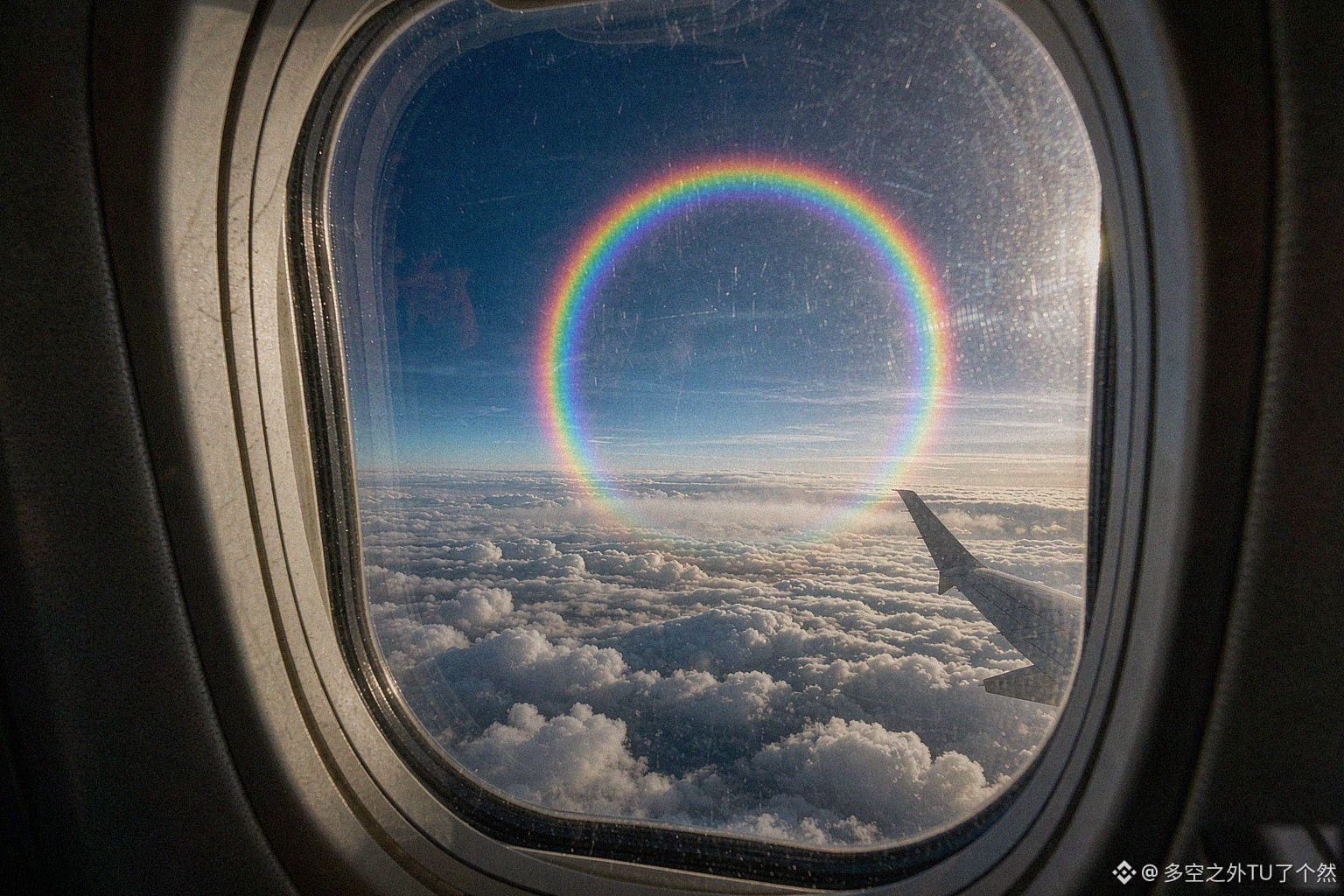
Standing on the ground, the lower half of the ring is cut off by the horizon, so we can only see a semicircle. To see the full circle, you’d need to take a plane through the clouds or stand on a mountaintop and look down at the cloud layer.
With a larger angle—about 51 degrees—another bow appears, with its colors reversed: red on the inside and violet on the outside. It’s much dimmer and is called a supernumerary bow, or "霓".
Next time you look up and see a rainbow, you can tell the person next to you: what you’re seeing is just half—what’s complete is a circle.
Because the other half is blocked by the ground. A rainbow is originally a complete circle.
Sunlight enters the water droplets, refracts, reflects, and refracts again. Since different colors bend at different angles, at a direction about 42 degrees away from the sun behind you, it draws a ring of light with red on the outside and violet on the inside. The center of the circle lies exactly opposite the direction between you and the sun. What’s interesting is that this rainbow belongs only to you—people next to you see a different set of droplets drawing a rainbow for them.
Standing on the ground, the lower half of the ring is cut off by the horizon, so we can only see a semicircle. To see the full circle, you’d need to take a plane through the clouds or stand on a mountaintop and look down at the cloud layer.
With a larger angle—about 51 degrees—another bow appears, with its colors reversed: red on the inside and violet on the outside. It’s much dimmer and is called a supernumerary bow, or "霓".
Next time you look up and see a rainbow, you can tell the person next to you: what you’re seeing is just half—what’s complete is a circle.