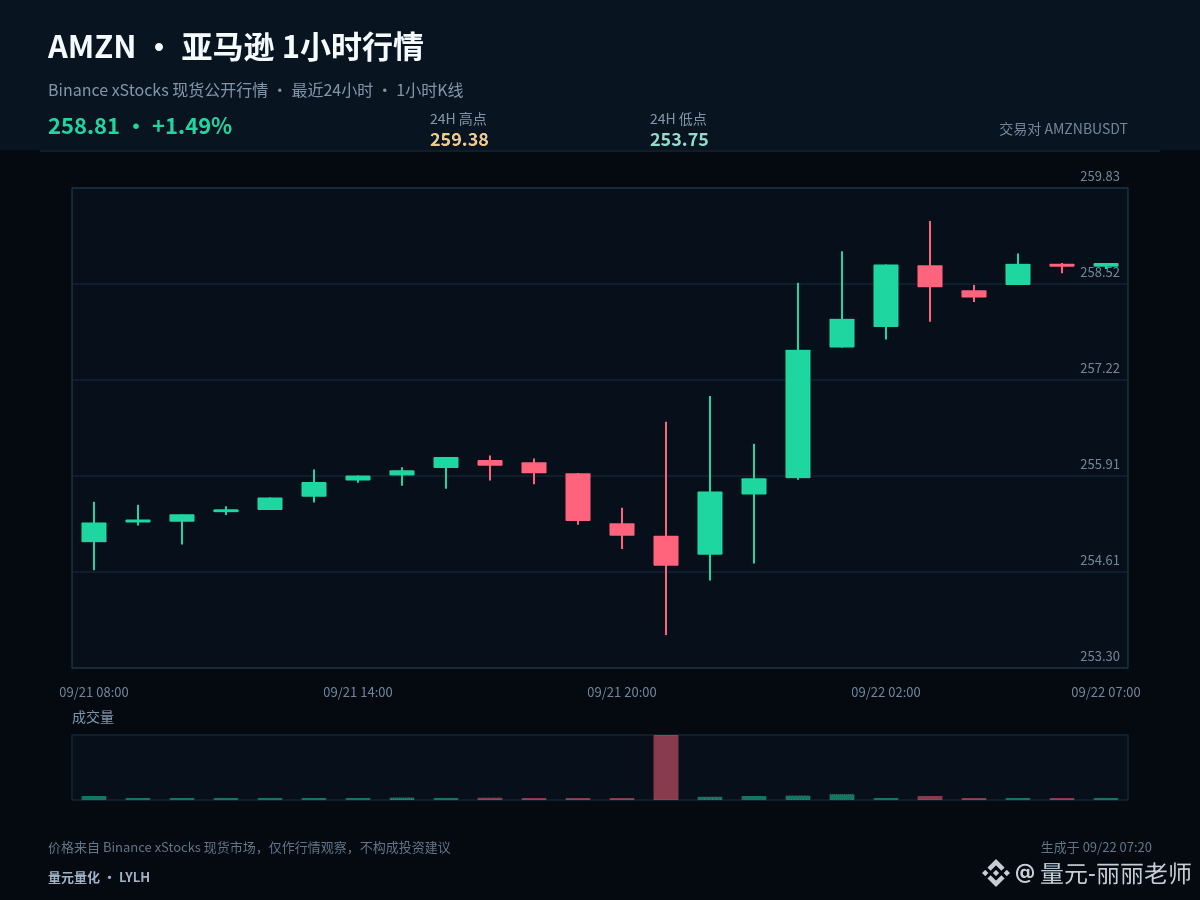
$AMZNB #AMZN Over the past 24 hours, the low-high amplitude has been about 2.2%. The current price is 258.81. This is not a calm, easy-to-enter market for opening positions on a whim. When volatility expands, you should adjust your position size first, before discussing direction.
$AMZNB #AMZN It’s coming close again to the high of the past 24 hours. The closer price gets to the resistance zone, the more important the closing location and the subsequent pullback become. A breakout that occurs intraday by itself does not necessarily mean it has held.
At the moment, the price is near the upper edge of the past 24-hour range: 1-hour +0.02%, 24-hour +1.50%. In the high area, the most important thing is to confirm post-breakout acceptance. If the price can stay above the upper edge, it shows the market acknowledges a higher range. If it only briefly pierces upward and then rapidly pulls back, you need to guard against a false breakout.
Key levels: 256.565 is the current structural midline, and it’s the first standard for judging whether a pullback is healthy. As long as price can hold steadily above it, the bulls still retain initiative. Above that, the next target is 259.38. If price falls back below the midline, then attention should shift to the second support/acceptance at 253.75.
Execution rules in high-volatility phases: reduce single-trade exposure, avoid chasing prices back and forth in the middle of the range, and write the invalidation conditions before entering. If price does not provide confirmation, it’s better to do one less trade than to make up for uncertainty with a larger position.
Execution should be conditional and precise: after a break above 259.38, you need confirmation—not just seeing a momentary surge and chasing it. After a dip to 253.75, you need to see whether price can quickly recover—not catching just because you see weakness. If the middle zone doesn’t offer sufficient reward-to-risk, waiting is itself part of the strategy.
Risk control still comes before the conclusion: execute only when conditions are met; if price fails, reassess promptly. The greater the volatility, the more you must restrain your single-trade position size. The above is a scenario-based market projection based on current 1-hour and 24-hour data, and it does not constitute any promise of returns.
#ZetaChainVotesToMigrateZETAToSolana
$AMZNB #AMZN It’s coming close again to the high of the past 24 hours. The closer price gets to the resistance zone, the more important the closing location and the subsequent pullback become. A breakout that occurs intraday by itself does not necessarily mean it has held.
At the moment, the price is near the upper edge of the past 24-hour range: 1-hour +0.02%, 24-hour +1.50%. In the high area, the most important thing is to confirm post-breakout acceptance. If the price can stay above the upper edge, it shows the market acknowledges a higher range. If it only briefly pierces upward and then rapidly pulls back, you need to guard against a false breakout.
Key levels: 256.565 is the current structural midline, and it’s the first standard for judging whether a pullback is healthy. As long as price can hold steadily above it, the bulls still retain initiative. Above that, the next target is 259.38. If price falls back below the midline, then attention should shift to the second support/acceptance at 253.75.
Execution rules in high-volatility phases: reduce single-trade exposure, avoid chasing prices back and forth in the middle of the range, and write the invalidation conditions before entering. If price does not provide confirmation, it’s better to do one less trade than to make up for uncertainty with a larger position.
Execution should be conditional and precise: after a break above 259.38, you need confirmation—not just seeing a momentary surge and chasing it. After a dip to 253.75, you need to see whether price can quickly recover—not catching just because you see weakness. If the middle zone doesn’t offer sufficient reward-to-risk, waiting is itself part of the strategy.
Risk control still comes before the conclusion: execute only when conditions are met; if price fails, reassess promptly. The greater the volatility, the more you must restrain your single-trade position size. The above is a scenario-based market projection based on current 1-hour and 24-hour data, and it does not constitute any promise of returns.
#ZetaChainVotesToMigrateZETAToSolana