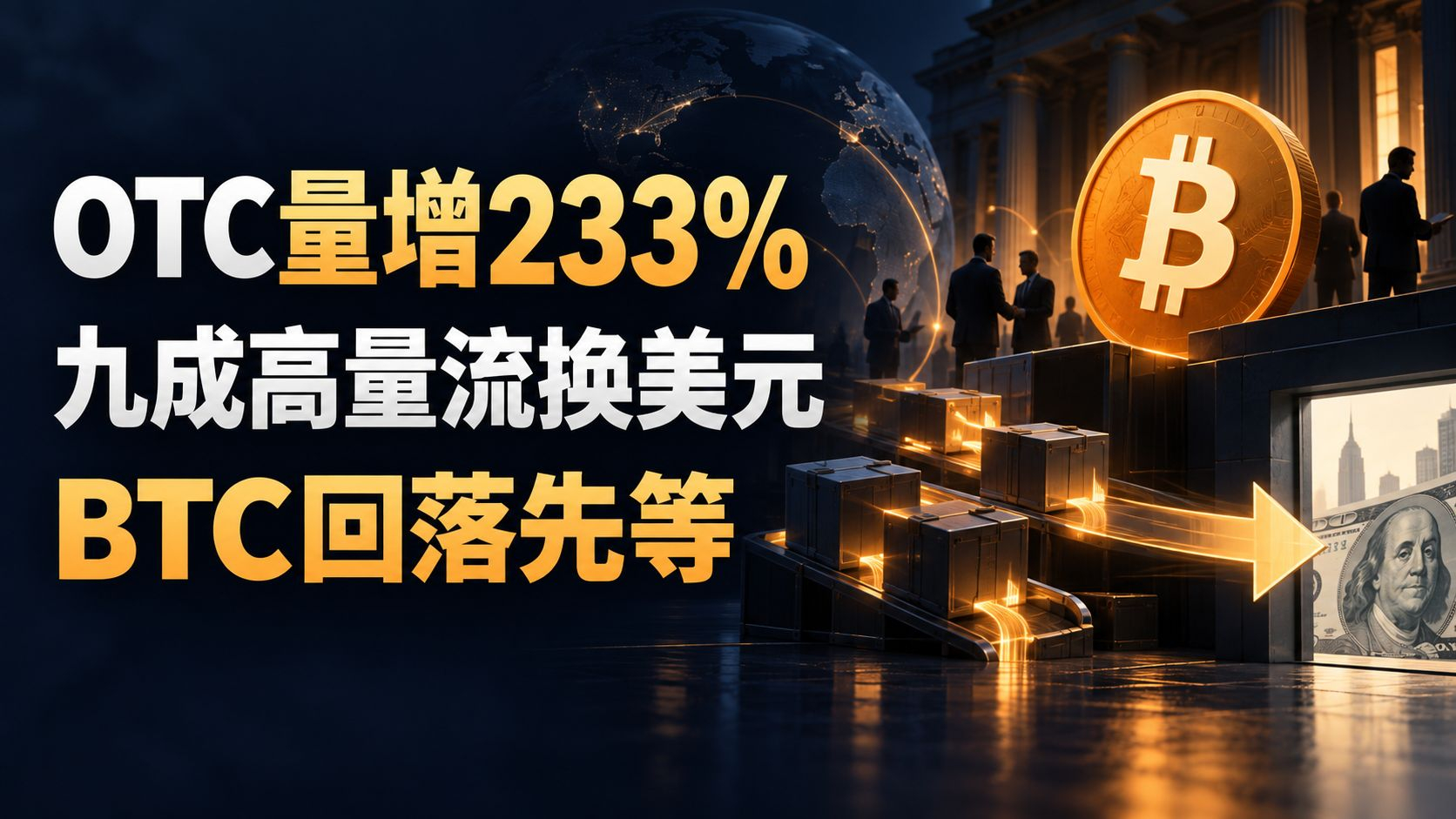
Binance OTC year-over-year up 233%: 90% of large-amount flows are actually stablecoins swapped into USD—BTC spikes and then falls back, so I’m waiting to see if there’s truly buying demand
Right now, I’m cautious and observing for BTC. I won’t chase longs just because the phrase “institutional trades surge.” In Binance’s September 21 release, the OTC and execution services monthly report states that, as of August, the year-to-date trading volume compared with the same period last year increased by 233%, about 3.33 times. In August, large-lot trading demand for BTC, ETH, and SOL continued to exist. But the report also makes it very clear: within the 90% of high-volume client flows, about nine-tenths are driven by stablecoins being withdrawn and swapped into USD. Here, “nine-tenths” refers to the high-volume flow the report observed—not the total trading volume of the entire market. OTC execution involves two-sided switching, and it’s not the net amount of BTC new positions added to the public market.
This contrast is worth discussing. The growth in institutional execution demand suggests that big money is paying more attention to the pathways for slippage, clearing, and settlement. If the main direction is stablecoins being swapped into fiat, then you can’t infer from total volume growth alone that there is an immediate BTC buying bid. The report is reviewing August, not orders added just tonight. Also, the exchange-reported data doesn’t provide an asset net-buy/sell breakdown that can be independently verified. I’ll keep looking at verifiable ETF creations/redemptions, official company disclosures, spot depth, and how prices absorb orders—not treating every OTC service revenue as “fuel for a bull market.” The hot topic #BitcoinHits$85K reflects warming sentiment; the discussion volume itself also isn’t capital flow. If macro interest rates rise, the holding cost for leveraged funds will still suppress chasing bids at high levels.
OKX publicly showed BTC perpetuals around $86,622: the 24-hour low was 80,822 and the high was 87,374. The 15-minute chart initially surged up to 87,374 and then pulled back. Around 86,965 dropping toward 86,568, the contract volume completing that K-line clearly expanded, and afterward the price stayed range-bound between 86,500 and 86,700. This looks more like a turnover test after a breakout than a confirmed one-way continuation rally. Funding rate was about +0.01%, open interest about 29,405 BTC, and notional value around $2.548 billion. A positive funding rate isn’t sufficient proof of overheated conditions, but it also can’t be taken as evidence of spot inflows. In the last round, when I was accepting bids around 86,800–87,000 and confirming around 87,200, 87,375–87,600 was the first observation zone. After price got near 87,374 during the session, it fell back to around 86,600—so the old confirmation didn’t hold. I won’t write the plan as already executed profits, and I’ll put drawdown risk first.
If I were trading on my own right now, I would be with zero position. Only if we retest and hold on lower volume between 86,450 and 86,600, and then the 15-minute chart reclaims above 86,900 with improved成交量, I’d use at most 2% of principal to try a spot long. First I’d look at 87,290–87,375; only after holding above it would I consider 87,600–88,000. If price reaches 87,375, I’d cut one-third first. If after buying price falls back to 86,450, I’d cut half. If the 15-minute chart closes below 86,150, I’d close the remaining position—if I’m wrong, I撤. If price breaks directly through 87,375 without any pullback, I won’t chase. If 86,450 breaks down on heavy volume, and the rebound fails to get above 86,700, I’ll continue to stay cautious for now, watching 85,850–86,000 for absorption. I will never use OTC historical volume growth as an excuse to add to positions against the trend.
Source: Binance OTC September monthly report and cross-checking with Binance’s official news account; OKX BTC-USDT perpetuals public行情 and derivatives snapshots. #BitcoinHits$85K $BTC
The above is only my personal market observation and does not constitute investment advice.
Right now, I’m cautious and observing for BTC. I won’t chase longs just because the phrase “institutional trades surge.” In Binance’s September 21 release, the OTC and execution services monthly report states that, as of August, the year-to-date trading volume compared with the same period last year increased by 233%, about 3.33 times. In August, large-lot trading demand for BTC, ETH, and SOL continued to exist. But the report also makes it very clear: within the 90% of high-volume client flows, about nine-tenths are driven by stablecoins being withdrawn and swapped into USD. Here, “nine-tenths” refers to the high-volume flow the report observed—not the total trading volume of the entire market. OTC execution involves two-sided switching, and it’s not the net amount of BTC new positions added to the public market.
This contrast is worth discussing. The growth in institutional execution demand suggests that big money is paying more attention to the pathways for slippage, clearing, and settlement. If the main direction is stablecoins being swapped into fiat, then you can’t infer from total volume growth alone that there is an immediate BTC buying bid. The report is reviewing August, not orders added just tonight. Also, the exchange-reported data doesn’t provide an asset net-buy/sell breakdown that can be independently verified. I’ll keep looking at verifiable ETF creations/redemptions, official company disclosures, spot depth, and how prices absorb orders—not treating every OTC service revenue as “fuel for a bull market.” The hot topic #BitcoinHits$85K reflects warming sentiment; the discussion volume itself also isn’t capital flow. If macro interest rates rise, the holding cost for leveraged funds will still suppress chasing bids at high levels.
OKX publicly showed BTC perpetuals around $86,622: the 24-hour low was 80,822 and the high was 87,374. The 15-minute chart initially surged up to 87,374 and then pulled back. Around 86,965 dropping toward 86,568, the contract volume completing that K-line clearly expanded, and afterward the price stayed range-bound between 86,500 and 86,700. This looks more like a turnover test after a breakout than a confirmed one-way continuation rally. Funding rate was about +0.01%, open interest about 29,405 BTC, and notional value around $2.548 billion. A positive funding rate isn’t sufficient proof of overheated conditions, but it also can’t be taken as evidence of spot inflows. In the last round, when I was accepting bids around 86,800–87,000 and confirming around 87,200, 87,375–87,600 was the first observation zone. After price got near 87,374 during the session, it fell back to around 86,600—so the old confirmation didn’t hold. I won’t write the plan as already executed profits, and I’ll put drawdown risk first.
If I were trading on my own right now, I would be with zero position. Only if we retest and hold on lower volume between 86,450 and 86,600, and then the 15-minute chart reclaims above 86,900 with improved成交量, I’d use at most 2% of principal to try a spot long. First I’d look at 87,290–87,375; only after holding above it would I consider 87,600–88,000. If price reaches 87,375, I’d cut one-third first. If after buying price falls back to 86,450, I’d cut half. If the 15-minute chart closes below 86,150, I’d close the remaining position—if I’m wrong, I撤. If price breaks directly through 87,375 without any pullback, I won’t chase. If 86,450 breaks down on heavy volume, and the rebound fails to get above 86,700, I’ll continue to stay cautious for now, watching 85,850–86,000 for absorption. I will never use OTC historical volume growth as an excuse to add to positions against the trend.
Source: Binance OTC September monthly report and cross-checking with Binance’s official news account; OKX BTC-USDT perpetuals public行情 and derivatives snapshots. #BitcoinHits$85K $BTC
The above is only my personal market observation and does not constitute investment advice.