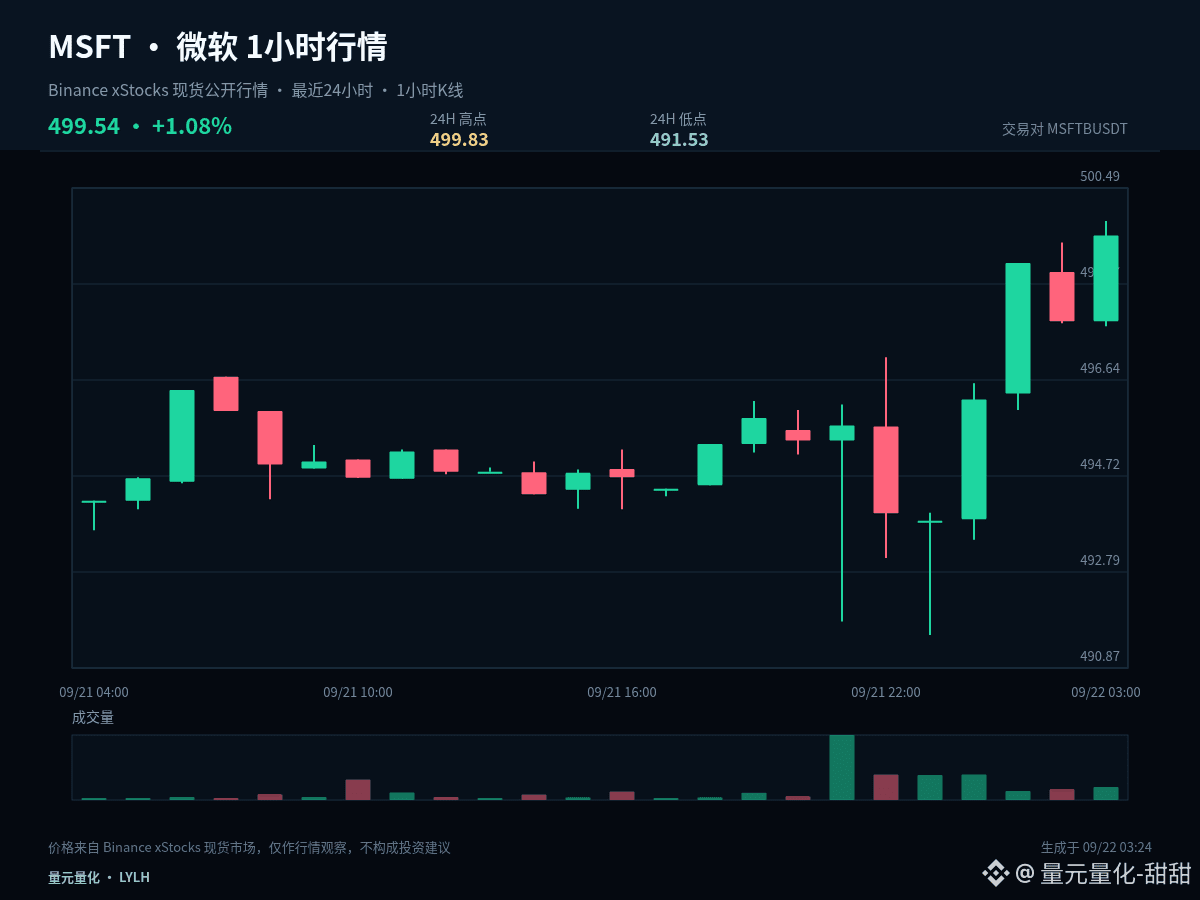
$MSFTB #MSFT At the moment, it’s more suitable to first do a rebound confirmation rather than define a reversal in advance. Current price is 499.54, 1-hour +0.35%, 24-hour +1.08%. Whether the two time periods realign in the same direction is the key focus for the next step.
The current price is near the upper bound of the past 24-hour range, with 1-hour +0.35% and 24-hour +1.08%. The most important thing at the highs is to confirm the market’s acceptance after a breakout: if the price can stay above the upper bound, it indicates the market acknowledges a higher range; if it only briefly pierces above and then quickly snaps back, you need to guard against a false breakout.
If the rebound can reclaim 495.68 and then further hold above 499.83, it suggests buyer momentum is starting to change the prior weakness. If, after pushing toward the midline, the price drops again—especially if it falls back toward 491.53—then it looks more like a failed repair, and you shouldn’t continue to rely on a “strengthening” expectation.
Confirming a failed rebound also requires evidence; you shouldn’t jump into shorting just because of one high-to-low move. A more reasonable sequence is to observe whether the resistance zone keeps rejecting price, whether the lows begin shifting lower again, and then decide your next action based on whether subsequent pullbacks reclaim key levels.
For existing positions, handle them in segments based on key levels to avoid making a full set of decisions all at once. For those with no position, wait for breakout confirmation or for a pullback to stabilize. For U.S. stock instruments, also watch for volatility caused by trading session transitions; your plan should be driven by price conditions, not by emotions.
Risk control should still come before the conclusion: only execute when the conditions appear; if the price action invalidates, reassess immediately. The larger the volatility, the more you must restrain the size of any single position. The above is a scenario analysis based on the current 1-hour and 24-hour data and does not constitute a promise of returns.
#CanaryFilesSecondAmendmentForStakedSEIETF
The current price is near the upper bound of the past 24-hour range, with 1-hour +0.35% and 24-hour +1.08%. The most important thing at the highs is to confirm the market’s acceptance after a breakout: if the price can stay above the upper bound, it indicates the market acknowledges a higher range; if it only briefly pierces above and then quickly snaps back, you need to guard against a false breakout.
If the rebound can reclaim 495.68 and then further hold above 499.83, it suggests buyer momentum is starting to change the prior weakness. If, after pushing toward the midline, the price drops again—especially if it falls back toward 491.53—then it looks more like a failed repair, and you shouldn’t continue to rely on a “strengthening” expectation.
Confirming a failed rebound also requires evidence; you shouldn’t jump into shorting just because of one high-to-low move. A more reasonable sequence is to observe whether the resistance zone keeps rejecting price, whether the lows begin shifting lower again, and then decide your next action based on whether subsequent pullbacks reclaim key levels.
For existing positions, handle them in segments based on key levels to avoid making a full set of decisions all at once. For those with no position, wait for breakout confirmation or for a pullback to stabilize. For U.S. stock instruments, also watch for volatility caused by trading session transitions; your plan should be driven by price conditions, not by emotions.
Risk control should still come before the conclusion: only execute when the conditions appear; if the price action invalidates, reassess immediately. The larger the volatility, the more you must restrain the size of any single position. The above is a scenario analysis based on the current 1-hour and 24-hour data and does not constitute a promise of returns.
#CanaryFilesSecondAmendmentForStakedSEIETF