

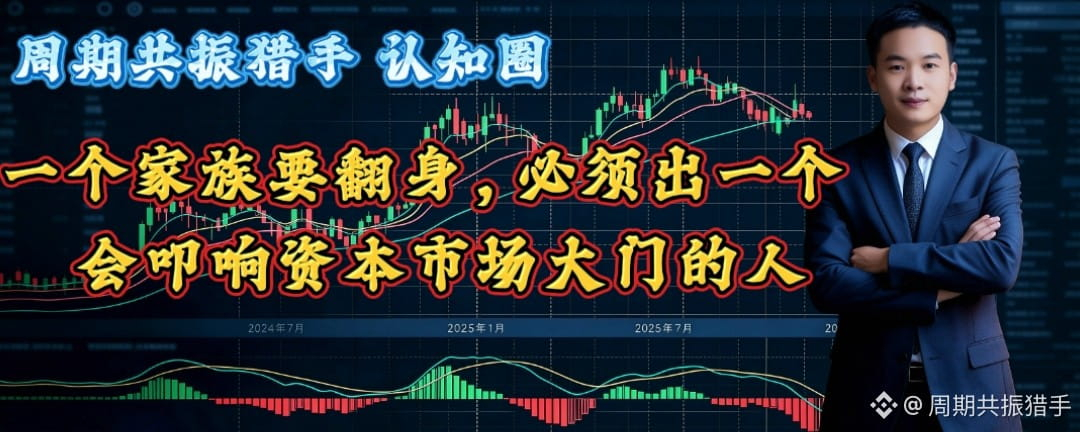

If a family wants to change its fate, it doesn’t necessarily have to be preceded by someone who first makes a huge amount of money.
But more often than not, it takes someone first—someone willing to walk up to the entrance of the capital markets and seriously ask: how exactly does money flow?
Family said he wasn’t doing honest work. Friends said he was too ambitious and impractical. But he knows in his heart:
The money in this world has never been distributed according to labor; it’s distributed according to cognition.
He doesn’t want to save anyone with a reckless gamble. He has seen his parents spend their whole lives working their heads off, yet still can’t provide the future his children want. He doesn’t want the next generation to keep repeating the cycle of surviving on physical labor alone. —So he wants to be the one who knocks on the door of the capital markets.
🧠 What he wants to end is a kind of endless dead loop.
Whether it’s a shop on the street or a company with thousands of people—once you peel off the shell, they’re all answering the same question:
Where does the money come from? Where does the cost flow? Which link creates value, and where is the system continuously bleeding?
The boss may manage people, goods, and business on the surface—but in essence, they manage capital, resources, and efficiency.
If you can’t understand this layer, you can only trade time for money for your whole life; if you understand it, money might finally work for you.
So he dives headfirst into the financial market. What he learns isn’t just how to buy and sell—it’s the real rules of how this world truly operates.
📊 The market is a mirror—what it reflects first is yourself.
People who just enter the market watch only the rise and fall. After going on for a long time, you realize the market is more like a mirror—it reflects changes in the industry, and it also reflects people’s desires.
Before you can understand the financial market, you have to understand yourself first: when prices rise, do you get greedy? when they fall, do you dare to admit you were wrong? after you miss a move, do you impulsively chase just to prove yourself?
What he ultimately faces isn’t just price fluctuations, but his own fear, luck-seeking, hesitation, and unwillingness to accept it.
Theory can be learned from books, but temperament can only be refined again and again through drawdowns.
🌙 This road is destined to have a stretch that no one understands.
Countless late nights, alone, he replays and reexamines everything—questioning again and again: “Why does this judgment hold? What supports it with data? If I’m wrong, how much loss can I actually bear?”
If no one guides you, you’ll hit a wall on your own. If no one relies on, you’ll become your own support.
But he also slowly realizes two things: not being understood doesn’t mean you’re proving the direction is correct; and the market won’t reward the result someone wants just because of their determination.
Courage must go hand in hand with discipline; ideals must go hand in hand with research.
⚖️ Financial markets are a testing ground for human nature.
Someone always says financial markets are like a casino. But are the risks of starting a business really small? Rent, deposits, labor, inventory—when the business fails, you don’t even have the资格 to cut losses and exit.
Financial markets don’t look at your education or ask about your background. They give people the option to cut losses anytime—but they never promised outcomes.
It’s a continuous test of human nature:
When you’re greedy, can you keep your boundaries?
When you’re afraid, are you controlled by emotion?
When you get it wrong, can you cut losses in time?
When someone else makes money, do you adjust your own plan?
Impulse is the tuition; self-discipline is the credit.
Written at the end
Once a person like this gets it right, what they leave for the family isn’t just money—it’s a map for discerning direction: write cycles, risk, and asset allocation into the family’s understanding of wealth.
But this map can’t replace the act of walking. An understanding of wealth can’t replace action, and accumulating as a family doesn’t mean you’ll always be safe. What future generations inherit shouldn’t be only money, but the ability to understand how money works.
The capital market won’t lower risk because of one person’s sense of mission. If you want your family to have more choices, the first step is never to bet everything—it’s to first learn the rules, understand risk, and set boundaries.
Those who open new paths for the family aren’t crazy. They simply stand in a position that isn’t understood yet, bearing the burden of upgrading the family’s wealth mindset on their own.
⭐ If you’ve found value, please tap to save/bookmark it—bring it back on some late night when you’re planning your family’s assets, or when you’re quietly shouldering something alone; follow me—an analyst who speaks with K-lines. I’ll help you break down formations, read the flow of funds, and see the real replay.
What do you think a family should prioritize accumulating most: assets, skills, or the ability to understand how wealth works? Let’s discuss in the comments 👇
⚠️ Disclaimer: The content in this article is for personal opinion sharing only and does not constitute any investment advice (NFA). Stocks, funds, and other financial markets involve risks. Please conduct independent research and make prudent decisions based on your own circumstances.
#Trading Mindset #Financial Cognition #Wealth Management #Risk Control #Long-termism