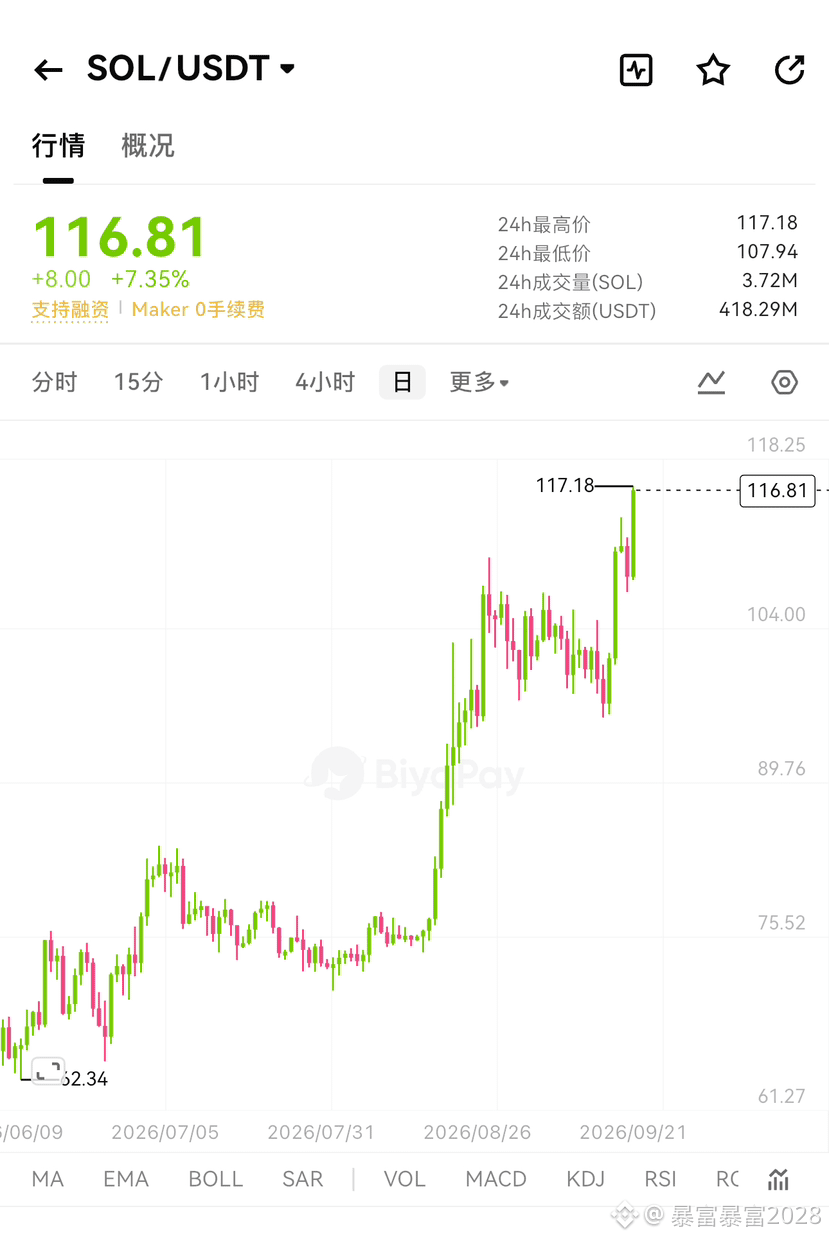
SOL jumped from Zone 106 to 114 in Q3, with a monthly-line level of +18%. Institutions are bringing back the narrative of “the consumption chain/payment chain/high-throughput L1” again.
Core narrative: low fees and high TPS, the Memecoin launch location, PayFi, mobile wallets, and ETF expectations—closer to the user side than a pure DeFi L1.
Old problem of token value capture: network revenue goes to validators, while SOL holders are essentially eating “ecosystem valuation,” not dividends. L2/Base/Sui/Aptos are all competing for developers.
On-chain metrics: active addresses and DEX volumes are recovering, Memecoin’s share is still high, and revenue quality isn’t as clean as the ETH+RWA line.
Macro constraints: SOL’s historical beta is about 1.5–2x BTC. It’s at its strongest in the later stages of bull markets, and when tightening expectations return, it gets hit the hardest. In the second half of 2026, there’s a tug-of-war between “adoption accelerating” and “interest rates suppressing.”
Capital flows: ETF expectations, institutional allocation, and stablecoin settlement are positive; unlocks, staking and unstaking events, and the Memecoin pullback are negative.
Positioning framework: strategic observation below 105; normal holdings from 108–112; if 114 breaks out on increased volume, then we can talk about 130+. SOL is a “public chain most like a tech stock,” not an asset most like “digital gold.”
It’s worth allocating to, but don’t use BTC’s holding logic for SOL. Use BiyaPay to look at BTC’s real-time market dynamics #BTC #ETH #加密市场 #BiyaPay #SOL
Core narrative: low fees and high TPS, the Memecoin launch location, PayFi, mobile wallets, and ETF expectations—closer to the user side than a pure DeFi L1.
Old problem of token value capture: network revenue goes to validators, while SOL holders are essentially eating “ecosystem valuation,” not dividends. L2/Base/Sui/Aptos are all competing for developers.
On-chain metrics: active addresses and DEX volumes are recovering, Memecoin’s share is still high, and revenue quality isn’t as clean as the ETH+RWA line.
Macro constraints: SOL’s historical beta is about 1.5–2x BTC. It’s at its strongest in the later stages of bull markets, and when tightening expectations return, it gets hit the hardest. In the second half of 2026, there’s a tug-of-war between “adoption accelerating” and “interest rates suppressing.”
Capital flows: ETF expectations, institutional allocation, and stablecoin settlement are positive; unlocks, staking and unstaking events, and the Memecoin pullback are negative.
Positioning framework: strategic observation below 105; normal holdings from 108–112; if 114 breaks out on increased volume, then we can talk about 130+. SOL is a “public chain most like a tech stock,” not an asset most like “digital gold.”
It’s worth allocating to, but don’t use BTC’s holding logic for SOL. Use BiyaPay to look at BTC’s real-time market dynamics #BTC #ETH #加密市场 #BiyaPay #SOL