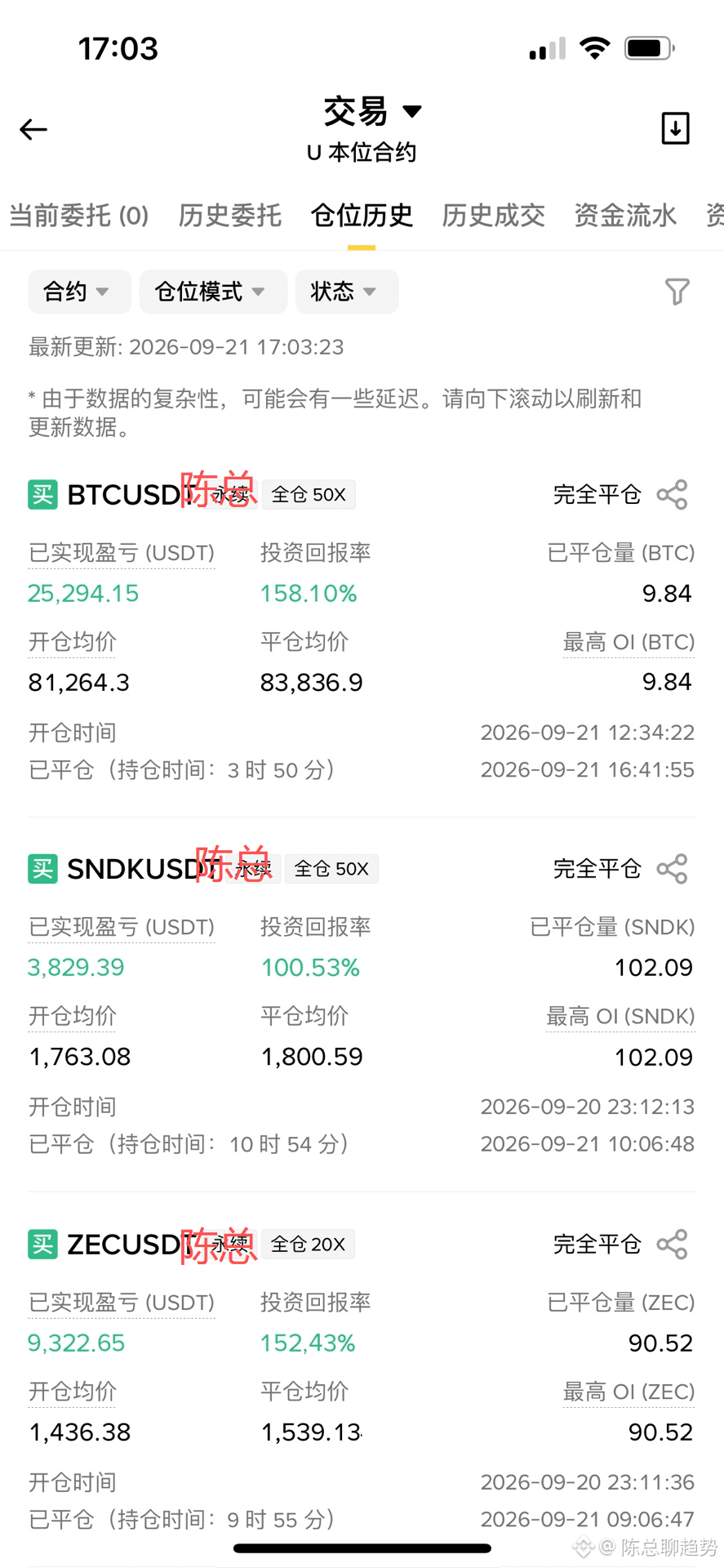
Today this trade $BTC —opened a long at 81264.3 and closed at 83836.9. I took the full swing in just three hours, with a return rate of 158.10%. The core logic has never been about betting on direction.
At the time, the price pulled back near 81000. It happened to land right on the strong support on the 4-hour timeframe, which had been tested three times consecutively. After two previous dips, the market quickly recovered each time, indicating that there was heavy buy-side support below and the shorts couldn’t push it down.
Meanwhile, on-chain data for large-amount coin holder addresses showed no changes in sell-pressure for two straight hours. Exchange BTC supply continued to decrease, suggesting that capital was quietly absorbing, with no signs of a large-scale exit.
After entering, I didn’t set an arbitrary wide stop-loss. Instead, I placed the stop-loss 1.5% beyond the outside edge of the support area. This avoided the dense zone where retail traders often get swept for stops, while keeping the risk exposure from becoming too large.
During the position, I wasn’t shaken out by minor pullbacks. It stayed until the price touched around 83800, reaching the prior high resistance level.
As volume started to shrink, momentum for the long side weakened. I closed the entire position and locked in the profits. There was no extra emotional or impulsive action throughout.
Many people can’t hold BTC swing profits—the real reason is that they ignore two key details:
Before opening, check on-chain supply data to avoid the moments when major players are distributing. From the source, you reduce the risk of being forced to close longs—regardless of how much unrealized profit you have.
Then judge only whether volume matches the resistance level. Don’t be greedy at the very last uncertain part of the move.
At the time, the price pulled back near 81000. It happened to land right on the strong support on the 4-hour timeframe, which had been tested three times consecutively. After two previous dips, the market quickly recovered each time, indicating that there was heavy buy-side support below and the shorts couldn’t push it down.
Meanwhile, on-chain data for large-amount coin holder addresses showed no changes in sell-pressure for two straight hours. Exchange BTC supply continued to decrease, suggesting that capital was quietly absorbing, with no signs of a large-scale exit.
After entering, I didn’t set an arbitrary wide stop-loss. Instead, I placed the stop-loss 1.5% beyond the outside edge of the support area. This avoided the dense zone where retail traders often get swept for stops, while keeping the risk exposure from becoming too large.
During the position, I wasn’t shaken out by minor pullbacks. It stayed until the price touched around 83800, reaching the prior high resistance level.
As volume started to shrink, momentum for the long side weakened. I closed the entire position and locked in the profits. There was no extra emotional or impulsive action throughout.
Many people can’t hold BTC swing profits—the real reason is that they ignore two key details:
Before opening, check on-chain supply data to avoid the moments when major players are distributing. From the source, you reduce the risk of being forced to close longs—regardless of how much unrealized profit you have.
Then judge only whether volume matches the resistance level. Don’t be greedy at the very last uncertain part of the move.