

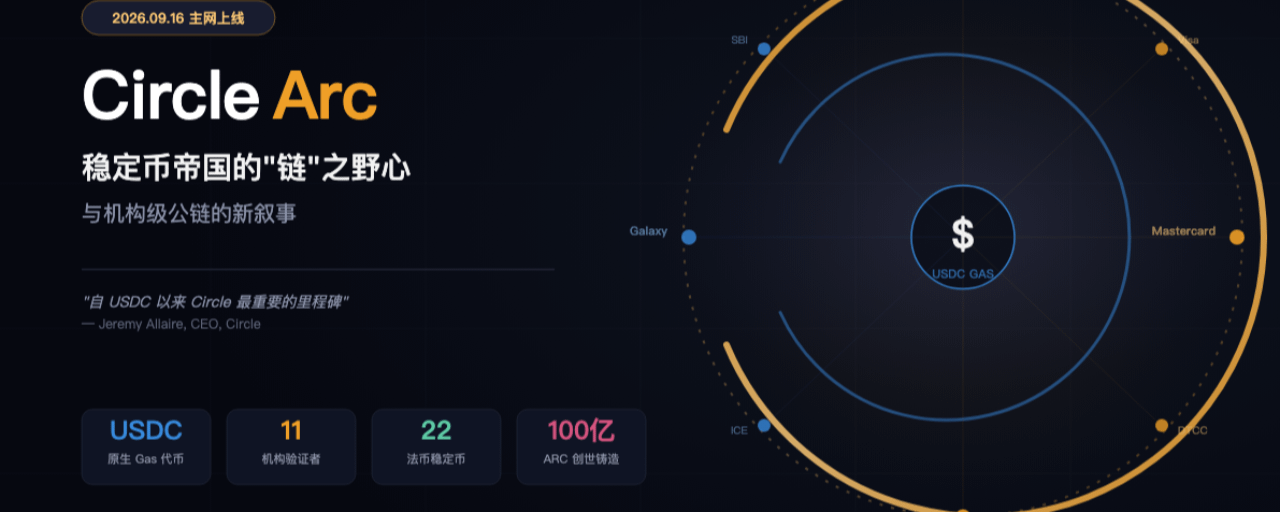

Circle Arc mainnet is live. CEO Jeremy Allaire calls it “Circle’s most important milestone since USDC.”
A Layer 1 public chain dominated by a stablecoin issuer, using USDC as its gas token, with BlackRock and Visa serving as validators—what does that even mean?
I. A public chain led by a stablecoin issuer is born
On September 16, 2026, a landmark moment arrived for the crypto industry: Circle—the issuer of the world’s second-largest stablecoin, USDC—officially launched the Arc public mainnet.
This isn’t another Ethereum L2, nor a fork of some existing chain. Arc is an independent Layer 1 blockchain with its own consensus mechanism, execution environment, and fee model. More importantly, it is tailor-made for stablecoin finance: USDC as the native gas token; 11 founding validators including BlackRock, DTCC, Visa, Mastercard; 22 fiat stablecoins integrated via the StableFX foreign exchange engine; BlackRock’s tokenized T-bond fund (BUIDL) and Circle’s tokenized money market fund (USYC) natively integrated.
At launch, Jeremy Allaire said: “Arc is Circle’s most important milestone since USDC… an open, neutral, always-on internet-economy operating system, maintained by the most important financial institutions on Earth—born for a world where humans and machines can trade.”
And the underlying logic behind all of this is simple: Circle is no longer content to be just a stablecoin issuer. It wants to become the “operating system” at the foundation of the stablecoin economy.
II. From USDC to Arc: Circle’s strategic leap
As of Q1 2026, USDC’s circulating supply reached $77 billion (up 28% year over year), and on-chain transaction volume hit $2.15 trillion (up 263% year over year). Circle has already deployed USDC natively across 30 blockchains.
But Circle faces a fundamental contradiction: its core asset, USDC, runs on someone else’s chain. Ethereum, Solana, Arbitrum—these chains’ gas tokens fluctuate wildly, and governance power is held by their respective communities.
Arc was created precisely to resolve this contradiction. Circle wants full-stack control—from asset issuance to settlement infrastructure.
This isn’t an isolated trend. Stripe and Paradigm jointly incubated the Tempo public chain, which also positions itself as stablecoin payment infrastructure. Stablecoin competition is evolving from “who has the license” to “who controls the infrastructure.”
III. Technical architecture: dual clients, USDC Gas, and post-quantum signatures
Arc runs two independent clients on each node:
Consensus layer: based on Malachite (Tendermint BFT), sub-second deterministic finality, with average settlement around 0.5 seconds
Execution layer: based on Reth (Rust Ethereum execution client), fully EVM compatible
With USDC as the native gas token—where all transaction fees are paid in USDC and you don’t need to hold volatile tokens. This directly challenges the public-chain “iron law” that native tokens must be used for Gas.
From genesis, Arc also supports post-quantum signatures and offers optional privacy (Opt-in Privacy), allowing selected balance shielding while preserving auditability.
IV. Wall Street validators: decentralization or a new version of consortium chains?
11 founding validators: BlackRock, DTCC, Visa, Mastercard, ICE, Galaxy, Standard Chartered, SBI Group, Sumitomo Corporation, MoneyGram, Global Payments.
Core controversy: 11 known, permissioned validators run under PoA consensus—so is this really a “public chain,” or a “consortium chain”?
Circle itself plays multiple roles in this network: the USDC issuer, the Arc software developer, a main holder of ARC tokens (25%), and one of the validators. This concentration—“both judge and player”—is a governance question Arc will need to address for the long term.
V. 22 stablecoins and StableFX
Arc connects to 22 fiat-backed stablecoins (USDC, EURC, JPYC, KRW1, BRLA, TRYB, etc.). It enables sub-second fiat settlement through the StableFX foreign exchange engine. Traditional cross-border settlement requires T+2; on Arc, it can be done in real time.
VI. Built for AI Agents
Arc is the first public chain designed from genesis for an AI Agent economy. USDC accounts for 98.8% of agent-driven transaction volume. AgentVM, Agent Wallet, and the x402 payment protocol—so machines and machines can trade directly on-chain.
VII. The tension between institutional infrastructure and Meme speculation
A cautionary tale from the Robinhood Chain: it positioned itself as RWA, but retail users created 16,639 tokens in one week, and the DEX hit a peak of $3.7 billion in a single day. Arc traders are betting on the same script.
The question is: will BlackRock and Visa accept their own validators helping secure a chain running on Meme coin speculation?
VIII. The ARC tokenomics paradox
10 billion ARC genesis minted (60% ecosystem / 25% Circle / 15% reserves). But gas is paid with USDC—what’s the value-capture logic behind ARC?
Answer: ARC is a governance and staking token, not a gas token. Only after the 2027 transition from PoA to PoS will the real economic functions be released. Genesis minting ≠ public launch.
Conclusion
Arc changes one basic assumption: a public chain doesn’t need a volatile gas token, doesn’t need anonymous validators, and doesn’t need “code is law”—it only needs accountable institutions, predictable fees, and auditable compliance.
Is this decentralization’s retreat, or the starting point of evolution? The 2027 PoS transition is the watershed moment. The market will vote with its feet.