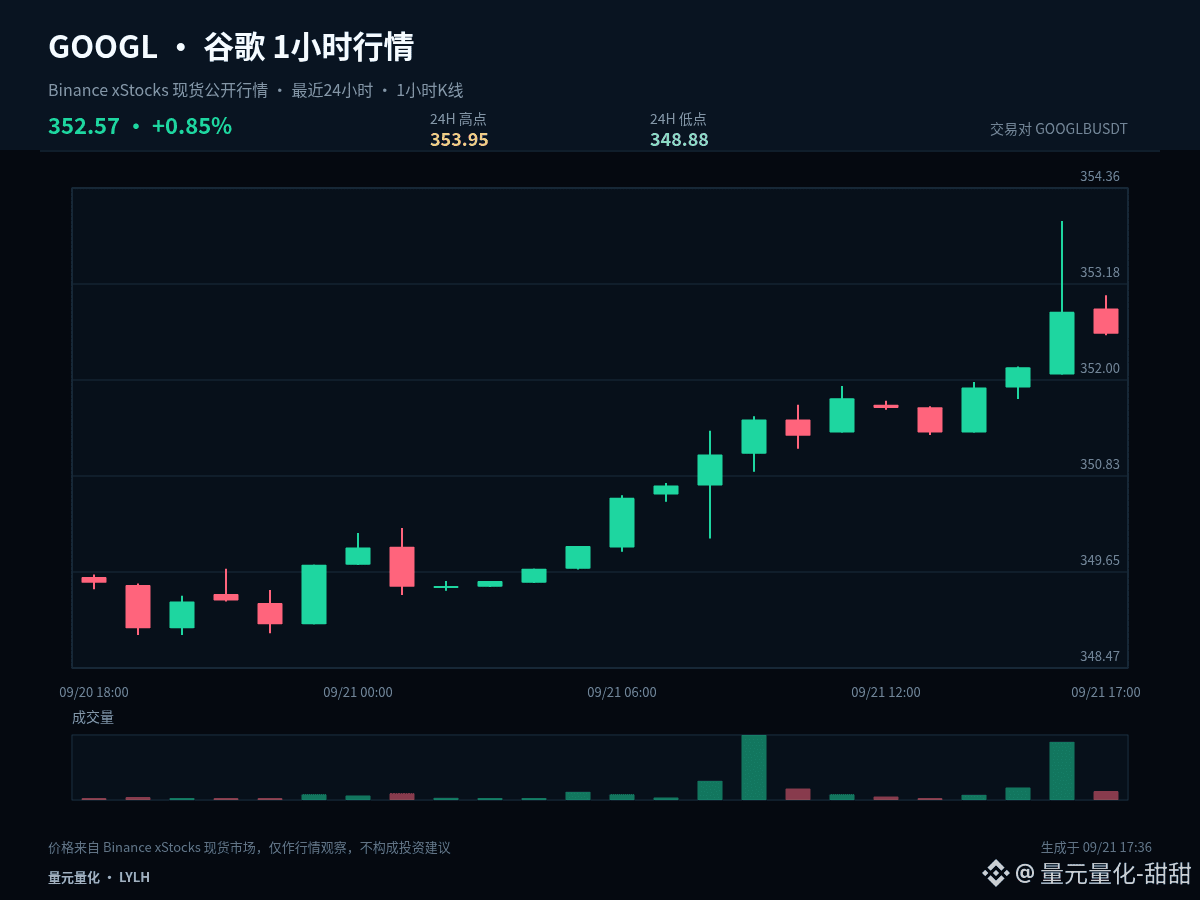
$GOOGLB #GOOGL If this round only allows me to keep one observation price, I would choose 351.415. Current price: 352.57, 1 hour: -0.08%, 24 hours: +0.87%. The midline’s gains and losses can help filter a lot of intra-day noise.
The price hasn’t reclaimed 351.415 yet. For now, treat the current rebound as a weak repair; real strength depends on proof from a stable close. If it turns weak again, 348.88 is the next level to observe whether selling pressure is fading.
With the current 1-hour -0.08% and 24-hour +0.87%, these two timeframes haven’t formed a sufficiently clear same-direction alignment. In a range-bound market, the tolerance for chasing and killing positions is low. It’s better to confirm direction with the upper boundary and confirm follow-through/hold with the lower boundary. The midline is only used as the line dividing strength and weakness.
My scenario isn’t a single bet on one direction. If price breaks above 353.95 and can hold, it means the upside space has been reopened; if it breaks below 348.88 and fails to rebound, it indicates the structure has weakened further. If it continues trading between the two, then keep observing the closing performance on both sides of 351.415.
Position management needs to distinguish between swing trades and short-term trades. For existing swing positions, first check whether the structure is broken; don’t be repeatedly influenced by a single 1-hour candlestick. For short-term positions, execute around support, resistance, and confirmation by closes. If you’re currently in cash, you don’t need to chase price in the middle of the range—waiting for a clearer level usually offers an advantage.
The real disagreement in this setup is whether it continues or returns to the range. Will you wait for a breakout confirmation, or will you wait for a pullback to support? Tell me the price you’re most focused on.
#BOJRaisesRatesTo31YearHigh
The price hasn’t reclaimed 351.415 yet. For now, treat the current rebound as a weak repair; real strength depends on proof from a stable close. If it turns weak again, 348.88 is the next level to observe whether selling pressure is fading.
With the current 1-hour -0.08% and 24-hour +0.87%, these two timeframes haven’t formed a sufficiently clear same-direction alignment. In a range-bound market, the tolerance for chasing and killing positions is low. It’s better to confirm direction with the upper boundary and confirm follow-through/hold with the lower boundary. The midline is only used as the line dividing strength and weakness.
My scenario isn’t a single bet on one direction. If price breaks above 353.95 and can hold, it means the upside space has been reopened; if it breaks below 348.88 and fails to rebound, it indicates the structure has weakened further. If it continues trading between the two, then keep observing the closing performance on both sides of 351.415.
Position management needs to distinguish between swing trades and short-term trades. For existing swing positions, first check whether the structure is broken; don’t be repeatedly influenced by a single 1-hour candlestick. For short-term positions, execute around support, resistance, and confirmation by closes. If you’re currently in cash, you don’t need to chase price in the middle of the range—waiting for a clearer level usually offers an advantage.
The real disagreement in this setup is whether it continues or returns to the range. Will you wait for a breakout confirmation, or will you wait for a pullback to support? Tell me the price you’re most focused on.
#BOJRaisesRatesTo31YearHigh