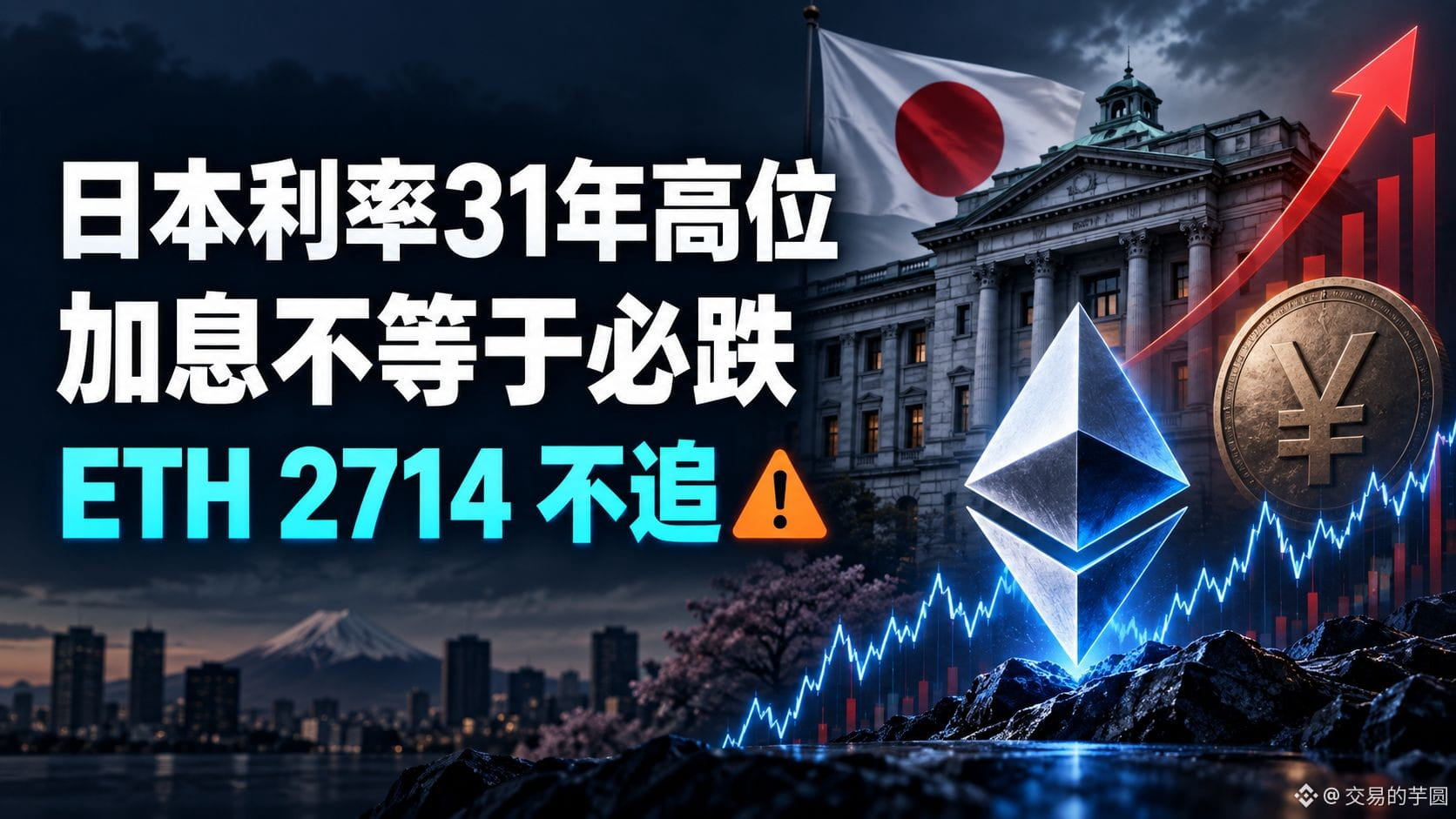
Japan’s Interest Rate Hits a 31-Year High: The Rate Hike Didn’t Directly Smash Risk Assets — ETH Touched 2714, I’m Not Chasing
My view on ETH is structurally bullish, but at a relatively elevated position—so I’ll wait for a pullback. The Binance Square topic #BOJRaisesRatesTo31YearHigh is heating up; this isn’t ordinary regional news. Japan has long been a source of low-cost global financing. Rising yen interest rates change the cost of carry trades, which transmits to U.S. Treasury yields, the yen exchange rate, and global risk appetite—eventually affecting crypto assets.
First, let’s get the facts straight. On September 18, the Bank of Japan passed a 7–2 decision to guide the target for the unsecured overnight call rate from 1% up to 1.25%, effective September 24; it’s the highest level since 1995. The official rationale cites wage-to-price pass-through, oil prices, yen weakness, and AI demand bringing potential inflation close to 2%, and it says that if the economy and prices align with the baseline scenario, it will continue to adjust easing going forward. But the document also emphasizes that financial conditions remain accommodative after the hike, and two members voted against, so this is not “tightening at all costs.”
For the crypto market, I’m not focused on the one-line conclusion of “Japan hikes rates = coin prices must fall.” Instead, I’m watching three links in the chain: first, after the rise in yen funding costs, will leveraged carry positions reduce exposure? Second, will the yen strengthen or weaken because expectations have already been priced in? Third, whether global long-end yields continue rising. Post-meeting coverage from AP and Reuters both noted that this move was widely expected; the yen did not keep strengthening after the rate hike. Whether the market goes up first or down first depends on the expectation gap, not on the interest rate number by itself.
When OKX published my ETH perpetual record, it was around $2,697. The 24-hour high/low were roughly 2714 and 2565.82, funding rate about +0.008%, and the public open interest was about 617,000 ETH, with a notional value around $1.66 billion. Earlier, at 12:50 I publicly wrote that after buying back above 2685 I would observe 2700–2710. Afterwards, price did enter the target zone—but that’s just a replay of the conditions and the tape; it doesn’t represent actual fills or profit. Now price is near the 24-hour high; the risk/reward for continuing to chase longs has already worsened.
If I were trading myself, I would hold 0 position size. The long plan: wait for 2670–2682 on declining volume to hold, then after a fresh close back above 2702, use at most 2.5% of principal spot to try a long—first look for 2714–2722, then 2750–2780. If it drops back to 2660, cut the position in half; if it loses 2645 within 1 hour, exit everything. If 2714 repeatedly rejects and breaks below 2670 with heavy volume, I would at most use 0.8% principal to test a low-leverage short; targets would be 2645 and 2620. If it closes back above 2715 immediately, I’ll cover the short. If the yen suddenly and quickly strengthens and global yields jump in sync, I would further reduce exposure—not bet on “bad news fully priced in.”
#BOJRaisesRatesTo31YearHigh $ETH $BTC
The above is only my personal market observation and does not constitute investment advice.
My view on ETH is structurally bullish, but at a relatively elevated position—so I’ll wait for a pullback. The Binance Square topic #BOJRaisesRatesTo31YearHigh is heating up; this isn’t ordinary regional news. Japan has long been a source of low-cost global financing. Rising yen interest rates change the cost of carry trades, which transmits to U.S. Treasury yields, the yen exchange rate, and global risk appetite—eventually affecting crypto assets.
First, let’s get the facts straight. On September 18, the Bank of Japan passed a 7–2 decision to guide the target for the unsecured overnight call rate from 1% up to 1.25%, effective September 24; it’s the highest level since 1995. The official rationale cites wage-to-price pass-through, oil prices, yen weakness, and AI demand bringing potential inflation close to 2%, and it says that if the economy and prices align with the baseline scenario, it will continue to adjust easing going forward. But the document also emphasizes that financial conditions remain accommodative after the hike, and two members voted against, so this is not “tightening at all costs.”
For the crypto market, I’m not focused on the one-line conclusion of “Japan hikes rates = coin prices must fall.” Instead, I’m watching three links in the chain: first, after the rise in yen funding costs, will leveraged carry positions reduce exposure? Second, will the yen strengthen or weaken because expectations have already been priced in? Third, whether global long-end yields continue rising. Post-meeting coverage from AP and Reuters both noted that this move was widely expected; the yen did not keep strengthening after the rate hike. Whether the market goes up first or down first depends on the expectation gap, not on the interest rate number by itself.
When OKX published my ETH perpetual record, it was around $2,697. The 24-hour high/low were roughly 2714 and 2565.82, funding rate about +0.008%, and the public open interest was about 617,000 ETH, with a notional value around $1.66 billion. Earlier, at 12:50 I publicly wrote that after buying back above 2685 I would observe 2700–2710. Afterwards, price did enter the target zone—but that’s just a replay of the conditions and the tape; it doesn’t represent actual fills or profit. Now price is near the 24-hour high; the risk/reward for continuing to chase longs has already worsened.
If I were trading myself, I would hold 0 position size. The long plan: wait for 2670–2682 on declining volume to hold, then after a fresh close back above 2702, use at most 2.5% of principal spot to try a long—first look for 2714–2722, then 2750–2780. If it drops back to 2660, cut the position in half; if it loses 2645 within 1 hour, exit everything. If 2714 repeatedly rejects and breaks below 2670 with heavy volume, I would at most use 0.8% principal to test a low-leverage short; targets would be 2645 and 2620. If it closes back above 2715 immediately, I’ll cover the short. If the yen suddenly and quickly strengthens and global yields jump in sync, I would further reduce exposure—not bet on “bad news fully priced in.”
#BOJRaisesRatesTo31YearHigh $ETH $BTC
The above is only my personal market observation and does not constitute investment advice.