SEC’s “innovation exemption” window for tokenizing U.S. stocks on the public market looks like it has directly exploded $UNI and $HYPE . But if you read the announcement carefully, you’ll see this isn’t a Web3 victory at all—it’s an extremely sophisticated recruitment operation.
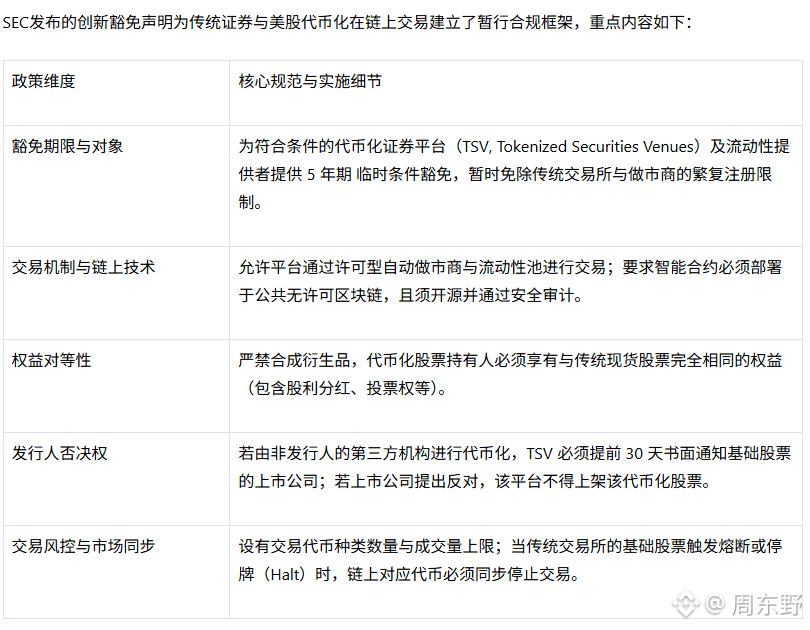
The regulatory concessions are certainly tempting. A five-year temporary exemption effectively wipes out the cumbersome approval processes required by traditional exchanges. The SEC even allows trading to be executed using AMMs and liquidity pools, as long as the deployment is on a public blockchain with open-source audits. On the surface, it seems like DeFi’s underlying technology is being embraced—but the real restrictions are all hidden in the details.
First comes “fairness of consideration,” which directly kills off synthetic-asset strategies. The on-chain “mirror U.S. stocks” approach is completely rendered ineffective. Token holders must be entitled to real dividends and voting rights. That means the platform’s underlying infrastructure must be tied to legitimately held custody assets, and compliance costs are driven infinitely higher.
Second is the veto power of the listed company. Third parties that tokenize stocks must give a 30-day advance notice. If the other side objects, the tokenized listing must be removed. For big-name blue chips like Apple or Tesla, if they say no, the on-chain platform can only pivot and list smaller-cap stocks instead.
Most deadly of all is the tightly coupled risk control between on-chain and off-chain. When U.S. market trading is halted due to a circuit breaker, the tokenized assets on-chain must be paused in sync. AMMs run 24/7. Once you add this “network cutoff gate,” liquidity providers’ hedging strategies face enormous liquidation risk at the instant the circuit breaker triggers.
The surges in UNI and HYPE reflect capital buying the idea of “DeFi getting an official identity.” But in the long run, this is regulators drawing a compliance fortress on public chains—pull liquidity in through the exemption period, then tighten control with veto rights, synchronized circuit-breaker pauses, and real-name custody.
The future winners may not necessarily be DEX giants, but rather compliant institutions that can successfully run traditional equity ledgers on-chain.
#hype涨超11%
The regulatory concessions are certainly tempting. A five-year temporary exemption effectively wipes out the cumbersome approval processes required by traditional exchanges. The SEC even allows trading to be executed using AMMs and liquidity pools, as long as the deployment is on a public blockchain with open-source audits. On the surface, it seems like DeFi’s underlying technology is being embraced—but the real restrictions are all hidden in the details.
First comes “fairness of consideration,” which directly kills off synthetic-asset strategies. The on-chain “mirror U.S. stocks” approach is completely rendered ineffective. Token holders must be entitled to real dividends and voting rights. That means the platform’s underlying infrastructure must be tied to legitimately held custody assets, and compliance costs are driven infinitely higher.
Second is the veto power of the listed company. Third parties that tokenize stocks must give a 30-day advance notice. If the other side objects, the tokenized listing must be removed. For big-name blue chips like Apple or Tesla, if they say no, the on-chain platform can only pivot and list smaller-cap stocks instead.
Most deadly of all is the tightly coupled risk control between on-chain and off-chain. When U.S. market trading is halted due to a circuit breaker, the tokenized assets on-chain must be paused in sync. AMMs run 24/7. Once you add this “network cutoff gate,” liquidity providers’ hedging strategies face enormous liquidation risk at the instant the circuit breaker triggers.
The surges in UNI and HYPE reflect capital buying the idea of “DeFi getting an official identity.” But in the long run, this is regulators drawing a compliance fortress on public chains—pull liquidity in through the exemption period, then tighten control with veto rights, synchronized circuit-breaker pauses, and real-name custody.
The future winners may not necessarily be DEX giants, but rather compliant institutions that can successfully run traditional equity ledgers on-chain.
#hype涨超11%