
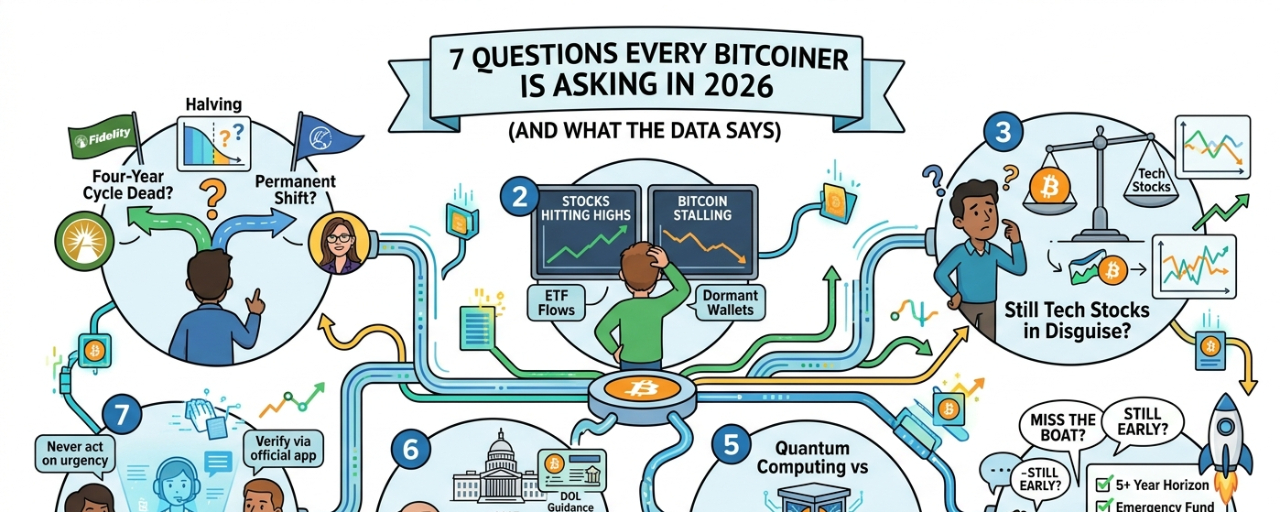

7 Questions Every Bitcoiner Is Asking in 2026 (And What the Data Actually Says)
Bitcoin in 2026 has stopped behaving like the asset most people learned the rules for. Institutions are in, the price hasn't cooperated with the old playbook, and a wave of technical and regulatory wildcards have holders genuinely unsure what to believe. Below are the questions coming up again and again — answered as honestly as the current data allows.
Table of Contents
Is the Four-Year Bitcoin Cycle Actually Dead?
Stocks Keep Hitting Highs — Why Isn't Bitcoin?
Is Bitcoin Still Just "Tech Stocks in Disguise"?
Have I Missed the Boat, or Is It Still Early?
Could Quantum Computing Actually Break Bitcoin?
Can I Legally Hold Bitcoin in My Retirement Account?
How Do I Spot an AI-Cloned Scam Before It Costs Me?
The Honest Takeaway
1. Is the Four-Year Bitcoin Cycle Actually Dead?
This is the single most argued-over question of the year, and industry leaders don't agree. One camp, represented by voices like Cathie Wood, argues that institutional adoption has permanently changed Bitcoin's behavior, pushing it toward steadier, less boom-bust price action where the old four-year halving cycle no longer applies. The opposing camp, including analysts at Fidelity, treats the 2025 pullback as an ordinary drawdown and points to a growing list of countries adding Bitcoin to reserves as a fresh, cycle-independent demand driver.
The honest middle ground: neither side has enough post-ETF cycle data to prove their case yet. Anyone telling you this is settled is selling conviction, not analysis.
2. Stocks Keep Hitting Highs — Why Isn't Bitcoin?
Viewers on live crypto Q&As keep sending in some version of this exact question, and it's a fair one. The disconnect usually comes down to Bitcoin's price being driven by a different mix of forces than equities — spot ETF flow data, dormant Satoshi-era wallet movements, and leveraged futures positioning — rather than earnings growth or Fed-driven multiple expansion. When those flows turn cautious even briefly, Bitcoin can stall while equity indices, propelled by a narrower set of mega-cap winners, keep climbing.
It's less a sign that Bitcoin is "broken" and more a reminder that it trades on its own liquidity mechanics, not the S&P's.
3. Is Bitcoin Still Just "Tech Stocks in Disguise"?
This one comes up constantly because it decides whether Bitcoin actually diversifies a portfolio. The uncomfortable answer for 2026: less than it used to, but the story is muddier than a yes/no. Correlation to equities was close to zero before 2020 and has run meaningfully positive since, meaning Bitcoin has, at times this year, delivered neither the diversification benefit nor a return that justified skipping it.
That doesn't mean correlation is fixed forever — it moves with macro conditions — but holders treating BTC as an automatic hedge against a stock downturn are working off outdated assumptions.
4. Have I Missed the Boat, or Is It Still Early?
Every price cycle produces some version of "is it too late," and 2026 is no exception — except now the question cuts both ways, since some ask it after highs near $126,000 and others after pullbacks toward the $60,000s. The more useful framing industry advisors keep returning to isn't about timing at all — it's a short checklist: a time horizon of five years or more, an emergency fund already in place, high-interest debt cleared, genuine comfort with a 50% drawdown, and a position size capped low enough that being wrong doesn't wreck your finances.
If those boxes aren't checked, the "is it too late" question is the wrong one to be asking in the first place.
5. Could Quantum Computing Actually Break Bitcoin?
A newer worry that's gaining real traction: Bitcoin's security rests on elliptic curve cryptography, and companies like Google and Cloudflare have already published concrete roadmaps for migrating away from vulnerable encryption as quantum computing advances. What unsettles serious observers is that the Bitcoin development community hasn't produced an equivalent public roadmap yet.
This isn't an imminent threat — practical quantum attacks on Bitcoin-grade encryption remain years away by most estimates — but it's a legitimate long-horizon question, and "no roadmap yet" is a fair, if uncomfortable, answer.
6. Can I Legally Hold Bitcoin in My Retirement Account?
This question has actual regulatory movement behind it. The U.S. Department of Labor rescinded its 2022 guidance that had urged extreme caution around crypto in 401(k) plans back in May 2025, and a 2025 executive order pushed the DOL to develop formal safe harbors for alternative assets in retirement accounts. A proposed rule followed in March 2026 — but it isn't finalized, and in practice, whether you can actually add Bitcoin to your 401(k) still depends entirely on what your specific plan sponsor allows.
Translation: the door is opening at the policy level, but your employer's plan menu is still the real gatekeeper.
7. How Do I Spot an AI-Cloned Scam Before It Costs Me?
As AI voice and video cloning has gotten convincing enough to fake support agents, executives, and even "verified" accounts, this has become one of the most urgent questions holders are asking — and rightly so, since it's the one with a direct dollar cost attached to getting it wrong. The consistent advice from security-focused voices in the space: never act on urgency alone (a real exchange won't threaten account loss over a phone call), verify any "support" contact through the exchange's official app rather than a returned call or DM, and treat unsolicited outreach about your holdings — however well-produced — as guilty until proven innocent.
8. The Honest Takeaway
None of these questions have a tidy, permanent answer — and that's arguably the real theme of Bitcoin in 2026. The cycle debate is unresolved, correlation is shifting, the quantum question has no roadmap yet, and retirement-account access is still policy-in-progress. The holders navigating this well aren't the ones with the most confident answers — they're the ones checking claims against current data, sizing positions to survive being wrong, and staying skeptical of anyone (including well-produced AI voices) who sounds too certain.
This is educational commentary, not financial advice. Crypto markets carry real risk — verify current data and consult a professional before making investment decisions.