


Abstract: The SEC approves a five-year innovation exemption, enabling the first compliant on-chain trading of tokenized US stocks, but the rules are packed with restrictions.
On September 17, the SEC officially released a temporary regulatory framework called the “Innovation Exemption” in the form of Order No. 34106402. Under the order, qualifying venues for tokenized securities (TSVs) may, for five years, conduct on-chain trading of tokenized NMS stocks through a permissioned regime with automatic market makers and liquidity pools, without being classified as an “exchange” under the (Securities Exchange Act of 1934).
Within 24 hours of the announcement, Uniswap jumped more than 15% to nearly $8, while Hyperliquid rose about 11% to break above $86, hitting a new high since November 2025.
This is the first time U.S. regulators have carved out a track for the lawful trading of tokenized stocks on-chain. But the track’s width, length, and turning angles have all been carefully calculated.
Rules: every step is constrained by a margin.
At the core of the exemption is the creation of a new category of market participants: tokenized securities trading venues (TSVs). TSVs can bypass the registration process of traditional exchanges and directly match trades of tokenized stocks through AMMs and liquidity pools. Liquidity providers are also granted exemption at the same time; they are no longer deemed “dealers,” but anti-fraud and anti-manipulation provisions still fully apply.
The eligibility conditions are quite specific. TSVs must be U.S. entities and comply with OFAC sanctions requirements. Trading operates under a licensing regime—only participants that meet the standards are allowed to enter. Synthetic tokenized stocks are explicitly excluded: tokens must be issued by the underlying stock issuer or their representative, or tokenized by a third party that is not affiliated with the issuer; holders must have the same dividend and voting rights as traditional stock.
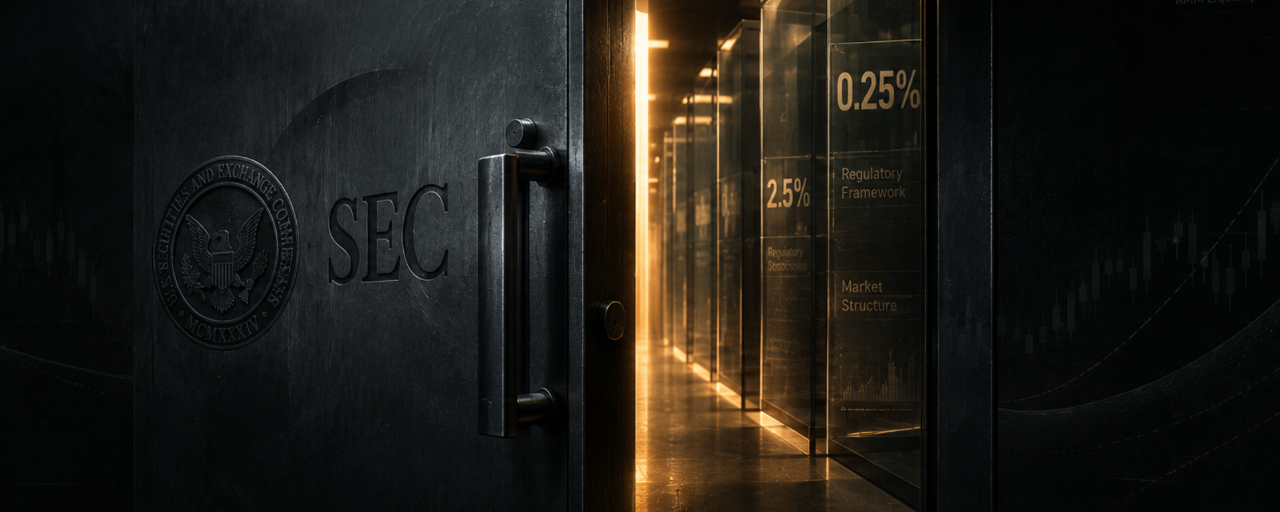
The trading volume limits are the most constraining design. For Tier 1 high-liquidity stocks, each TSV may trade at most 75 shares, with the average daily trading volume for any single tokenized stock not exceeding 0.25% of that underlying stock’s average daily trading volume for the month. Tier 2 stocks have an upper limit of 250, with a trading volume cap of 2.5%.
SEC trading and markets director Jamie Selway illustrates the scale of this constraint with an example: Tesla’s average daily trading volume is about 40 million shares. A single TSV can handle roughly 100,000 tokenized shares of Tesla, which—at $366 per share—amounts to about $36.6 million. “Start small, get people moving, and then measure the results,” Selway said.
Publicly listed companies also have a key right: before a third party tokenizes them, the TSV must give the issuer 30 days’ advance notice. If the issuer objects within those 30 days, the tokenized transaction may not be initiated.
What the SEC chose was a “controlled experiment” path, not a full legalization. Every layer of limitation in the rules compresses the possibility of “on-chain stocks” turning from a concept into systemic impact.
Why now: an administrative response to a congressional stalemate.
The timing of the issuance of the exemption order was not accidental.
On September 15, the Senate held a procedural vote on the (Digital Asset Market Transparency Act) (CLARITY Act). The result was 49 in favor and 50 against, failing to reach the 60-vote threshold required to advance the bill. The legislative process officially stalled.
Two days later, SEC Chair Atkins, in a statement, directly characterized this action as a response to Congress’s failure: “This week, Congress was unable to advance the CLARITY Act, so today the SEC is taking significant action within its statutory authority, pushing U.S. capital markets into the digital era through an innovative exemption.”
This is the first time, under the “Project Crypto” framework, that the SEC has used the exemption authority granted by Section 36(a)(1) of the securities law—creating an institutional design for on-chain securities trading scenarios. Atkins also emphasized that the exemption is temporary and conditional: “The Commission is not hard-coding today’s technology into future standards; it is allowing the market to evolve, monitoring its development, and using that as a basis to craft a more flexible regulatory framework.”
Why the market prices it the way it does.
The gains of UNI and HYPE far exceed those of other DeFi tokens; the logic behind it is specific.
Uniswap is the world’s largest decentralized exchange, and its core technology is the AMM automated market maker mechanism. By allowing TSVs to trade tokenized stocks through AMMs and liquidity pools, the SEC effectively sets Uniswap’s technical architecture as the compliance infrastructure for this new market.
Hyperliquid’s story is more direct. The platform already offers tokenized stock services through its HIP-3 market, and Kraken’s parent company, Payward, has also confirmed it will bring the HIP-3 market into its own user ecosystem. The SEC’s exemption order gives Hyperliquid’s previously grey-area business a clearer compliance path, and HYPE’s surge is the pricing of a premium for certainty.
After the exemption order was released, Robinhood CEO Vlad Tenev publicly said the U.S. is moving into the era of stock tokenization, and that investors will begin to enjoy advantages such as 24-hour trading, instant settlement, and fractional share holdings. But AMC CEO Adam Aron’s position represents the other side. He welcomed the new rules and emphasized three principles: investor protection is indispensable, synthetic assets are prohibited, and issuers have the right to object to their securities being tokenized for trading. He also urged Robinhood to follow the same standards in overseas markets.
Aron’s remarks are not purely a policy commentary. Earlier this month, he had criticized Robinhood for providing AMC-related stock tokens without the company’s involvement. The 30-day objection right that issuers are given in the exemption order, to some extent, addresses this controversy.
What comes next.
The issuance cadence of TSV licenses and the list of the first institutions to receive permissions. The exemption framework sets eligibility standards, but who will become the first batch of compliant TSVs determines how quickly this market gets off the ground. Both established traditional institutions and new entrants can apply, but U.S. entity requirements, OFAC compliance, and license-based operation will filter out a significant portion of existing on-chain platforms.
The actual frequency with which issuers exercise the 30-day objection right. If many listed companies choose to invoke their veto power, the scope of tokenized stocks will be significantly compressed. Conversely, if most companies choose to stay silent or not object, the range of tokenized stocks will gradually expand. This variable directly determines the supply of TSV assets.
Whether the trading volume cap is adjusted during the pilot period. The two thresholds—0.25% and 2.5%—determine the size ceiling of the tokenized stock market over five years. In its statement, the SEC invites the public to submit comments on every aspect of the exemption. If pilot data shows that the price discovery mechanism works effectively and risks are controllable, there is a possibility that the cap could be raised.
A bigger chessboard
Tokenized stocks have been operating in offshore markets for a while. Coinbase previously launched a 1:1 tokenized stock product, and Robinhood, Gemini, and Kraken also offered similar services overseas. But these products have always lived in regulatory grey areas, lacking clear federal-level recognition.
The significance of this exemption is not in how much it opens up, but in the fact that it acknowledges one thing: on-chain transaction infrastructure is no longer a strange outlier that needs to be isolated. Instead, it can be incorporated into a regulatory framework—constrained by rules and validated through pilots.
From “containment” to “carving out a track”—the direction of this step has changed. Whether the track will be widened after five years depends on whether what runs on it over those five years is safe, controllable, and truly better than traditional rails. The answer is not in the exemption order—it’s in the trading data to come.
#SEC #TokenizedStocks #TSV #InnovativeExemption #DeFi